By Sean Dempsey, 01/06/25
Before discussing presidents, missiles, or the moral abstractions of foreign policy, it may be wise to consult the document that claims to authorize such discussions at all. The Constitution of the United States is not lengthy, nor especially poetic, but it is precise. On the question of war, it is remarkably unambiguous.
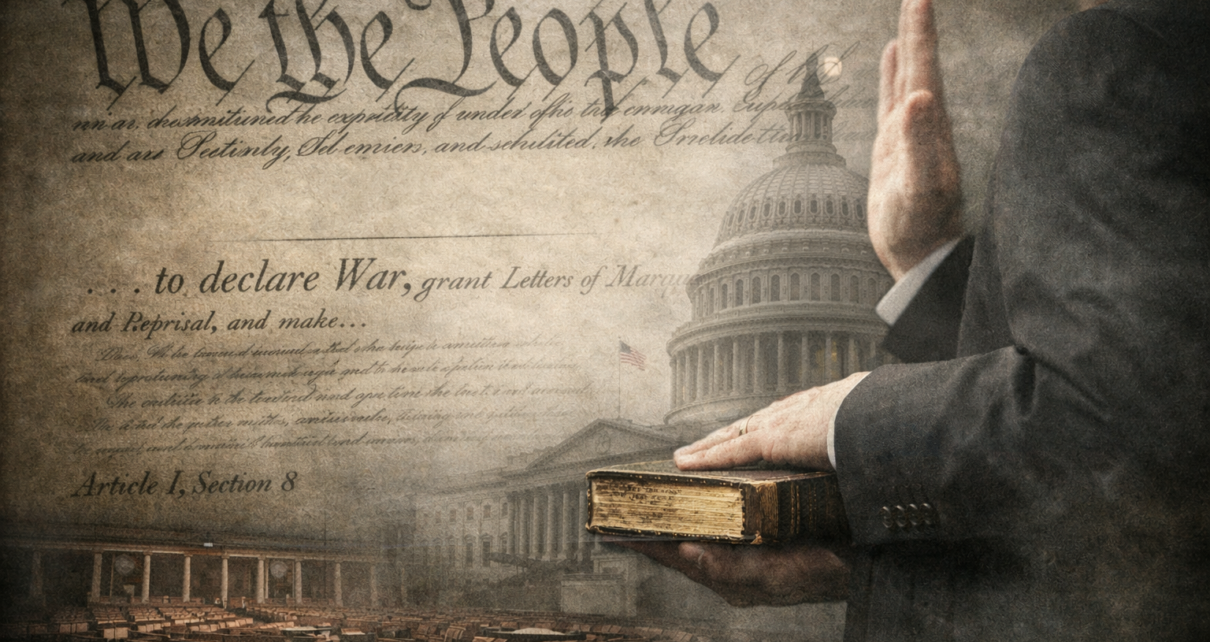
Article I, Section 8 states that Congress shall have the power “to declare War.” The sentence does not trail off. It does not add qualifications. It does not suggest that this power fades with time, urgency, or executive confidence. It assigns the decision to initiate war to the legislative branch, deliberately and without ornament.
Article II, Section 2 then describes the president as “Commander in Chief of the Army and Navy of the United States.” This distinction matters. One commands a military that already exists. One does not, by the ordinary meaning of language, command a war into existence. The Constitution separates these roles carefully, not because the framers lacked imagination, but because they possessed too much of it. They had seen what executives do when given unilateral authority over war.
With this structure in mind, the invasion of Venezuela presents a problem so straightforward that it almost feels impolite to dwell on it. There was no declaration of war by Congress. There was no imminent threat claimed by the administration. There was no assertion that delay would result in immediate harm to the United States. In fact, the opposite was true. The operation had been prepared for months.
Planning, by its nature, disproves emergency. Months of preparation imply months of opportunity. Opportunity to consult Congress. Opportunity to debate publicly. Opportunity to allow the system of representative government to do the work it was explicitly designed to do. None of this occurred.
The Constitution does not say Congress must be consulted only when convenient. It does not say the president may proceed alone if debate would be uncomfortable or politically risky. It does not say that war powers migrate quietly to the executive through repeated neglect. It says Congress shall declare war. That is not symbolism. It is law.
Some argue that the Constitution has been violated so often in matters of war that objections now are quaint. This is a curious defense. One does not typically excuse wrongdoing by citing its frequency. A rule does not lose its authority because it has been ignored. If anything, repeated violations only confirm how necessary the rule was in the first place.
What is lost in this process is not merely constitutional balance, but dignity. The framers intentionally slowed the machinery of war. They required friction. They demanded deliberation. They understood that war, once begun, cannot be argued back into silence. The requirement of congressional approval was meant to force hesitation in moments when enthusiasm might otherwise outrun judgment.
The invasion of Venezuela was slow in conception and sudden only in execution. It combined the worst traits of modern power… patience without accountability and force without consent. The people’s representatives were not asked. Votes were not taken. Debate was not held. The democratic process was not overruled by necessity, but bypassed by indifference.
If the Constitution binds the government only when it aligns with executive preference, then it does not bind the government at all. And if it does not bind the government, then the document that created that government has been reduced to a ceremonial relic… admired, cited, and ignored as needed.
There is also, finally, a matter so simple it almost feels childish to raise it. It is the oath.
Every one of these goddamn politicians in Washington, DC., Donald Trump included, gets up on a stage, puts one hand on a Bible and raises the other, and swears to God in front of all of us that they will defend and preserve and protect the Constitution of the United States of America. They do not mutter this under their breath. They do not qualify it. They do not say “unless I find it inconvenient.”
One may, like Lysander Spooner, argue that the Constitution is not binding on the people because the people never agreed to it. That is a coherent philosophical position. But it is not available to those who voluntarily swore an oath to uphold it. They did agree. They chose power under its terms. They invoked God and did so publicly.
They all swore to defend it.
And so the idea that one might casually say that these officials are free to violate the Constitution and launch a war whenever they want is not merely troubling. It is horrible. It renders the oath meaningless. It treats the Constitution as decorative. It tells the public that promises are for ceremony and law is optional.
If war can be launched without Congress when there is no imminent threat, then the constitutional requirement was never taken seriously to begin with. And if that requirement was never real, then neither was the oath.
This is not complicated. It is not ambiguous. It is totally indefensible.