by Sean Dempsey | March 23, 2026
Abstract: If Israel is God’s chosen people (and I devoutly believe they are), then why does their story so often read like a tragedy of leaders doing what is sublimely wicked?
Stated another way, why does the biblical record return again and again to that solemn sentence, “he did evil in the eyes of the LORD,” as though it were the ordinary weather of the throne rather than a rare storm?
For if we examine this question in great detail (and I try hard to do so below), we find a pattern of behavior about the rulers of Israel, and, indeed, about the core of the human condition itself, which dates back thousands of years. A pattern still alive and well today…
The Thesis of this Paper
This paper begins with an ambitious and controversial thesis, yet one that is both biblical in its foundations and spiritual in its interpretation: because Israel is chosen by God, Israel’s rulers, its kings of old and its leaders today, stand in a heightened arena of spiritual warfare, and therefore leadership corruption becomes a repeated, predictable strategy of the Adversary.
The devil does not need every citizen to fall if he can poison the fountains from which national life flows. He aims for the head, knowing the body will stagger. Scripture gives us language for that conflict, “our struggle is not against flesh and blood”, and the historical books give us the record of how often the struggle is lost at the level of leadership. [1]
Yet this thesis must be stated with precision, as a careful theologian (and a careful preacher) would demand. It does not claim that Israel is uniquely evil. The biblical record will not allow that easy slander. It does not claim that human beings are puppets without responsibility. Scripture will not allow that evasion either. Rather, it claims something heavier and more sober: that the chosen status of Israel intensifies both calling and conflict; and that the corruption of leaders is one of the oldest ways covenant communities are led away from covenant loyalty. [2]
To set the stage, I shall first set forth the question, then attend carefully to the authoritative texts (Scripture first, learned commentary second); only then shall I draw upon conclusions that are hopefully logical, biblical, and accurate, at least as best as I can attempt.
Before we walk through the kings, one further clarification is essential. When people say, “Israel is doing evil,” Scripture presses us to speak more carefully. Often it is not “the people” initiating rebellion from below; it is the king and his court, the priests who flatter him, the institutions that normalize idolatry and violence. The Bible’s historical theology repeatedly emphasizes what might be called top-down sin: rulers “cause Israel to sin,” and then the people inherit the consequences. [5]
Examining the Biblical Record of Israel’s Rulers
To begin, please take careful note of the following graphic created by Mark Barry, from which I shall base much of this paper’s assumptions:
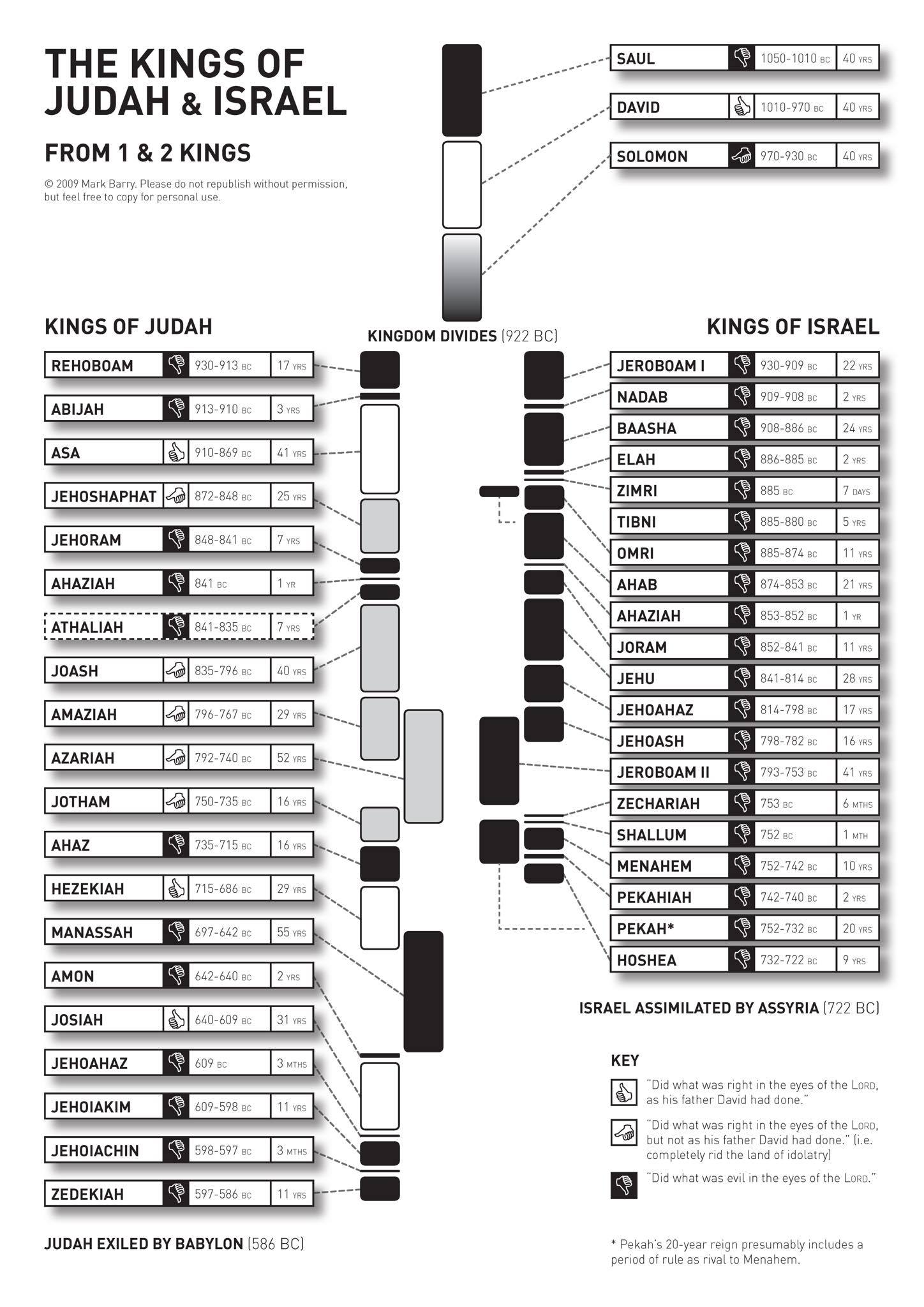
Mark Barry’s visual summary condenses the narrative judgments of 1 Kings and 2 Kings[7] into a stark visual theology: the kings are not assessed by prosperity, military success, or diplomatic skill, but by covenant fidelity, whether they “did what was right” or “did what was evil” in the eyes of the LORD. [8]
That is exactly how the Books of Kings themselves are written. Scholars routinely note that Kings is not bare chronicle, but rather theological history. The narration repeatedly uses evaluative “regnal” formulae, structured introductions and conclusions to reigns, so that readers learn to interpret political history as moral and spiritual history. A modern academic discussion of Kings’ judgments emphasizes that the book sorts monarchs largely into categories of “what is right” and “what is evil” in God’s eyes, language that functions as the narrator’s repeated verdict. [9]
This is often described within the broader framework of the “Deuteronomistic History”, a scholarly term for the narrative stretching from Deuteronomy through Kings, organized around a theology in which Israel’s fortunes rise and fall with fidelity to the covenant. Yale University[10]’s open lecture on Deuteronomy and the Deuteronomistic school summarizes the core idea: Israel’s history is told as a “historiosophy” in which covenant loyalty explains national outcomes. [11]
The chart makes this theology visible in a way even a hurried reader cannot ignore. It lists forty-three rulers: three before the divided kingdom, twenty rulers of the Kingdom of Judah, and twenty of the Kingdom of Israel. Then it marks each reign with one of three judgments drawn from the text: “did what was right … as David,” “did what was right … but not as David,” and “did what was evil in the eyes of the LORD.” [12]
Here the chart’s “data” becomes almost sermonic. From the division of the kingdom onward, every single ruler of the northern kingdom, every king of Israel, is categorized under the same condemnation: “did evil.” Judah contains a few bright lamps, but most reigns are shaded with compromise or outright wickedness. This may seem at first blush to simply be the bias of an illustrator; however, it is instead the moral shape of the canonical Biblical narrative. [13]
Why do the scriptures read this way? Because kingship in Israel was never meant to be autonomous. The Law of Moses already anticipated monarchy and bound it tightly: the king was commanded to live under Torah, to read it “all the days of his life,” so that his heart would not be “lifted up” above his brethren. Kingship was meant to be humble, Scripture-shaped power. When kings refuse that yoke, the history that follows is not surprising; it is tragically coherent within the larger biblical context. [14]
Even earlier, when Israel first demanded a king, the prophet Samuel warned that monarchy would naturally drift toward “taking”: taking sons, taking daughters, taking fields, taking a tenth, taking until the people cry out. Scripture does not romanticize political power. Rather, it warns that power, unless disciplined by fear of God, all too often tends to become predatory. [15]
So when the chart shows “evil” as the dominant and consistent pattern, we are not observing a random moral scoreboard. Instead, we should be interpreting what the biblical theology of kingship expects: when authority is severed from covenant obedience, the throne becomes a breeding ground of corruption.
History of the Northern Kingdom of Israel
To understand why the Kingdom of Israel collapses into a near-unbroken sequence of condemned reigns, Scripture points us again and again to one fountainhead: Jeroboam I[16]. The narrative portrays him not merely as a flawed man but as a kind of prototype, a mold into which later northern rulers are poured. A scholarly discussion of the Deuteronomistic presentation of Israel’s kings notes that Jeroboam is intentionally cast as the “evil king,” the standard against which subsequent “bad kings of Israel” are measured. [17]
The biblical event itself is infamous. Jeroboam, fearing political loss, crafts theological convenience: two golden calves, two rival sanctuaries, and a soothing lie, “It is too much for you to go up to Jerusalem.” Then Scripture delivers the line that should make every ruler tremble: “this thing became a sin.” In other words, leadership did not merely tolerate sin; leadership built it. [18]
This is why, when later northern kings are evaluated, the condemnation is often linked explicitly to Jeroboam’s pattern. The fall of the northern kingdom is interpreted not only as “the people followed the nations,” but specifically as “the kings of Israel introduced” practices that were “not right,” and the nation absorbed what leadership normalized. [19]
Now the text begins its relentless drumbeat of verdicts. Nadab[20] is described as doing evil and walking “in the way of his father.” Baasha[21] is marked by the same judgment; the pattern is already hereditary, already dynastic. Omri[22] is said to have done “more evil than all who were before him,” as though the throne were competing in rebellion. Ahab[23] is portrayed in even darker superlatives, provoking the LORD beyond prior rulers. [24]
Then the narrative makes the diagnosis explicit in a way that should haunt any person who seeks authority. It is not merely that individuals sin; it is that corrupt leadership creates a corrupting path for others. The author repeatedly connects royal behavior to national behavior: rulers establish, fund, and defend sin, murder, and idolatry; the people learn the liturgy of compromise. [25]
When the northern kingdom descends further into violence, the biblical record does not treat that violence as unrelated to spiritual apostasy. Some may tend to imagine idolatry as a harmless “religious preference.” However, the Kings presents idolatry as a seedbed of injustice. A form-critical and rhetorical analysis of 2 Kings 17 emphasizes that the phrase “do evil in the eyes of Yahweh” is closely tied to idolatrous worship, and this invariably links such worship with the anger of God and national ruin. [26]
Continuing on, Joram[27] is said to have done evil, though not as severely as his parents, yet evil remains evil. Later, after Jehu[28] executes judgment on the house of Ahab, the text still condemns him for refusing to depart from Jeroboam’s sins.
And the northern endgame is presented with blunt theological clarity. The writer of 2 Kings pauses history to preach: Israel’s exile is interpreted as divine judgment upon entrenched apostasy. “All this took place because the Israelites had sinned against the LORD,” and, crucially, because they followed “the practices that the kings of Israel had introduced.” The people certainly bear guilt; but the narrative insists that its leadership deeply shaped the nation’s course! [19]
At this point the chart becomes almost a visual lamentation. The northern kings, twenty names, are depicted as uniformly under the verdict “did evil.” The north is assimilated by Assyria, and Kings tells you why: not because the LORD forgot His people, but because leadership became haughty and made rebellion against God’s will normal and acceptable. [30]
Judah’s Complex History
If the northern kingdom is a near-unbroken chain of condemned reigns, Judah is a more complex sorrow. It is complex because Judah contains true reforms. It is sorrow because reform is the exception, not the rule. The chart’s gray “partial righteousness” dominates much of Judah’s middle; outright evil returns at Judah’s end; and only a few kings are presented as truly exemplary “as David.” [12]
One must begin, as Kings begins, with David[31], because David is not presented as sinless but as the canonical benchmark. The narrative uses David as a measuring rod: later kings are judged by whether they walked “as David” walked. That alone is a warning against shallow moralism. In Scripture, righteousness is not the absence of failure but the refusal to enthrone rebellion as identity and policy. [32]
But even before the kingdom divides, Scripture already shows the problem: kings can begin well and end crooked. Solomon[33] is portrayed in Kings as a man who builds the temple and yet does not “fully” follow the LORD. The chart marks him not as utterly faithful “as David,” but as severely compromised. [34]
After the division, Judah begins poorly. Rehoboam[35] presides over a period in which “Judah did evil in the eyes of the LORD,” provoking divine jealousy by the sins they committed.
Then, in the midst of early decline, Judah receives one of its first lamps: Asa[38] is explicitly praised, “Asa did what was right in the eyes of the LORD, as David had done”, and the text describes his removal of idols and immoral cultic practices. In other words, Kings insists that a single ruler can meaningfully reverse spiritual decay in its people, though often at a high cost. [39]
Even so, the narrative refuses to idealize. The “high places” of evil often remain and take root. This theme shows up repeatedly and embodies how partial obedience can become generational vulnerability. A ruler of Israel may purge some idols, yet leave convenient altars untouched; later rulers inherit those altars and turn them again into pathways of corruption. The Bible does not call such half-measures “neutral.” It sees them as seeds or corruption and future sin. [40]
The chart marks Jehoshaphat[41] in the “right, but not as David” category, and the biblical text captures that tension: his heart is often aligned toward the LORD, yet the high places persist. He can do “what is right” and still fail to uproot the entrenched habits of compromise among the people. This is one of the Bible’s most realistic insights into reform: a good leader can restrain evil without fully eradicating it, and the victory may be temporary if it is not thorough. [42]
Then Judah falls into darker alliances. Jehoram[43] is explicitly said to have followed “the ways of the kings of Israel” and to have “done evil in the eyes of the LORD.” [44] His son Ahaziah of Judah[45] follows the same corrupted line, doing evil “as the house of Ahab had done.” Here again the text presses the theme: leaders, not merely “the masses,” often set the trajectory. [44]
Many more kings come and go, none of them especially godly. Eventually darkness deepens with Ahaz[52], whose reign is portrayed in Kings as a departure from faithfulness, aligned with the ways of Israel’s corrupt patterns. [44] And then Judah receives one of its brightest lamps. Hezekiah[53] is praised for doing what was right “as David had done” and for trusting the LORD; he becomes, in the narrative, a model of reform and reliance. The chart marks him as fully faithful in the “as David” category, and Israel is blessed under his reign. [34]
Manasseh[54] “did evil in the eyes of the LORD,” and the text ties his evil to practices the LORD had driven out, including Baal worship and astral cults. [55] His son Amon[56] follows him into evil, “as his father Manasseh had done,” walking in the same idolatrous ways. [57]
Judah receives a final great lamp in Josiah[58], praised for doing what was right and for not turning aside. [59] After Josiah, Kings tells a cascade of rulers whose reigns are explicitly condemned: Jehoahaz[60] “did evil”; Jehoiakim[61] “did evil”; Jehoiachin[62] “did evil”; and finally Zedekiah[63] is likewise condemned. [64]
The chart ends where the Biblical monarchy ends: Judah exiled by Babylon. The implied moral of the whole record obviously is not, “Israel is God’s chosen people, therefore Israel’s rulers are always righteous and to be followed blindly.” The moral is closer to its opposite: “Israel is chosen, therefore Israel’s rulers are judged by a holy standard, and most are found wanting.” [65]
Spiritual Warfare & the Bullseye on Israeli Leadership
Now we come to the spiritual claim at the heart of this paper: that the devil focuses especially on Israel’s rulers because Israel is God’s chosen people.
To speak this way responsibly, one must show the biblical foundation for spiritual warfare, the biblical depiction of Satan’s strategies, and the biblical logic for why leaders are strategic targets.
First, Scripture teaches without apology that the conflict behind human conflict is real. “Our struggle is not against flesh and blood,” Paul writes, but against rulers and authorities of a darker order, “spiritual forces of evil.” This is not poetic flourish but theological realism in the New Testament’s moral universe. [66]
Second, Scripture portrays Satan not only as tempter but as accuser, one who seeks to prosecute, shame, and destroy. In Zechariah’s vision, Satan stands at the right hand to accuse Joshua the high priest, leadership attacked in the courtroom of heaven. And the LORD rebukes the accuser while reaffirming divine choice: “the LORD who has chosen Jerusalem” rebukes him. This is profoundly relevant to the pattern in Kings: if Israel is “chosen,” its leaders are not thereby safe; they are thereby contested. [67]
Third, Scripture shows explicit satanic interest in destabilizing the leadership of the covenant community. Jesus tells Simon Peter, “Satan has asked to sift all of you as wheat,” and then Jesus prays that Peter’s faith will not fail so that he can “strengthen” his brothers. Here the logic is unmistakable: if the leader collapses, the community is endangered; therefore the enemy aims for the leader. [68]
Fourth, Scripture teaches that Satan operates within limits set by divine sovereignty, yet still seeks destruction. Job’s prologue depicts Satan moving “to and fro” and seeking a case against a righteous man; the narrative’s point is not that Satan is omnipotent, but that he is active, seeking to tear down what God calls good. [69]
Now connect this spiritual framework to Israel’s chosenness. The Old Testament declares that Israel is God’s “own possession,” called to be “a kingdom of priests and a holy nation.” The New Testament likewise affirms Israel’s covenant privileges, “the covenants… the worship… the promises”, without suggesting that covenant privilege equals moral infallibility. Chosenness is vocation; vocation invites opposition. [70]
At this point the thesis becomes more concrete. If Israel’s vocation is to bear God’s name before the nations, then corruption of its leadership would have disproportionate spiritual consequences. The enemy need not destroy Israel by killing every Israelite; he can destroy Israel’s witness by corrupting its kings… its rulers… its prime ministers. And this is precisely what Kings seems to narrate: rulers who should have modelled faithfulness instead institutionalize idolatry, injustice, and violence.
Yet a truly biblical theology must also hold a second truth tightly: spiritual warfare does not erase human responsibility. The king who “did evil” is not excused because the devil tempted him. Kings does not read like, “Satan made him do it.” Kings reads like judgment: “he did evil in the eyes of the LORD.” The king chose. The king built. The king persisted. And the people suffered. [71]
This is why the Torah’s “law of the king” is so severe in its gentleness: read the law daily; do not exalt your heart; do not turn aside. The Scripture anticipates the temptation of power and demands the daily mortification of pride by obedience. When that discipline fails, the throne becomes vulnerable not only to political corruption and sin but also to the deeper corruption of idolatry: false worship that ultimately authorizes false ethics. [72]
So the spiritual warfare thesis does not replace the historical explanation. Rather, I believe it deepens it. The kings do evil because humans with power tend to do evil; and the devil, seeing God’s covenant purposes, exploits that tendency with special fury at the level of leadership for Israel’s rulers most especially so. In short, the kings and rulers of Israel have a spiritual “bullseye” on their backs.
Is Israel a Mirror for the Universal Human Condition?
The temptation here is to treat Israel as a bizarre exception, uniquely corrupt, uniquely prone to wickedness. But Scripture itself presses the other conclusion: Israel is often presented as a public example of what humanity is, especially when humanity is entrusted with privilege, revelation, and responsibility.
Paul states explicitly that Israel’s history was written “for our instruction.” In other words, the Bible does not preserve this long record of corrupt leadership so that later readers may sneer at Israel. It preserves it so that later readers may tremble at themselves. [11]
In that sense, Israel functions as a priestly “sign” among the nations. When the sign’s rulers are faithful, the nations see something of God’s order. When the sign’s rulers are corrupt, the nations see something of humanity’s fall. And because Israel’s calling is high, the fall appears especially stark. That is why the refrain “did evil in the eyes of the LORD” feels relentless: the narrative is insisting that without sustained covenant obedience, leadership defaults toward idolatry and injustice.
This is also why the Bible’s warnings about kingship are almost prophetic of the later record. Samuel warned that kings would “take,” and Deuteronomy warned that kings would be tempted toward pride and departure from the law. Kings then reads like the fulfilment of those warnings in historical sequence. Scripture is not surprised by power’s corruptions, because Scripture knows the human heart. [73]
Here the chart’s structure becomes a moral parable. Out of forty-three rulers listed in the graphic, only a few are marked unambiguously faithful “as David.” Many are condemned outright; many are shaded as compromised. This is a picture not only of Israel but of fallen governance as such. Most rulers do not drift toward righteousness by default. They drift toward self-preservation, toward expedience, toward national gods made in their own image. [32]
To speak theologically: man is fallen; man is brutal; man is wicked. And when man is elevated into concentrated authority, his fall is magnified into institutions, policies, armies, and laws. Israel’s kings show this with painful clarity precisely because Israel’s kings are measured against God’s revealed covenant rather than the shifting moralities of surrounding cultures.
This is not exactly cynicism; I believe it is an accurate reflection of biblical realism. Kings is a treatise against political idolatry. It refuses to treat the throne as sacred simply because it governs the sacred people. It treats the throne as accountable because it governs Israel, God’s sacred, beloved, and chosen people.
The Sad, Present Hour
Now we must move from ancient kings to modern rulers, and here I must speak with the sobriety of one who knows they will answer to God for careless words or accusations. The biblical record does not grant us permission to declare every modern policy “demonic,” as though providence were a simple code. Yet the biblical record does require something uncomfortable of believers: the refusal to give any ruler a blank check, especially a ruler associated with sacred stories, when that ruler’s actions produce massive suffering and moral scandal.
In the current world, the question of Israel’s leadership and moral restraint is not theoretical. The humanitarian reality in the Gaza Strip has been described in recent reporting by UN bodies as catastrophic, with ongoing casualties reported even after the announcement of a ceasefire framework in late 2025, according to data cited by the UN’s own humanitarian coordination mechanisms. [75]
The term “genocide” is among the most grave accusations one can make, and therefore the most morally and legally demanding. Some organizations have concluded that the label applies. Amnesty International[76], in a detailed report, argues that Israel has committed genocide against Palestinians in Gaza, grounding that claim in patterns of killing, destruction, displacement, and deprivation, and in statements by decision-makers. [77]
At the same time, the case before the International Court of Justice[78] remains ongoing; the Court’s actions to date have been orders for provisional measures, not a final merits judgment. Provisional measures reflect the Court’s view that urgent protections are necessary within the legal framework of the Genocide Convention while the case proceeds. [79]
Meanwhile, the International Criminal Court[80] lists an arrest warrant for the Prime Minster of Israel, Benjamin Netanyahu[81], indicating how serious some international legal institutions regard allegations of crimes under international law in the broader conflict arena. [82]
In addition to Gaza, the present geopolitical crisis includes war involving Iran and the United States alongside Israel (or, more accurately stated: with Israel’s leader effectively acting as the United State’s puppet master in promoting and cheering on an unprovoked war). According to reporting from Reuters[85], Israel stated it launched a “pre-emptive” attack on Iran on February 28, 2026, and that U.S. military action accompanied Israel’s strikes, with the escalation undermining diplomatic efforts regarding Iran’s nuclear dispute. Reuters’ subsequent reporting describes a war launched by the U.S. and Israel on February 28 and ongoing threats and escalation connected to the Strait of Hormuz. [86]
A sober examination of the facts surrounding the war with Iran reveals a deeply troubling picture: by the admission of the United States’ own intelligence community, Iran was not actively building a nuclear weapon, nor had its leadership made the decision to do so, with assessments stating plainly that “Iran is not building a nuclear weapon” and that its program had long remained dormant at the weaponization level. Even as tensions escalated, diplomatic channels were not exhausted but actively underway; indeed, negotiations had recently taken place in Geneva, with reports of “substantial progress” and further talks scheduled, only for military strikes to follow almost immediately thereafter. To launch an attack under such conditions, when no imminent nuclear threat was confirmed and while negotiations were still in motion, is not the act of a nation pursuing peace, but rather by one choosing force over diplomacy, impatience over prudence, and escalation over restraint. It is perhaps the actions of a nation’s leader who is spiritually besieged by dark spiritual forces. Regardless, it certainly reflects a doctrine not of defense, but of preemption untethered from necessity, where the threshold for war is lowered to suspicion and dissatisfaction rather than clear and present danger.
In this light, the conflict appears not as an unavoidable response to aggression, but as a deliberate rupture of peace efforts, a decision that carries profound moral and geopolitical consequences. The assertion is obvious: the rulers involved (both those in Israel as well as the United States) very clearly have sinned in the eyes of the Lord. Yet this is all broader context to showcase that the pattern of Kings is following through as it always has. The warning to believers in God is clear; for the Bible warns believers against sanctifying rulers simply because they claim sacred necessity. Kings repeatedly shows rulers claiming legitimacy while acting in ways the LORD blatantly calls evil. [87]
The spiritual warfare lens, however, tells us something else: when war spreads, when violence multiplies, when civilians are crushed, the conflict is rarely only “strategic.” It becomes spiritual in the biblical sense, an arena where truth and falsehood, justice and injustice, reverence and pride contend.
And this is precisely where many Christians in America, especially those shaped by certain streams of political theology, are tempted to lose their discernment. Christian political support for Israel is often influenced by Christian Zionism, a movement that Encyclopaedia Britannica[88] describes as both religious and political, rooted in biblical readings and, for many, end-times expectation. Britannica notes its increasing political activity in the United States since the formation of the modern State of Israel. [89]
Public opinion data shows that Americans, including religious Americans, are deeply divided not only over the reasons for Israel’s wars but over the acceptability of its conduct. Pew Research Center[90] reports rising shares who say Israel has “gone too far” in its military operation, and increasing unfavorable views of the Israeli government. The point is not that polls define truth; the point is that even within the West, the moral certainty of “support at all costs” is eroding under the weight of suffering and disputed conduct. [91]
And when American leaders offer maximalist rhetoric, Christians must examine it in the light of Scripture’s chronic suspicion of kings. Ted Cruz[92] stated that the United States must ensure Israel has “all the weapons and all the time” it needs to “utterly eradicate Hamas.” However one judges the aims implied by such language, Kings demands that Christians ask what happens to the innocent when rulers are given weapons and time without moral constraint. [93]
Likewise, neo-conservatives such as blood-thirsty Lindsey Graham[94] have publicly praised the partnership of President Trump and Prime Minister Netanyahu as “great and necessary” for security, and have made statements and appearances during the current Iran war environment that illustrate a strongly interventionist posture with the loss of innocent human life as merely an unimportant afterthought. [95]
This paper’s core biblical warning is therefore urgent: Israel’s chosenness does not guarantee the righteousness of Israel’s rulers. Nor does it require that Christians in the West support reckless war, hate, and mass-murder with cult-like adoration simply because the appointed leader of God’s chosen people acts unrighteously or presupposes western fealty.
In the biblical record, chosenness intensifies accountability; it does not set Israel’s rulers above judgment! The kings of Israel and Judah were judged (and found unworthy) precisely because they ruled the people of God and bore the responsibility of covenant example.
And here the pattern of Kings becomes a lens for our own time: modern rulers, any modern rulers, whether in Jerusalem or Washington, can commit great evil while invoking noble aims. Christians must not imagine that covenant language baptizes violence. The God who rebuked evil kings is not mildly impressed by war propaganda, alliances, slogans, chest-thumping, or prophetic branding. He sees the crushing of the poor, the spilling of innocent blood, and the hardening of man’s hearts. Mankind should not be in the business of sacrificing all traces of love, kindness, or empathy for other human life on the altar of Israel’s chosen status. Yes, Israel is God’s chosen people; but as the Scriptures clearly profess, this does not give them (and certainly not its rulers) a carte blanche on depraved behavior. I beg Christians to not be so blinded by a blind allegiance to Israel’s corrupt and misguided leader(s) that they sacrifice love and Truth, which are the core messages of Scripture.
If we place this conclusion back inside the spiritual warfare thesis, the warning becomes sharper. If Satan targets the leaders of the covenant people, he may do so not only by tempting them into private vice, but by luring them into public cruelty, by persuading them that security justifies the trampling of the weak, that national survival sanctifies indiscriminate force, that power is righteousness. Kings shows that when rulers absorb such logic, the narrator’s verdict might then follow like thunder: “Benjamin Netanyahu did great evil in the eyes of the LORD.” [96]
Thus we arrive, not at a contradiction, but at a terrible consistency. For if one reads the sacred Biblical records without sentimentality, he finds not a nation of perpetually righteous rulers, but a long and grievous procession of Jewish kings who “did evil in the sight of the Lord,” who hardened their hearts, who shed innocent blood, and who led the people astray.
This is not an anomaly… it is the pattern occurring again and again and again and again and again and again and again … and again (!) all throughout Israel’s history! From Jeroboam who “made Israel to sin,” to Ahab who provoked the Lord above all before him, to Manasseh who filled Jerusalem with blood, to Netanyahu who funded Hamas and indiscriminately killed innocent women and children, the throne of Israel has too often been a seat not of righteousness, but of rebellion. And thus, we now behold leadership whose actions result in the near genocide of a captive people, and all the suffering and death of innocents it portends, we sigh in despair. We weep to see the plight of civilians, of women, of children; but we ought not be surprised, as though something new has entered the world. Rather, we should tremble, recognizing the echo of a three-thousand-year history in which power, when severed from obedience to God, becomes an instrument of devastation, wretchedness, and murder.
For though Israel remains God’s chosen people, its rulers are uniquely targeted above all men raised to great authority. They are cruelly plagued by the devil himself and thus remain fallen, assailed, and capable of tremendous, unspeakable evil. And herein lies the sober truth: the story has not changed… only the names of Israel’s leaders have.
“And he did that which was evil in the sight of the Lord, and walked in the way of Jeroboam, and in his sin wherewith he made Israel to sin.”
— 1 Kings 15:34
[1] [27] [66] [92] [96] https://www.biblegateway.com/passage/?search=1+Peter+5%3A8%2CEphesians+6%3A10-12&version=NIV
[2] [16] [33] https://www.biblegateway.com/passage/?search=Exodus+19%3A5-6%2CLeviticus+20%3A26%2CDeuteronomy+7%3A6%2C1+Peter+2%3A9-10&version=NASB
[3] [7] [8] [12] [13] [22] [28] [30] [32] [34] [43] [65] THE KINGS OF JUDAH & ISRAEL
[4] [52] https://www.brandeis.edu/library/archives/essays/special-collections/aquinas.html
[5] [19] [25] [45] [48] [60] [80] [81] https://www.biblegateway.com/passage/?search=2+Kings+17%3A7-23&version=ESV%3BNIV
[6] [15] [53] [73] https://www.biblegateway.com/passage/?search=1+Samuel+8%3A10-18&version=NIV
[9] [58] [71] https://brill.com/view/journals/vt/aop/article-10.1163-15685330-bja10210/article-10.1163-15685330-bja10210.xml?srsltid=AfmBOorZaHLR8vUh588aqASKIMk6ybIC3YgInA_zn5Q8QvEXOBPFZBey
[10] [50] [75] https://www.ochaopt.org/content/humanitarian-situation-report-19-march-2026
[11] [63] [74] [83] [85] [87] [94] https://oyc.yale.edu/religious-studies/rlst-145/lecture-12
[14] [38] [56] [72] https://www.biblegateway.com/passage/?search=Deuteronomy+17%3A14-20&version=NIV
[17] [21] https://bibleinterp.arizona.edu/articles/2016/07/jos408019
[18] [37] https://www.biblegateway.com/passage/?search=1+Kings+12%3A28-33&version=NIV
[20] [36] [49] https://www.biblegateway.com/passage/?search=1+Kings+14%3A22&version=NIV
[23] [59] https://www.biblegateway.com/passage/?search=2+Kings+21-23&version=NKJV
[24] [35] https://www.biblegateway.com/passage/?search=1+Kings+14-16&version=ESV
[26] https://www.jstor.org/stable/43717531
[29] [54] Introduction: – Bible Commentaries
[31] [41] [69] https://www.biblegateway.com/passage/?search=Job+1%3A6-8&version=NET
[39] https://www.biblegateway.com/passage/?search=1+Kings+14%3A21-15%3A24&version=NIV
[40] https://www.biblegateway.com/passage/?search=1+Kings+15%3A11-24&version=NIV
[42] https://biblehub.com/1_kings/15-11.htm
[44] [78] [84] https://www.biblegateway.com/passage/?search=2+Kings+8-14&version=NIV
[46] [61] [76] [91] https://www.pewresearch.org/politics/2025/10/03/how-americans-view-the-israel-hamas-conflict-2-years-into-the-war/
[47] [93] https://www.cruz.senate.gov/newsroom/press-releases/sen-cruz-issues-statement-after-israel-announces-start-of-offensive
[51] [90] https://www.biblegateway.com/passage/?search=2+Kings+15&version=NIV
[55] https://www.biblegateway.com/passage/?search=2+Kings+21&version=NIV
[57] [62] https://www.biblegateway.com/passage/?search=2+Kings+21%3A1-23%3A30&version=NIV
[64] https://www.biblegateway.com/passage/?search=2+Kings+21-24&version=NIV
[67] https://www.biblegateway.com/passage/?search=Luke+22%3A31%2CZechariah+3%3A1%2C1+Peter+5%3A8%2CJob+1%3A6-12%2CJob+2%3A1-6&version=NASB%3BESV%3BNIV%3BNKJV%3BKJV
[68] https://www.biblegateway.com/passage/?search=Luke+22%3A31-34&version=NIV
[70] [88] https://www.biblegateway.com/passage/?search=Exodus+19%3A5-6%2CRomans+9-11%2CEphesians+2%2CGalatians+3%3A15-29%2C1+Peter+2%3A4-10%2CRevelation+1%3A4-8%2CRevelation+5%3A9-10&version=NASB
[77] https://www.amnesty.org/en/documents/mde15/8668/2024/en/
[79] Provisional measures
[82] https://www.icc-cpi.int/defendant/netanyahu
[86] https://www.reuters.com/world/middle-east/israel-says-it-launched-pre-emptive-attack-against-iran-2026-02-28/
[89] https://www.britannica.com/topic/Christian-Zionism
[95] https://www.lgraham.senate.gov/public/index.cfm/2026/1/statement-from-u-s-senator-lindsey-graham-r-south-carolina