Sean Dempsey’s short story “Justice” (which is an extract from his 2022 work “A Sad Collection of Short Stories, Cheap Parables, Amusing Anecdotes, & Covid-Inspired Bad Poetry”) works best when read not as a replacement for Kafka, but as a narrowing of Kafka’s nightmare. Kafka gives us the whole disease. Dempsey gives us the moment the fever breaks.
Kafka begins with the famous outrage of unexplained accusation. Joseph K. wakes and finds that the world has shifted beneath him. The ordinary room is still ordinary, yet the moral weather has changed. This is where Kafka is stronger. His genius is domestic intrusion. The nightmare does not begin in a dungeon or tribunal, but in the familiar space of a bedroom. That makes the violation more subtle and more complete. Law enters the room like a draft under the door. It does not need thunder.
Dempsey begins later in the nightmare. John has already been taken into the machinery. He is led through a corridor toward a dark chamber, unable to understand why he is treated as a criminal despite having “always been an honest man” . This loses Kafka’s slow invasion of normal life, but gains urgency. Dempsey does not ask us to watch the disease enter the body. He shows us the body already bound to the table.
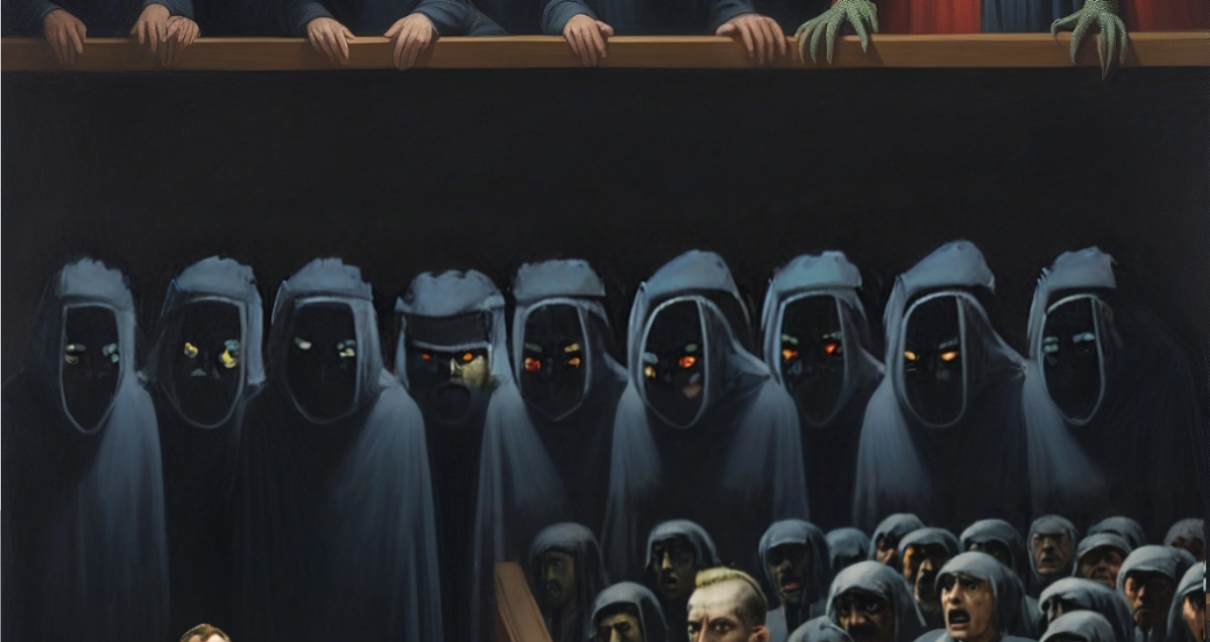
Kafka’s early strength is psychological hesitation. Joseph K. keeps trying to interpret the arrest as error, prank, misunderstanding, procedure. The reader shares that uncertainty. Kafka makes absurdity feel administratively possible. Dempsey is less ambiguous. The chamber, magistrate, shackles, and hooded figures announce the story’s meaning at once . This is less sophisticated, but more theatrical. Kafka whispers from behind a wall. Dempsey lights the scaffold.
The magistrate in Dempsey is far more direct than Kafka’s officials. Kafka’s officials evade, redirect, imply, and smother. They are frightening because they seem petty and cosmic at once. Dempsey’s magistrate is frightening because he says openly what Kafka’s world implies secretly: “The specifics are unimportant” . That line is the story’s sharpest improvement on Kafka. Kafka makes the reader discover that the charge does not matter. Dempsey makes authority confess it.
Here Kafka is artistically richer, but Dempsey is morally cleaner.
Kafka’s court is a labyrinth of implication. It has clerks, offices, advocates, painters, priests, women, messengers, and rumors. Each layer adds texture. The system feels endless because it is distributed through life itself. Dempsey’s court is almost allegorical: magistrate, hooded figures, prisoner, crowd. It lacks Kafka’s social density, but it has the severe beauty of a woodcut. Each figure is reduced to function. The magistrate condemns. The shadows witness. The prisoner pleads. The crowd howls.
Kafka shines brighter in atmosphere. His world feels lived in. Its madness has dust on it. Its rooms smell of stale air, sweat, paper, and deferred explanations. Dempsey’s setting is more symbolic than sensory. The darkness, the oak desk, the hooded panel, the iron shackles are effective, but they are familiar Gothic instruments . Kafka’s rooms are stranger because they are less obviously strange. Dempsey gives us ritual horror. Kafka gives us ordinary horror that slowly remembers it is ritual.
The accused men differ as well.
Joseph K. is not purely innocent in the emotional sense. He is arrogant, irritated, vain, sometimes cruel, often self-important. Kafka’s brilliance is that Joseph K. is not a martyr carved from marble. He is recognizably human, which makes his helplessness more disturbing. Dempsey’s John is simpler. He is honest, confused, afraid, desperate. His innocence is foregrounded. That simplicity makes him easier to pity, but less complex to study.
Kafka is stronger here as character.
Dempsey is stronger as parable.
John’s questions are the moral center of “Justice.” “What have I done?” “Let me see the evidence.” “Bring forth my accusers.” These are not merely pleas. They are the basic demands of civilization . Dempsey’s merit is that he places these elementary rights in plain speech. There is no philosophical embroidery. The man asks for the minimum, and even the minimum is denied.
Kafka, by contrast, makes the denial more insidious. Joseph K. often does not even know what to ask for. His confusion becomes part of the court’s power. This is a more refined terror. Dempsey’s version is sharper because John asks exactly the right questions and receives exactly the wrong answers.
The sentence itself marks another major difference.
Kafka delays condemnation until the entire novel has trained the reader to expect no true resolution. The ending arrives with a horrible quietness, as though the system has finally grown bored. Dempsey sentences John almost immediately: “You are to be sentenced to death, for the sake of Justice and the preservation of Order” . The capitalized abstractions matter. Justice and Order become idols. They are no longer values. They are names of gods demanding blood.
This is one of Dempsey’s strongest contributions. Kafka’s system is nameless, diffuse, and evasive. Dempsey’s system uses noble words as weapons. It does not abandon the language of virtue. It inhabits that language and hollows it out.
The line “The more you protest, the more your guilt is certain” is another place where Dempsey shines . Kafka dramatizes this principle across the whole novel. Dempsey condenses it into one terrible formula. It has the bleak wit of Swift and the trapdoor logic of Poe. Speak, and you are guilty. Be silent, and judgment proceeds. The accused is not merely denied defense. Defense itself is converted into evidence.
Kafka is stronger in duration.
Dempsey is stronger in compression.
The crowd is Dempsey’s clearest departure. Kafka’s terror is institutional, almost metaphysical. Dempsey makes it public. When John is led away, the balcony erupts. They boo, hiss, and cry out for him to be silenced . This is not merely a court failure. It is a civic failure. The people do not rescue the accused from the machine. They become the machine’s choir.
That is where Dempsey’s version has special merit. Kafka asks what happens when law becomes unknowable. Dempsey asks what happens when ordinary people applaud that unknowability, provided it is aimed at someone else.
Still, Kafka’s restraint is superior in one respect. His horror is less named, less directed, less morally labeled. He trusts unease more than proclamation. Dempsey sometimes makes the machinery too visible. The magistrate is openly cruel. The hooded figures are openly ominous. The crowd is openly bloodthirsty. The symbolism is powerful, but it does not always surprise. Kafka surprises because his nightmare often behaves politely.
Dempsey’s ending, however, has force because it refuses detour. John is carried from accusation to death with no meaningful interval. There is no advocate, no priest, no debate, no last philosophical chamber. The story becomes a single moral compression: accusation without charge, judgment without evidence, execution without truth.
Kafka’s final power lies in exhaustion.
Dempsey’s final power lies in impact.
If Kafka’s The Trial is a long illness of the soul, Dempsey’s “Justice” is the autopsy report.
Kafka is the greater architect. His work has more rooms, more contradictions, more human weakness, more interpretive depth. He is stronger at making absurdity feel endless and intimate. Dempsey is strongest when he stops trying to match Kafka’s maze and instead turns the maze into a chamber. His version has less mystery, but more accusation. Less atmosphere, but more verdict. Less psychological complexity, but more moral clarity.
So the fairest comparison is this:
Kafka shows how a man can be lost inside a system that never explains itself.
Dempsey shows what that system looks like once it no longer feels any need to hide.
Kafka’s work haunts because it does not finish speaking.
Dempsey’s work wounds because it says the quiet part aloud.