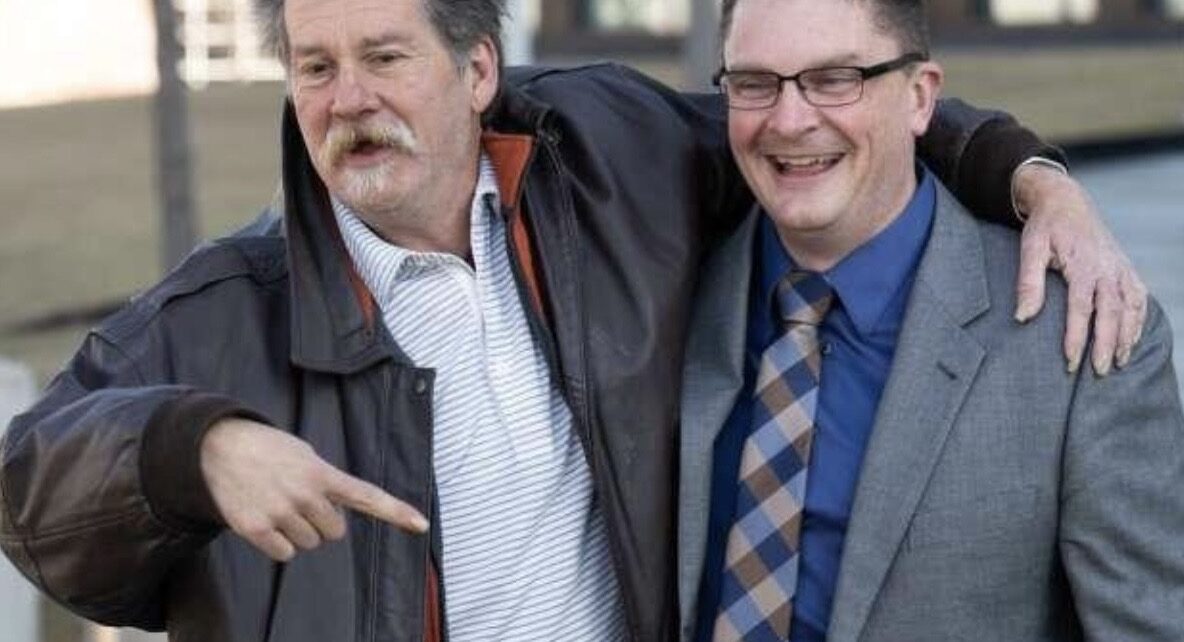
by Sean Dempsey | 07/21/26
Dear reader, before you begin this story please know that every fact is real. I embellished nothing, save my typical literary flare. Always remember this simple truth: upon this earth, human injustice is not the exception, it is the rule…
=====
It was 11:07am on a Tuesday when I first learned I no longer existed.
I discovered this rather dismal piece of truth about myself inside a bank of all places. And I guess that’s rather fitting, as a bank is one of those rare and venerable institutions where everything invisible is treated as real and everything real must first be translated into vague abstractions.
Well, hold on a moment…. let me first go back. If memory serves, I stepped with alacrity into the reputable branch of U.S. Bank located towards the western side of downtown Los Angeles. It was a hot, humid day, so I recall feeling quite pleased to get out of the sun and step into the stale, artificially cool air. I walked to the teller with intent and purpose; for I was there specifically to report that someone had stolen my identity! Yes, I remember I entered the bank’s opulent halls quite full of myself, in fact; my existence was as secure as the recirculated air I breathed, and my cause was resolute. However, I’m loathe to say that when I exited that lofty place the police had arrested me for the crime of inconveniently being myself without their explicit permission. This was done politely, mind you, without raised voices, broken chained pens, or any visible departure from ordinary business. I think the bank manager continued smiling through the entire ordeal. The customers never stopped filling out deposit slips or whatever else customers of banks do. Somewhere behind the walls, invisible money passed silently from one imaginary column to another. I remember thinking, as the handcuffs closed around my wrists, that the only person in the building who seemed surprised… was me.
But I’m still getting ahead of myself, aren’t I? Let me start from the beginning. See, you must understand. I had not gone to the bank to claim any money in these accounts I supposedly owned. Ha, not at all. In fact, I didn’t know how much money was in them, and I didn’t want a penny of it even if I did. Rather, these accounts of ill-gotten gain were evidence of something that had been done to me. For just prior to that day an online credit-monitoring service had rocked my universe by showing me a wide array of debts, loans, and financial activity tied to MY name and MY social security number! It appeared that a whole second economic life had developed somewhere beyond my sight and certainly without my knowledge or approval. And, if you must know, I had purchased the monitoring only after a YouTube creator named Yousef Erakat filmed me while I was living, homeless, on the streets of Los Angeles. Needless to say, millions of people later saw those videos. They saw my face, heard my name, and watched me receive money for food and scant lodging. Those ridiculous internet videos seemed, at the time, like somewhat concrete proof that I existed. I took that fact for granted at the time, of course. Later I learned that existence viewed by millions of human beings carries infinitely less weight than existence confirmed by a sage bank terminal reading from the right database.
As it was, the credit report showed that I, William Woods, had somehow become quite successful over the last three decades without me playing any role at all in that success. I’m not sure it felt particularly great to determine this in retrospect; it filled me with a savage incredulity to find out that an imposter had lived my stolen life better than I had lived it. Nevertheless, he had opened accounts, amassed wealth and various assets, borrowed money, developed a respectable history, and behaved financially in ways I could not fully comprehend. I studied the report as one might study photographs from an exotic vacation he had never taken. There were addresses I had never lived at, certain financial ‘obligations’ I had never accepted, and transactions I most certainly had never made. Yet, to be sure, all of it bore my name! And prior to walking into the bank, I recall feeling lost and wandering in a sort of dreamlike haze, and I batted around the idea that my life had been proceeding elsewhere, and that I was merely the part of it that had been misplaced or perhaps asleep at the wheel for more than thirty years!
Anyway, explaining all of this to the illustrious bank personnel proved somewhat less than fruitful. I suppose my haggard appearance, unkempt hair, and rancid breath likely did little to ameliorate their concerns. And, you must think, of course, I simply didn’t explain myself articulately enough to the authorities, eh? Perhaps. Quite so, I guess. But I distinctly remember my conversations with all those who questioned me and I don’t think I could have done anything more appropriate even with the benefit of hindsight! In the back office I explained all the facts I knew to the assistant manager. She listened carefully, which I later understood is simply the first stage in not believing someone. I told her, specifically, that someone (some “dastardly criminal!” as I put it) was using MY identity, that I wanted the bank immediately to investigate, and that I did not want to be held responsible for the debts created by some other person who was not in fact me at all or, that is, me in any way, shape, or form.
She blinked a few times, then asked for identification. I gave her my California identification card and my social security card, both genuine, both bearing my name: William Donald Woods. She held them in her hand for a moment and then placed them beside her keyboard, where they appeared to shrink under her intense scrutiny.
She then asked questions about the checking accounts in question. Here I faltered, of course. I could not answer these questions because I had never opened them to begin with. She asked about balances, recent transaction history, addresses, loans, and security information. I explained I had no knowledge of such things as such things did not involve me. However, each wrong answer I provided seemed to strengthen her confidence that she had asked the right question to attain so confused a reply. I tried to explain that my inability to answer her queries was the same reason I was there. If I had known the details of the accounts, I said, perhaps I would not be reporting that they were fraudulent.
She replied that the bank still had to verify. Verification was key. Verification was essential! She must therefore verify, verify, verify I was who I said I was. I told her that was exactly what I wanted. In response, she looked at me strangely, as though I had agreed to or admitted something I did not yet understand. Then she called the telephone number listed on the accounts. A man in Wisconsin answered, or so I soon learned. I could not hear him, but I could hear the manager’s side of the conversation, and through her replies I listened to myself disappear.
“Yes,” she said. “He is here now.”
There was a pause. I imagined the other man sitting in a clean room, perhaps at a desk, perhaps beside a window, speaking calmly because the polite voice on the telephone had called him by the correct name.
“He says his identity has been stolen.”
Another pause. The manager looked at me.
“No, he cannot answer the security questions.”
The man said something longer. I could immediately tell by the way her face settled that he had provided an explanation large enough to contain me.
“I … understand…” she said pleasantly.
When she ended the call, she appeared relieved. The bank had found satisfaction. Things were in order once again after a brief, uncomfortable moment of uncertainty.
I reminded her that I had come there to report the theft. She told me that the account holder had now reported it as well.
It was an elegant reversal! The other man did not need to deny that someone had stolen an identity. He merely had to identify me as the thief. Since his voice came from the telephone number preserved in the bank’s own immaculate records, his accusation entered the room with valid credentials and thusly were accepted as easily as a pin number on one of their atm machines might be.
The police soon arrived. They were courteous, and I remember their courtesy gave the whirlwind event a semi-weightless quality. A violent arrest would have suggested that something dramatic had happened. This arrest was administrative. It seemed less like being seized than being politely admonished for spilling wine at a dinner table.
One rather sleepy looking officer examined my identity paperwork (“evidence” as he called it), which I had conveniently enough for them brought with me for them to confiscate. The other used the manager’s phone again and spoke to the man in Wisconsin. He eventually faxed to the bank a driver’s license, a social security card, and a certified Kentucky birth certificate, all bearing my name. I suppose his documents were real in the way a locked door at a food pantry is real; they had been issued by the proper authorities and could therefore not be disputed or argued about. My own cards were also real, but they sadly stood alone…tragically alone. His documents were surrounded by a wife, a child, a house, a job, loans, taxes, bank records, and decades of accumulated agreement. Mine were surrounded only by my inconsequential body and soul, which had apparently become the least official objects in the room.
The officer asked my name.
“William Woods,” I said.
He wrote something down.
“Do you have another name?”
“No.”
“Have you ever used the name Matthew David Keirans?”
“No.”
“Do you know someone by that name?”
I remembered the hot-dog cart in Albuquerque, although the memory surfaced almost as though it belonged to another life entirely. It was back in 1988. Keirans and I had worked together. My wallet had ‘disappeared’ when I turned my back, and was returned only after I threatened the thief with a respectful beating behind the trash cans. Then the matter was resolved and I moved on. For I had foolishly believed, because my wallet came back to me, that the entire incident was over. It never occurred to me that a man might return the leather while still keeping the contents that mattered: the name, date of birth, and social security number, those small numerical organs by which a person is recognized and respected by the established order of things.
So anyway, as I thought of these things, I naturally told the officer that I had known Keirans briefly and that he had taken my wallet at our hot dog stand. I suppose it became an admission of sorts that I knew him, for the police officer’s face bristled with a fatherly understanding and he smiled in the same wispy way that bank manager did.
I explained he was most certainly the same man using my identity. The theif who stole my wallet was the same thief that stole my identity. I then shouted with a certain rage that now flushed my face: “Dammit! I am William Woods!”
But this became the first indication that I might be mentally unwell.
For after the faxes were examined and the phone calls were silent, the sleepy officer then kindly and patiently explained to me that there was already a William Woods in Wisconsin and he was the real one, and I was therefore a nuance and an agitator. This other Woods… this imposter, this usurper… he had lived under my name for many, many years. He apparently had a family, a career, and extensive records. All legitimate records! All in keeping with polite society. I explained that none of those lofty things made my name his. The officer said they made this matter not one for him to sort out, and he looked relieved to speak the truth of this aloud.
This affair, even then, did not seem particularly complicated to me. There was a certain man (him) who had stolen an identity and a man (me) whose identity had been stolen. Black and white. Cut and dry. The complication began and ended, I believed, with the trite determination of which was which.
However, facts and the truth of the matter were wholly inconvenient to the police, so they instead arrested me on August 20, 2019. The ever-pleasant bank manager maintained her smile and breathed an air of relief as I was led away in cuffs. I’m sure she had critical administrative work to see to on the laudable bank accounts of the other William Woods, and this sordid affair had already taken enough of her important time.
My arrest was perfunctory. The charge: identity theft and false impersonation. I had walked into the bank to prevent fraudulent debts from being assigned to me and was led out for the dastardly crime of attempting to interfere with the identity under which the false debts had been created. The transformation took place so smoothly that I wondered whether this reversal of fate had been waiting for me all along and I, like a fish caught in an unfortunate net, was thus destined for the dinner plate set by far better and more respectable men than I.
At the police station, the room changed slightly but the building seemed to stand still, a fixed position in time and space. The bank, station, and later the courtroom, jail, and hospital all seemed like departments of a single, dark institution, connected only by vast and nameless corridors I was never permitted to fully traverse. Each dank hallway or clinical room was shrouded in a haze of institutional complacency. Each contained the same chairs, the same forms, and the same smiling person asking for my name with an expression strongly suggesting that the wrong answer would certainly delay everyone, much to their chagrin. Everyone held a clipboard, or wore an official badge, and carefully asked me my name; but they all, each and every one of them, failed to listen for my reply.
With painted smiles, the myriad of officers slowly unwrapped and showed me pieces of a life that had been constructed over thirty years. In 1990, Keirans had obtained a Colorado driver’s license using my identity. He had moved through several states under my name. He had acquired cars, written bad checks and been arrested. In Oregon, the police photographed and fingerprinted him as William Woods. His fingerprints and my name entered the same record and remained there like ancient mosquitos trapped in amber.
In 1994, he married under my name. His wife believed she had married William Woods. Their child carried my surname. Later, he worked for Kohl’s, the Kentucky Department of Education, and private contractors. He paid his taxes and established credit. The stolen name settled down, became respectable, and stopped attracting the kind of attention that follows a younger man through police stations.
In 2012, after researching my family through a genealogy service, I deduced he must have obtained a certified copy of my Kentucky birth certificate. The certificate was not forged. The State itself produced it! He then used it to obtain a Wisconsin driver’s license in the name William David Woods. My middle name is Donald. His is David. A piece of his true identity had leaked through the disguise, but by then I suppose the disguise had become official enough to tolerate slight imperfections. The state cared not for middle names, after all; it cared whether or not the state-issued number he was assigned matched all the right ledgers. And it did.
In 2013, he obtained a position with University of Iowa Health Care. A background check found nothing unusual because it searched the history already created in my name. He eventually became a highly paid information-technology administrator with elevated access to critical hospital systems. The man who had constructed himself inside databases was placed in charge of databases containing other human beings. The parody was so intense that in a more rational, less postmodern world it might have drowned him.
From 2014 through 2022, he obtained nine vehicle and personal loans worth more than $250,000 using my name, birth date, and Social Security number. Each loan confirmed the next. One institution asked another whether William Woods was real, and the second institution consulted a third, which relied upon the first. The records formed a self-reflecting circle of recursive affirmation.
I was booked as Matthew Kierans. They misspelled the surname of the man they believed me to be. This did not trouble anyone. The State was permitted small errors because it possessed many official records. I was permitted none because I possessed so few.
In jail, the vague shapes of people continued to ask me who I was repeatedly. Over and over again. “What is your name?” I was asked to spell it. I was asked to pronounce it slowly. The question was asked at intake, before meals, before court, after court, and at every locked door. At first I answered immediately. Later I hesitated. The question had changed. They were no longer asking who I was but whether I had learned what answer was required in order to pass their test.
“William Woods,” I said.
The guard would look at the paperwork.
“Matthew Keirans,” he would correct.
“That is not my name.”
“That is what it says here.”
“It is wrong.”
“If it were wrong, it would have been corrected.”
“How?”
“Through the proper process.”
“What is the proper process?”
“That is not my department.”
My lawyer asked whether I understood the seriousness of the charges. I told him that I understood them better than anyone because I was the victim. He explained that, no, actually the problem was my continued refusal to accept the evidence.
I gave him names of relatives. I offered to contact the former owner of the hot-dog cart. He could clear everything up. The hot-dog man, I explained! Reach out to the man who proffered the hot-dogs! I even told him about the videos in which millions of people had already known me as William Woods on the internet. Didn’t he know that I was on the internet, and in online videos? I was on YouTube reels! He listened, but I sensed that these details exhausted him. They were human details. They required telephone calls, memory, and a modicum of judgment. They demanded patience which men of his profession and stature didn’t have. Meanwhile, the other man baring my name had a mortgage! He was of consequence. I was not.
Thus, my public defender raised doubts about my competence to the venerable court. Apparently my irate insistence to speak to the man with the hot-dogs was received poorly. So on February 10, 2020, the court declared me incompetent to stand trial. The reasoning possessed the perfect shape of a Hitchcock film: the formal records all proved that another man was William Woods….yet I continued to inconveniently insist that I was William Woods; therefore I could not understand reality. My insistence on the truth became proof that I was incapable of recognizing it.
So my body was unceremoniously impounded like a vehicle, and remanded to a well-respected Institution for the mentally unwell.
The psychiatrist’s office smelled just like the bank where I was arrested; it contained beige walls, a clock, and an unattractive, artificial plant. I often think of that plant. It seemed to have been placed there as an example of proper citizenship. It looked alive, remained where it had been assigned, and demanded nothing from the State. It did not desire to be acknowledged or accepted. It was content where it was, and its station was whatever the Respectable others made it. If it were moved to another room, it did not complain. If it were hidden in a broom closet, or discarded entirely, it did not object. Its role was simply to be and to imitate something living and real. Again, as I said, I envied that plant.
The psychiatrist asked why I believed another man had stolen my identity.
“I do not just believe it,” I said. “It happened. It is a fact.”
She scribbled something on her pad.
“What did you write?”
“An observation.”
“About what?”
“Your response.”
“What should my response have been?”
“There is no correct response.”
“Then why write it down?”
“All responses are relevant to your treatment.”
She asked whether I believed the bank, police, prosecutors, and man in Wisconsin were all wrong. I said they were relying upon the same bad records. She observed that this was a very large number of people and institutions. I explained that a single mistake copied many times does not become many independent mistakes.
She wrote again.
I began to understand that the pen welded by captured persons could not record anything in my favor. Anger showed instability. Calmness showed a deeply organized delusion. Asking questions suggested suspicion. Refusing to speak suggested withdrawal. The evaluation was not designed to discover whether I was sane. It was designed to classify every possible behavior within the conclusion they had already reached. It was merely a formality to go through the required paces.
I remained in jail while waiting for a bed in a state hospital. The pandemic lengthened the wait. Men and women hid their faces behind cloth masks and claimed I was hiding something. Time stopped behaving like time. It became fluorescent light, doors, trays, and unwelcome announcements. At night I dreamed of filing cabinets so tall that clouds formed around their upper drawers. Clerks climbed ladders carrying names from one cabinet to another. Occasionally one dropped a name, and the man below vanished entirely. Swallowed by the system. Zeroed out of existence!
On October 20, 2020, I was transferred to the hospital. I recall it was quieter than the jail. The doors locked softly. The staff spoke more gently. Every command was labeled a form of treatment, which meant that objection could be interpreted not as refusal but as a need for additional treatments to be gently administered.
A doctor asked what I would do if I were released.
“I suppose I will sue the man who stole my identity,” I stated matter-of-factly.
This was written down as part of my illness.
They treated me with psychotropic medication under court authority. When I objected, I lacked proper insight. When I swallowed the pills, I was improving. The State institution offered a solitary yet simple cure: complete obedience.
In group sessions, I sat beside men who believed satellites watched them, relatives had been replaced by alien imposters, or television programs contained private instructions meant only for them. And perhaps they did; who was I to insist what was true? But when I told them that a man had taken my name, married under it, borrowed money with it, built a career with it, and arranged for me to be falsely imprisoned, they all listened with hushed murmurs of what I took to be sympathy. Some of the patients truly believed me, and I thanked God in heaven for those gentle, poor souls. There is perhaps more gentle humanity in a psych-ward than there is on the sardonically sane streets of Boston or New York. However, the therapists and doctors admonished those who asked questions of me. They instructed them not to validate my sad delusion. And each day I envied the other patients. Their persecutors did not dispossess their certified birth certificates from them.
On March 17, 2021, I pleaded no contest. No, I did not confess. I merely accepted that the almighty State owned the door and that the door would open only after I regurgitated the necessary language they demanded I speak. There was no place on the form to record this specific distinction, for only the human heart can properly record injustice. The State’s language is sterile and lifeless. It is neither just or unjust; it merely processes. It records. It categorizes. Man, supposedly a creature of the Almighty God, has no place among such barren things. Yet man created the State, did he not? Man created the State to strip other man of their dignities and their very souls. In my case, it was there to proudly officiate the transfer of my identity to another, and inorganically demanded I comply by filing the proper form.
I had spent 428 days in county jail and approximately 147 days in the state hospital. California later counted 576 custodial days by including part of the day on which I was released. The government remained uncertain who I was but knew exactly how long it had confined me.
The judge sentenced me to two full years, imposed a fine, and released me for time served. Then came the final correction. I was ordered to use my “true name.” Matthew Keirans.
I had entered the bank to report that my identity had been stolen. I emerged from the system legally forbidden to ever use it again.
Yet outside those walls, every door required a name. Housing, employment, medicine, assistance, and banking all required identification. If I used William Woods, I violated the order. If I used Matthew Keirans, I validated the theft. My body had been released, but my name remained in custody. I remember vomiting in disgust and contemplating suicide.
Instead of ending my life, I filed complaints. Police departments referred me to courts I couldn’t access. The courts referred me to expensive attorneys I couldn’t pay. The lawyers who did take my calls referred me to State agencies. However, these agencies mailed forms to me requiring a legal name before the complaint could be considered. I wrote William Woods. The forms were returned because the name was disputed. I wrote Matthew Keirans, gritting my teeth and swallowing more vomit each time I did. The complaints disappeared into the malignant history of the man I knew I was not.
In Wisconsin, Keirans filed his own complaint accusing me of identity theft. His accusation was supported by my California conviction. My California conviction had been supported by his accusation. The structure was perfect. No new evidence could enter because every entrance led back to the beginning.
In June 2021, California tried to collect the cost of my state-hospital confinement. The notice reached Keirans in Wisconsin because the hospital had treated me under the name William Woods, which of course belonged to him in the sacred records owned by the State. He replied that he was the victim of identity theft and provided my last known address. Thus, California billed me more than $118,000 for my psychiatric care.
The joke was too complete to be funny. The State had imprisoned me for claiming to be myself, medicated me for refusing to become someone else, released me under that other man’s name, and then demanded immediate payment for the treatment. There was no suitable office to which one could report such sinister irony. I was too bitter to laugh, so I just wept. It seemed the only suitable reaction. Heartache and laughter may both touch the same immortal human soul, but one tickles while the other burns.
With nothing left remaining in my heart other than pure bile and righteous spite, in January 2023 I desperately called the human-resources department at University of Iowa Health Care and reported that one of its employees was using my identity. I didn’t expect much from this, other than to make waves. If I couldn’t win fairly, I would fight as dirty as I could. It was petty, but I don’t apologize for it. My puerile complaint actually reached the university police, and was assigned to a rare specimen of a man named Ian Mallory. Like the others, he found two men claiming ownership over the same moniker. But unlike the others before him, he continued looking after the confusion became mildly inconvenient.
The government’s records had fused us. FBI searches connected my name with two sets of fingerprints. My birth certificate had been joined to Keirans’s arrests, my father to his photograph, my Social Security number to his employment, and his financial life to my criminal conviction. The databases had created a … third man, of sorts, one who had been born in Kentucky, arrested in Oregon, employed in Iowa and homeless in California. He was all at once the thief and the victim, sane and delusional, imprisoned and free. Every institution recognized him. Yet neither Keirans nor I could fully become him.
Mallory miraculously found another FBI number buried inside the records that spurred him to keep digging. It apparently belonged to Matthew David Keirans and led to a different birth date, Social Security number, photograph, and fingerprints. The distinction between our two souls had never fully disappeared; it had merely been stored somewhere no one previously thought, or bothered, to look.
He examined the birth certificates. Mine was genuine. The copy Keirans had obtained was also genuine. The government in its inexhaustible genius had issued two authentic documents describing one birth and allowed two men to carry them.
Mallory found my biological father in Kentucky. My mother had died. My father had not seen me in years, but we spoke regularly, and he believed I lived in California. Police showed him photographs, and he selected me. They collected his DNA and mine.
On June 19, 2023, the laboratory concluded that I was indeed his son!
The fact occupied only a few lines. It did not describe my childhood, my memories, the sound of my father’s voice, or the feel of my mother’s caress. It did not explain the bank, the jail, the hospital, or the court order. It contained none of the evidence I carried inside me. Yet those few lines succeeded because they were printed by an official laboratory. A facility made of plastic and metal and science proved that a flesh-and-blood man actually existed. My own body had finally produced acceptable paperwork to the righteous and impervious State.
On July 17, 2023, police arrested Keirans at the University of Iowa. Because his identity had not yet been legally established, the warrants called him John Doe. After thirty-five years of living under my name, he entered custody without one. For the first time in many years, I think I truly smiled upon hearing that news. Not a bank-manager smile, but a real smile that touches the mortal soul.
His fingerprints matched the old Matthew Keirans records. During the interview, he proclaimed innocence and still described me as unstable and suggested I should be confined again. Mallory told him that my father was alive. Keirans had claimed he was dead. When asked to name his father, he first gave the name of his own adoptive father and then corrected himself with the name of mine. The two lives had become entangled in him and were now answering in turn. I suppose a complicated lie has a way of making the truth seem entirely foreign. I wonder if it works in reverse; does a simple truth have a way of making lies seem foreign?
When Mallory confronted him with the DNA, Keirans asked, “My life is over, isn’t it?” Then he said, “Yes, my name is actually Matthew Keirans.”
Even after confessing, he gave my name to the police officers during his booking. I suppose old habits die hard, eh?
Mallory later telephoned me and told me Keirans had been arrested. “Cool,” I said in quiet disbelief. I didn’t know what else to say. “See, I told you so. No one believed me.”
People later thought this response strangely calm. They did not understand that the discovery did not belong to them. I had known the answer all along. I knew the truth and never let go of it. I never forgot who I was. It was as simple as that.
Keirans pleaded guilty in state and federal court. The federal charges concerned making a false statement to a credit union and aggravated identity theft. The terms made the crime sound primarily financial. He had done more than borrow money. He had actually stolen the raw machinery through which society recognizes a person. He used my name to work, marry, father a child, receive loans, and persuade the State to prosecute me for attempting to reclaim it.
Mallory contacted Los Angeles officials to have my conviction vacated. At first, he was told that they saw no defect in it. The confession existed. The fingerprints existed. The DNA existed. Yet the correct conviction remained correct only until the correct office recognized the correct evidence in the correct order. That’s government logic for you.
On April 11, 2024, a judge vacated my convictions and declared me factually innocent. The judge called the case ‘surreal.’ I’m sure he felt a lot better after letting himself off the hook with that mild confession. He offered no apology, however. Nor did the district attorney ever apologize. The records were ordered sealed and likely destroyed.
No one satisfactorily has explained to me when I “officially” become William Woods again.
Perhaps I had become him at the moment of the DNA results. Perhaps at the moment of the confession. Perhaps when the judge signed the order. Or perhaps I had remained him throughout, although the government had temporarily misplaced that fact when it declared me and reality a nuisance. Either way, I was the same man I always was, only now I was officially myself again. I don’t think it felt any more real. Being a person again doesn’t come with a ton of fanfare or trumpets; it is a quiet success in the unmarked halls seldom few care to tread.
In September 2024, I applied to California for compensation. The paperwork was returned. They told me my application was incomplete. The agency requested additional documents, including an abstract of judgment that my lawyers and I could not obtain despite repeated efforts. The State had imprisoned me through records I could not defeat and required a record I could not locate before it would deign to compensate me.
Eventually, the claim was approved. I received $80,640 for 576 days. There was a precise value for every day. There was no defined space on the form for my name. I suppose it didn’t matter at that point.
In January 2025, a federal judge sentenced Keirans to twelve years in prison and said he had weaponized the criminal-justice system. The sentence was affirmed on appeal in April 2026. People ask me whether justice had been done. I can’t truly answer that. Justice had arrived thirty-five years late and expected congratulations for recognizing the person who had been standing in front of it all along. It just causes me to scratch my head. Justice is an enigmatic, blind bitch, I think.
I live in Albuquerque now and work as a landscaper. People say I am rebuilding my life. Meh, maybe so. A life, however, is not like a brick wall. The missing years are not stacked nearby waiting to be returned to their original positions. My documents now say ‘William Donald Woods.’ Yes, even the courts agree! The State has restored the name it savagely once ordered me not to use. Should I thank them for this honor?
Still, whenever I hand identification to someone behind glass, I remember the bank in California. I remember the smiling manager. I remember the telephone ringing in Wisconsin. I remember the other man answering from inside my name and the manager’s face becoming calmer and calmer as mine became less so.
In my dreams, the bank has grown until it contains the whole city. The whole county. The whole country. The whole world! Its corridors extend through police stations, hospitals, psychiatric offices, courtrooms, credit bureaus, and government offices. There are no windows. Every corridor returns to the same counter and the walls are stained in dismal, black ink.
I tell that smiling clerk in my dream that someone has stolen my identity.
She gives me a form.
The form asks for my legal name.
I write William Woods.
She examines it and slides it back, still smiling.
“You have entered a disputed name.”
“It is my name.”
“If it were your name, it would not be disputed.”
“What should I write?”
“The name in the records.”
“The records are what I am disputing.”
“Then you must submit a correction.”
“This is the correction form.”
“No,” she says. “This is a form declaring theft.”
“That is what I am reporting.”
“According to the system, you committed the theft.”
“Against whom?”
“William Woods.”
“I am William Woods.”
She looks toward the computer, and I know before she speaks that I have again answered incorrectly.
Behind her, bleak filing cabinets open and close without human hands touching them. One machine prints birth certificates. Another prints arrest reports. A third seals the records created by the first two. The artificial plant from the psychiatrist’s office has grown through the ceiling and spread into every department. It stretches out aimlessly, but the leaves are not green, but black and dead. Numbered forms hang from its dismal, plastic branches like poisoned fruit.
I ask to see a supervisor.
The clerk tells me supervisors cannot meet with unidentified persons.
I present my identification.
She studies it and says that it belongs to the man whose identity I claim was stolen.
“That man is me.”
“Then why are you reporting that his identity was stolen?”
“Because another man is using it.”
“Who?”
“Someone else.”
She searches the records.
“That is you.”
“No. That is the other man.”
“The system does not permit two men.”
“Then the system is wrong.”
“The system cannot be wrong. It can, however, be corrected.”
“How do I correct it?”
“By proving your identity.”
“With what?”
“Proper identification.”
I slide my papers beneath the glass.
She places them in a metal tray. The tray withdraws into the wall, and I hear the papers traveling through pipes above the ceiling, deeper into the building. Somewhere far away, a stamp descends.
“Please take a seat,” she says with a smile. “Your identity is now being processed…”
The waiting room is filled with men who look vaguely familiar. I think they share my face, or perhaps it is the face of the usurper. Each one holds a number. Above us, a screen flashes the words NOW SERVING WILLIAM WOODS.
Every man stands.
The clerk calls for order, and we all sit down again.
The screen continues displaying my name. Bold typeface. But the letters are profane. The letters laugh at me. They each stare at me with ghastly intent. My dreadful, incorrigible name mocks me and shakes my soul entire. My damnable name! It stares at me and condemns me as I cry in horror.
