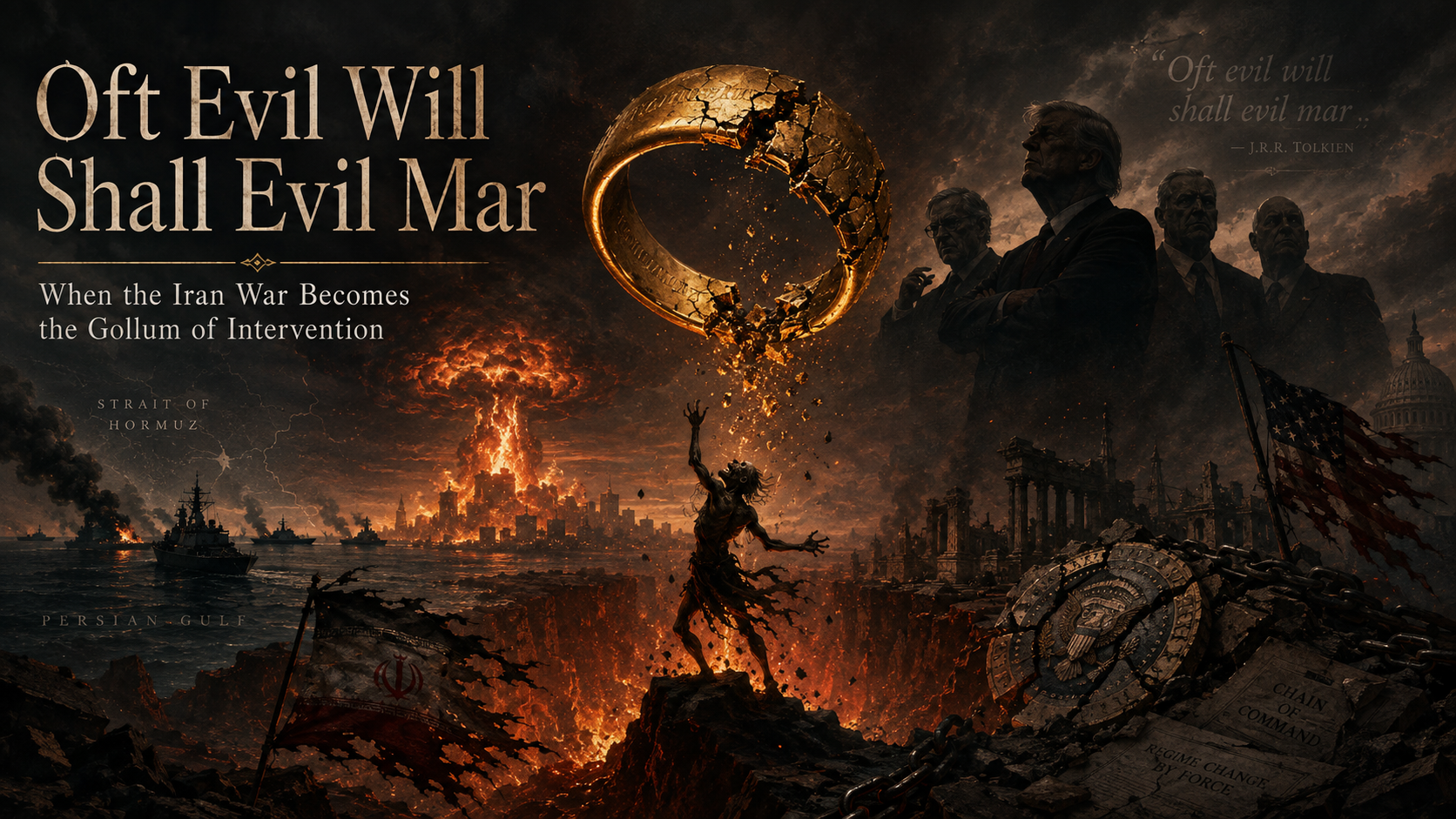
There are certain English sentences which explain a plot, and there are sentences which, having explained the plot, proceed rather impertinently to explain half of human history.
I believe Tolkien possessed a peculiar gift for the latter. “Oft evil will shall evil mar,” Theoden remarks in The Two Towers, somewhere towards the latter end of the chapter “The Palantír,” after the company discovers that the very machinery by which its vicious enemy intendeds to watch, intimidate, deceive, and dominate has instead produced an advantage for those it meant to destroy.
Now, the grammar of this one single sentence sounds a tad archaic because Tolkien meant it to. Oft means often; evil will is an intention ordered toward evil; mar means to damage or ruin. Thus this simple proverb amounts to something rather more interesting than the comfortable maxim that ‘good eventually triumphs over evil.’ That is a bit too droll. No, Tolkien says something far more profound, and far more bleak… something almost indecently amusing once one notices how frequently it occurs: evil frequently ruins evil. For it is not always the saint who destroys the devil. Sometimes one devil trips another devil while going down the staircase.
The immediate occasion is Pippin’s disastrous curiosity about the Palantír itself. Pippin, as Pippin is oft to do, does precisely what every sensible person knows he should not do. He steals a glimpse into the orb, encounters the evil Lord Sauron, and nearly destroys himself. And yet, because Sauron possesses the peculiar stupidity of the supremely powerful, the stupidity which comes from believing that every event must necessarily confirm one’s own assumptions, the encounter deceives Sauron more than Pippin! Sauron concludes something akin to believing the halfling must be Saruman’s prisoner and that the ring is therefore in his (not Frodo’s) possession. Later, when Aragorn reveals himself through the same orb, Sauron’s fear and pride draw still tighter around the false picture forming in his mind. His instrument of omniscience has not made him omniscient at all. It has merely allowed him to be wrong with magnificent confidence. Remind you of anything? Well, we’ll get to that…
But allow me to extend this point further. Yet Tolkien is only rehearsing on a small stage what he will later perform upon a larger one; for who, after all, destroys the Ring?
No, no, remember… it’s not Frodo.
That is one astonishing component in the trilogy. Remember, Frodo fails. At the cusp of victory, at the edge of Mount Doom, after all the miles, all the wounds, all the starvation, all the pity, courage, friendship, and sacrifice, this goodly hobbit comes at last to the decisive moment and cannot do the one, single thing required of him that he set out to do. Total loser!
What does he do? He claims the ring for himself. Nor does Aragorn arrive with Anduril to cleave it in two and save the day. Gandalf the White does not appear in a burst of magic light. Providence does not reward virtue with some convenient miracle. Instead comes Gollum, wretched Gollum, corrupted Gollum, treacherous, murderous, sniveling Gollum. The very same creature who has spent centuries worshipping the vile object upon which Sauron’s power depends. He bites the One Ring off Frodo’s finger and, in the sheer ecstasy of possessing it again, dances himself over the precipice and into the lava. Total loser!
But consider the cruelty of that joke. The Ring has spent centuries cultivating within Gollum the very appetite that finally destroys it. Its power over him is so complete that he cannot abandon it even when abandoning it might save his life, and consequently the instrument of Sauron’s domination manufactures the slave whose enslavement proves necessary for Sauron’s destruction. Gollum does not repent. Despite those hungering for a redemption arc, he does not suddenly become good. He does not overcome evil. He remains, until his final epic moment, exactly what the Ring has made him, and that is precisely why he can destroy it.
This is perhaps what makes Tolkien’s maxim so much more profound than the overly-simplistic “good triumphs over evil.” Sometimes good cannot triumph by itself. Sometimes goodness brings the ring nine hundred and ninety-nine steps and collapses on the 1000th. Sometimes evil must be permitted one final act of evil, one last greedy outreach, one final assertion of itself, and in stretching too far, it takes itself right over the edge…
Stephen King understood this principle perfectly in what I think is the best horror novel of all time: The Stand. Whether or not he consciously borrowed Tolkien’s metaphysics or merely stumbled upon the same ancient truth about wickedness is unknown. Randall Flagg has gathered his kingdom in Las Vegas. He has assembled the frightened, the ambitious, the cruel, the resentful, the obedient, and the broken remnant that humanity has left after the plague obliterates 99.5% of humanity. He gathers them around himself because these are precisely the people from whom tyrannies are made. And among them is Trashcan Man, the pathetic little pyromaniac whose life has been shaped almost entirely by humiliation, madness, fire, and the desperate desire to belong somewhere. Trashcan Man loves Flagg, insofar as he is capable of loving anything. He wishes to serve him. He wishes to bring him something worthy of his great dark master. Yet Flagg has made the oldest mistake of the tyrant: he assumes that because a madman worships him, the madman has therefore ceased being mad.
[WARNING: THE STAND SPOILERS INCOMING]…
And so Trashcan Man disappears into the desert and returns with the greatest offering imaginable, an atomic warhead! This is the beauty of it, if one may use the word beauty for something so grotesque. Trashcan Man does not betray Flagg. He does not join the good people of Boulder, Colorado. He has no great moral awakening. He does not suddenly perceive the wickedness of Las Vegas and devise a heroic plan to destroy it. Quite the contrary. The skin literally dripping off his skin, he wheels the nuclear bomb he has unearthed into Flagg’s kingdom as an offering of fealty. But it’s his loyalty that produces the catastrophe. His madness, recruited because it was useful to evil, has remained sufficiently mad to destroy the evil that recruited it! At precisely the moment when Flagg is displaying his ultimate power before his assembled followers, the weapon is detonated, and the kingdom consumes itself in fire. Flagg’s Gollum arrives pushing a nuclear bomb.
Literature is replete with variations upon this same unpleasant little truth, because literature is replete with men, and men have always possessed the curious capacity to construct the instrument of their salvation and the instrument of their destruction with approximately equal enthusiasm. The deeper principle is not difficult to understand. Evil contains certain structural defects. Lies require additional lies. Cruelty manufactures enemies. Pride silences advisers. Paranoia purges the competent. Violence requires violent servants. Power produces the conviction that because something can be done it therefore ought to be done. And sooner or later the evil man becomes so convinced of the magnificence of his own will that he commits one unnecessary act too many.
Which brings us, rather unfortunately, to the current war with Iran (and, yes, it’s most definitely a war whatever else you might have heard to the contrary and whatever issues with constitutionality that manifests). The American-Israeli war with Iran has become precisely the sort of undertaking that invites Tolkien’s maxim, because what was sold as an assertion of cold, overwhelming strength has instead become a demonstration of how quickly the evils of war can become a self-defeating entanglement. The campaign has not produced the clean, decisive conclusion promised by those self-righteous champions who spoke most loudly for it. Rather, it has produced chaotic escalation, massive cost, asymmetrical resistance, profound uncertainty, economic disruption, political exhaustion, and the familiar spectacle of men who assured the public that force would definitely simplify matters explaining, some months later, why matters have somehow become extraordinarily far more complicated.
There is something profoundly evil in the wretched appetite for war, particularly when the men possessing that appetite will not themselves crawl through the burning wreckage produced by it. There is something sublimely evil in treating thousands of lives as pieces upon a geopolitical chess board; something positively evil in imagining that another nation filled with innocent civilians may be smashed, decapitated, starved, bombed, destabilized, and rearranged so that statesmen thousands of miles away may discover whether their theory of reckless madness was somehow worthwhile.
With a lack of humility barely rivaling his lack of military intelligence, Netanyahu urged on this naked confrontation. Trump chose to embark upon this evil at his evil behest. Ted Cruz cheered the escalation of evil. Before his merciful death, Lindsey Graham spent more than two decades unable to encounter a foreign-policy problem that couldn’t be improved by bombing somebody. Call them ‘hawks’ if this gentler, less accurate word makes the thing easier for you to swallow. But I call the impulse they have repeatedly represented as blood-thirty war-mongering, and all good men of conscience or religion should regard that vile impulse as evil.
And yet here Tolkien begins whispering from the corner because perhaps these men have succeeded in producing something that all the lovers of peace, antiwar writers, dissident congressmen, libertarians, paleoconservatives, left-wing doves, Iraq war veterans, historians, realists, America-First advocates, and assorted Cassandras of the last quarter-century could never quite produce themselves. Perhaps they have finally created an argument against the perennially-destructive, interventionist foreign-policy establishment so large, so expensive, so ugly, so prolonged, and unbelievably evil and impossible to disguise that millions of ordinary Americans will be forced to finally acknowledge the sin for what it is.
Some people may point to the Democrat party as the “lesser of two evils” which likely will rise to power as a direct result of this insane, unconstitutional, savage massacre in the Middle East. But I would disagree with that rather neat assessment. It may be true to a point, but I actually believe that the Gollum in this particular story may not be the Democratic Party at all; it may be the Iran war itself.
Let me explore that thought a bit. The irony is too delicious to be ignored. For the evil thing created to demonstrate the ‘wisdom’ of intervention may become the instrument that discredits intervention altogether. The vile and pernicious campaign meant to exhibit American omnipotence may expose American limitation. The unholy alliance that would cause George Washington to turn in his grave, which is meant to make Israel more secure, may actually provoke Americans to reconsider the terms, costs, and limits of this sacrosanct America-Last alliance. The crimson-soaked politicians who believed another Middle Eastern war would silence their critics may succeed, after immense expenditure of blood and treasure, in multiplying those critics beyond anything the antiwar movement could possibly have achieved on its own!
It is, in a word, a silver lining soaked in blood and bile.
For years the interventionists possessed an enormous advantage: their ever-persistent, constant failures could be discussed as abstractions. The never-found WWMDs of Iraq happened long ago. Afghanistan was complicated. Libya was someone else’s administration. Syria was… somehow different. Yemen was obscure. Each corpse could always be filed under its own heading, each disaster provided with its own explanatory footnote, each previous failure declared irrelevant to the next proposed evil misadventure. And so the strange and bloody American ritual continued, in which men who had been wrong about the previous war appeared on television to explain why the next war was absolutely necessary (morality and Constitutionality be damned!) and everyone behaved as though this were a perfectly natural qualification to put aside reason and objective Truth. And those evil creatures in Washington DC who were most obscenely wrong over and over and over and over before were, naturally, given the chair closest to the head of the table. Because they had the loudest voice at the banquet of sin, and the loudest voice must always be the most revered.
Those rare fools with memories longer than a goldfish still recall that Trump originally campaigned as the one man who would “end the stupid foreign wars in the Middle East.” (direct quote). Yet, due to Netanyahu’s insatiable bloodlust, Trump has now, forever and indelibly, attached his name to the most egregious one yet. For Netanyahu, in seeking to bind American power still more tightly to Israel’s regional struggle, may instead provoke the strongest American reconsideration of that relationship in generations. Cruz and Graham, in demanding greater resolve, greater pressure, greater escalation, have discovered that there exists somewhere, even in the patience of a self-righteous empire, a devastating silence after the public begins asking the eternally-forbidden question: Why the hell are we even doing any of this at all? They may, in short, have reached for the Ring, and in their eagerness to possess it may discover, as so many powerful men have discovered before them, that one does not always know whether one is holding the instrument of one’s triumph or the instrument of one’s ruin.
This is the terrible defect in evil which Tolkien understood so well. Evil is eternally ruinous due to its very nature.
Evil cannot leave well enough alone because leaving well enough alone would require restraint, and restraint requires nuance. It requires recognition that the world contains something beyond one’s own will. Evil conquers one province and desires another. It tells one lie and requires ten more to defend it. It wins one battle and begins dreaming of the next war and then surely the greater one after that. It acquires power and then, being unable merely to possess power, must demonstrate it. Eventually it reaches once too often. If the Iran war ultimately produces a broad American revulsion against the very ideology that produced it, if the catastrophe becomes the event that finally breaks the enchantment of endless Middle Eastern intervention, then villains like Netanyahu and Trump and Cruz and Graham will have accomplished something their clean and righteous opponents could scarcely have accomplished without them. They will have supplied the argument. They will have provided the evidence. They will have dragged their own doctrine into the public square, placed it beneath the tungsten lights, and demanded that Americans look at it…
And evil is ugly!
Look hard, and breathe deep, America. This scourge of evil is one of our own making. It is a festering wound on the soul of our country; and the sin, suffering, and disaster of reckless, profane bloodlust is now on full display in 4K. Given all this, it is entirely possible.. perhaps, just perhaps, well-meaning Americans finally will take a real long look at the horror that is war.
Gollum never intended to save Middle-earth, and Trashcan Man never intended to destroy Randall Flagg. That is precisely the point. The lesser instrument need possess no virtue whatsoever. It need only carry the logic of the greater evil one step farther than the greater evil can survive. The Ring made Gollum, Flagg gathered Trashcan Man, and the men who desired the Iran war may yet discover that they have created their own destroyer. Not because their creation became virtuous, but because evil, when given sufficient freedom to express itself, so often becomes excessive, ridiculous, ravenous, and finally suicidal. Evil cannot help but be true to its vile nature.
Tolkien required only six words for the whole miserable comedy: Oft evil will shall evil mar.
However, Tolkien was writing for a far smarter audience and in a time when perhaps all men were a bit more intelligent. The good people of the United States sadly require slightly more. They require perverted politicians screaming for blood in order to witness the horror that will undo the resolve that started it flowing. They require neoconservative pundits demanding from their cushy studios that the children of other men make great sacrifice. They require an allegiance held together by moral hazard and alchemy be shown for what it is: not any great benefit for them, but the other nation. Thus, America requires only to see the brutality and tragic results of evil in order to eventually witness evil undo itself.
The mirror showing evil to those who cry for it may therefore become the greatest weapon against it.