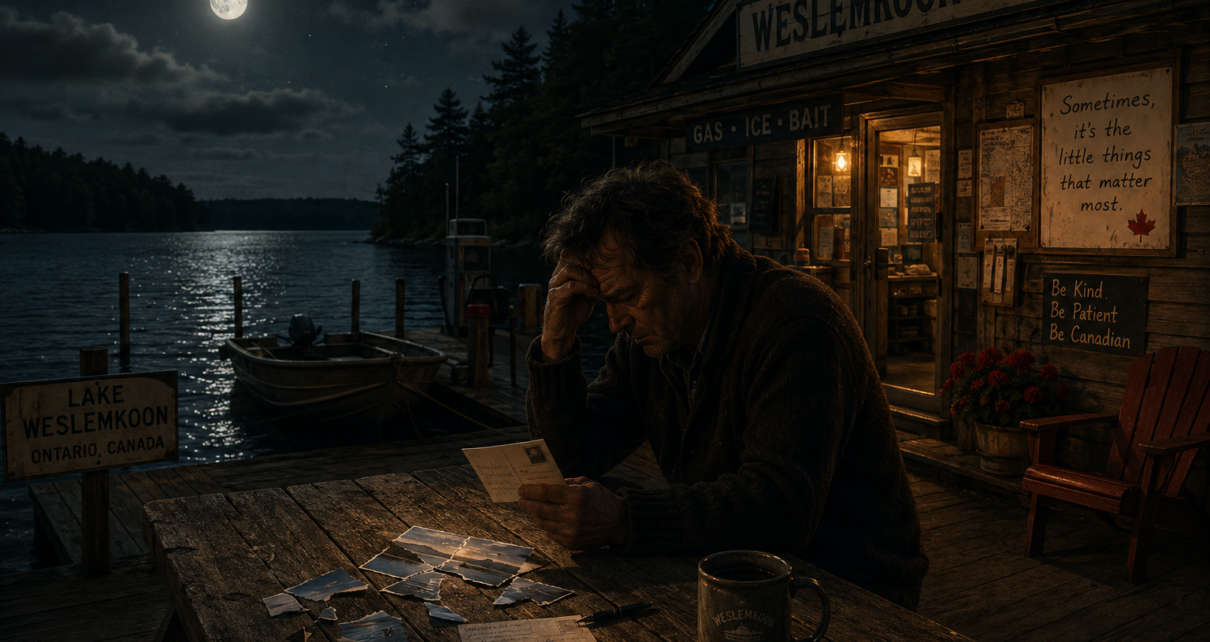
by Sean Dempsey | 08/06/24
I swear by God in heaven above: I had not intended during this vacation north to become some sort of rogue or dishonest man! Indeed, I had intended nothing of the sort. I had intended only to mail a simple postcard, dammit! And if ever there was a thing less capable of corrupting a man’s immortal soul, surely it was a postcard. A theft, perhaps. A murder… certainly. The administration of a war-mongering empire like the one I was vacationing from… most assuredly. But a postcard? Surely not! A postcard is an innocent thing. It is a trifling thing. And if I repeat that it is a trifling thing, it is because the reader will discover that there exists nothing in this world more dangerous than a trifling thing.
See, this all started because I had promised a friend of mine, M. Cole, that I would write to him while vacationing at Lake Weslemkoon in Ontario. Why had I promised him this? I cannot say. Men make promises every day with the same casual indifference with which they cast crumbs to birds in parks. They promise to clean, to diet, to write, to visit, to remember, to reform themselves. Usually they do none of these things, and the world continues onward as though nothing had happened. Yet I had given my word, and, what is worse, I had remembered that I had given it.
The lake itself was magnificent. The water was clear and warm, the pines stood in their endless ranks upon rocky ledges, and the loons called to one another at dusk with that mournful and lonely cry which always seems to me like the lamentation of a soul imprisoned somewhere between heaven and earth. Everything possessed an extraordinary stillness. One felt that the world had not merely slowed down, but that it had become altogether indifferent to the very notion of Father time. The goodly Canadians, too, seemed to partake of this quality. They possessed a raw cheerfulness so sincere and so unaffected that, to a man such as myself rather accustomed to the suspicious and industrious temperaments farther south, it appeared almost miraculous.
Now, before I proceed, I must emphasize once more that the matter itself was quite insignificant. It was such a trifling thing. There was no news to communicate on this postcard. No revelation. No declaration of love, no warning of danger, no final testament to convey. I intended to write only that I was well, that the lake was beautiful, that the fish had entirely escaped me, and that I remembered my friend. In short, I intended to write precisely the sort of trivial things one always writes upon postcards, which is to say, things of absolutely no consequence whatever.
Accordingly, I traveled by Pontoon to the local marina on a separate errand, and while there purchanced to purchase the postcard. It was a most handsome one to be sure, displaying a majestic loon at sunset with the name of our lake emblazoned below it in bold font, thus proving I was in fact where I claimed I would be. I took the item home and put it on the living room table to be dealt with later. In short, I forgot about it, as most postcards deserve.
However, after a productive day in the sun had fully played out, I returned to the cottage, saw the card, remembered my promise, grabbed the item, sat down, and wrote my message. I remember that I was quite pleased with myself afterward. This, too, is characteristic of mankind. Give a man an opportunity to accomplish something entirely trifling, entirely unnecessary, and he will regard himself with great aplomb.
The next morning I returned to the marina to purchase a stamp and mail my correspondence.
“We don’t sell stamps,” the young blonde woman behind the counter told me with a bemused smile.
I confess, I was surprised. It struck me as curious to sell postcards but not stamps. It seemed rather like selling coffins without lids or boats without motors. Or, as my daughter might vehemently protest: pancakes sold without syrup. Yet the matter did not concern me too greatly, for it was such a trifling thing to be sure. I was content to take my mumps and go home.
However, it was not to be. Another employee overheard the conversation and interjected with a word of good news. “You’re in need of a stamp, eh? Oh, well, hurrah – we’re headin’ into town today,” she said. “Or, that is, my friend is heading into town and I’ll be dropping by her place on my way off work. I could have a conversation with her, for she wouldn’t mind in the least to get a stamp for you. You see, Claire is such a wonderful person. She always has a smile on her person and a cup of tea for me when I arrive. I don’t even like tea, but I oblige her. Oh, she has a collection of stamps you would just adore. Loons from around lakes all across Canada. And maple leafs of course. And even Elvis Presley on a few pages. A full page and a half of Elvis stamps! I know with your love of stamps you’d appreciate her collection. Although you can’t have any of these, I’m sure you understand, for your postcard. Her stamps are all commerative. Quite rare. But of course she can pick one up for you. She would be, if not elated, then at least pleasantly resigned to the task!”
This conversation is not word for word, of course, but the logistics and essentials of her message are all quite accurate. In fact, the real conversation lasted at least ten or more minutes and I learned far more about this woman’s friend named Claire than I ever intended or desired. Truth be told I didn’t even know the name of the attendant to whom I spoke, but I learned much of her plans and her friends and her interests that day. Needless to say, I thanked her profusely, and then proceeded to think no more of the subject at all. It was all such a trifling matter, and I had other pressing activities on my mind.
The following day I returned to the marina to purchase a bag of milk. The poor girl’s face immediately darkened as she saw me.
“Oh, no!” She cried. “I forgot to ask Claire!”
She was so genuinely distressed that I nearly laughed. “Please,” I said, “don’t give it another thought. It is such a trifling thing. I can handle this at another time, and this particular postcard bearing such trivial details has already received far more attention than it deserves. Don’t worry about it at all! I’ll take this milk and be on my way…”
She apologized nevertheless, and proceeded to explain the meeting with her friend and how it was all so lovely and the tea was actually enjoyable this time around and that the conversation flowed so naturally that she forgot to mention the request for a stamp at all. Again, I repeated it was not a bother; it was a trifling thing, really. She seemed on the verge of tears, however, and I daresay if this were another time or place she might be said to beat her breast with shame. She cursed her failing memory and lamented her overindulgence, her epicurean appreciation for the tea that kept flowing as did the conversation with her friend. At one point she even blamed her friend saying with great angst “If Claire wasn’t so pleasant and loquacious, this never would have happened! Oh, your poor friend will not receive his postcard. What a shame. What a shame, what a shame!”
It was at this particular moment that the affable wife of the manager of the marina entered the affair. She was one of those astonishingly cheerful creatures whom one encounters only rarely in life. There was in her manner something so open, so obliging, and so entirely free of calculation that one could not help but admire her. She seemed to move through the world in the conviction that every difficulty was an opportunity to be useful. Had I informed her that our roof had blown away in a raging storm, I honestly believe she would have climbed onto the cottage herself with hammer and nails, despite any knowledge of nor a mite of appreciation for construction.
“Oh, oh! I’ll get you a stamp!” she exclaimed with euphoric delight.
“Oh, please. I shall not hear of it. There really is no need.”
“Nonsense.”
“It is such a trifling thing.”
“All the more reason.”
“Please, don’t trouble yourself.”
“No trouble at all! I am heading into Bancroft later today. The post office is on my way.”
“Are you quite sure?”
“Without question!”
Thus, the matter was quite settled. I smiled, as hers was alarmingly contagious, and her desire to help was arresting. Who am I to dispossess one of their desire to assist in such a matter, even a matter as trifling as this? Is not helping others a Godly love language, or so I’ve been told?
Several days passed. I happened to see her again upon a trip to the marina for icecream, and, remembering the stamp, casually inquired about it.
At once she clasped her hands together and made a face not unlike anguish or terrific pain. She had forgotten. The depth of her remorse was extraordinary. One might have thought she had neglected to deliver medicine to a dying man.
“But it really doesn’t matter,” I again protested. “Really. Truly! Indeed, it is such a trifling thing.”
“No, no! I’ll go into town at once!”
“Oh, no. You really mustn’t.”
“I insist.”
“You are speaking of an hour’s journey!”
“And?”
“All for a stamp.”
“Pish posh! ‘Tis a matter of principle. I gave my word and that’s all there is to it.”
“Surely you can see that it is such a trifling thing.”
Yet she would hear none of it. She departed immediately. I was flummoxed and felt a small wave of emotion difficult to describe. I felt it quite impossible to “put myself in her shoes,” so to speak, as I would never have imagined going to such lengths for another, certainly someone no more than a stranger, for the simple matter of attaining a stamp. All this for a postcard to a friend who was more than likely not even to read it before discarding it. Was it guilt I felt? No, it was more akin to grief or even despondency. Perhaps it was shame? Yes, that was it. I definitively felt the wet, clammy hand of shame upon my brow. “Am I such a terrible person?” I questioned myself. For when examining my heart and asking honestly, truly honestly, I was forced to admit that I surely would never go to such effort for a matter so small. And standing at the Pearly Gates, with God Almighty solemnly placing my immortal soul upon the scale of justice, He would surely find it to be less weighty than that of this matronly creature who was at this moment barreling towards a remote post office in Bancroft because I needed a two-dollar stamp.
I have often reflected that civilization rests entirely upon people of this sort: people who insist upon undertaking enormous labors on behalf of trifling things, and people like myself, who accept those labors while protesting feebly that they ought not to be undertaken. Contemplating thusly, I finished my icecream and discarded the wooden spoon and paper cup in the trashcan. These were wild thoughts for another time; I had to go make lunch for my child who now announced her unfathomable boredom to me and anyone else who would listen. This snapped me out of my reverie.
The next day, upon arrival at the marina, I discovered that the prior day’s expedition had been a triumph. The manager’s spouse was jubilant. She had obtained the stamp. Indeed, she was not merely pleased; she was victorious! Moreover, she had told everyone she knew…
At first I was touched. Then I became somewhat uneasy. For soon I noticed a peculiar expression upon the faces of the other patrons. It was not disapproval, exactly, but rather a sort of disaffectionate astonishment. And I interpreted it, I think rightly, as mild distain.
“This American,” their eyes seemed to say. “To ask such a thing! To demand such sacrifices! What boldness!” And then their gaze would turn toward the wife of the manager with lavish awe. “What generosity! What goodness! What a noble spirit! And what stark contrast between the saintly giver and the brutish receiver!”
I began to feel rather ashamed. I wished to stand upon a chair and cry out, “Gentlemen, no! My Canadian friends, you misunderstand the matter entirely! It is all such a trifling thing!”
Yet I said nothing.
The wife of the manager seemed especially delighted. Good deeds will and should breed delight in those who do them. She recounted the story repeatedly to her employees, laughing all the while. I listened in growing horror as the affair acquired details, dimensions, and significance entirely absent from the original event. My prosaic postcard now contained tidings of tremendous import.
It was then that I turned the postcard over and also examined the coveted stamp. The postage was insufficient. I looked at it once. I looked at it again. There could be no mistake. I remember thinking, quite calmly, “Well, this is rather unfortunate. Then I thought, “No matter. It is such a trifling thing…”
Then I thought again, “No. But it is not a trifling thing at all.”
For the reader must understand that the stamp itself was trivial, the postcard was trivial, and the promise was trivial. But the efforts of these good people were not trivial. Their kindness was not trivial. Their enthusiasm was not trivial. And it seemed to me that, by informing them of the dismal truth, I should somehow transform their cheerful little victory into a defeat.
So instead I headed home upon our pontoon and immediately placed the postcard in a drawer. And there it remained, encased in darkness, not much unlike the Tell-Tale heart beating loudly beneath the floorboards.
The following day someone asked me whether the postcard I’d sent had arrived to the recipient and if I had inquired for news of him and, more importantly, the card. “Sorry, I don’t know,” I replied. “Canadian mail can take time to deliver to the States.” They seemed slightly embarrassed at this rejoinder, so pressed on with their questioning. “Who is this friend of yours, eh? I understand his name is Ian, eh? Does he travel with you often?” I explained he did not. “Well, I hope your postcard finds him well and in good health. Let us know when he receives it, eh?”
The day after that another person inquired about the postcard. Then another.
Soon the entire lake appeared to have taken an interest in the matter. Men hailed me from their boats. Neighbors called to me from their docks. At the marina later that week to acquire some sausage, one elderly gentleman interrupted the filling of his gasoline tank merely to walk over and inquire whether my ‘dearest and best friend of so many long years’ had received the postcard and if he knew how much effort was expended to procure the coveted stamp affixed upon it. He proceeded, “Your postcard must surely have made it by now to your best chap down south, eh?
“I can’t say,” I answered with reddening cheeks. “Uh, I mean, no, I don’t think he got it yet.” This was not, strictly speaking, a lie. Yet neither was it the truth.
“Ah, that’s odd, eh? My grandpapppy and his grandpappy before him were postalmen. Ontario’s best they were, yeah! They’d see the mail delivered rain or sun, night or day, eh. They’d see to it! They’d have seen your postcard delivered, they would. Times are hard these days, eh? Times are hard when a simple postcard takes such time to arrive.”
I nodded, hoping the conversation would quickly end.
“I assume you’ve called, eh? Called and inquired to the postal service about it…? They’ll know where your postcard is, they will. Mark my words, son, and mark ‘em well: your postcard will reach your friend, it will. Canada’s finest will see it done.” Then he wandered back to his boat, topping off his tank quickly, as a queue had developed, before finally turning to me and giving me an affirmative and cheerful thumbs up.
I quickly purchased my Italian hot sausage and left.
Now the strange thing is that, although I was conscious from the beginning that the entire matter was quite ridiculous, I nevertheless found myself increasingly oppressed by it. Such is the nature of the human soul, I suppose. It cheerfully accommodates the weightiest crimes but collapses altogether beneath the burden of some tiny absurdity. It is such a trifling thing, one says to oneself. Yet precisely because it is trifling, one cannot justify suffering on its account, and precisely because one cannot justify it, one suffers all the more…
To that end, at night I began to dream of the unmailed postcard sitting in our cottage drawer…
In one dream, I saw the wife of the manager of the marina standing upon the green shoreline by our diving rock while the entire population of the lake, including my long dead grandfather wearing red suspenders and jean shorts, assembled around her. They were annoyed with me and looked disappointed. My grandfather blew his boat whistle and then silently pointed in my direction, moaning with muted vexation. In another, my friend Ian stood before an empty mailbox, becoming older and older, his face growing a longer and longer beard, which eventually reached his knees, as the seasons swirled and stretched around him. In yet another, I discovered that dark government officials from both nations had become involved and that the entire peace of the North American continent depended wholly upon the successful delivery of my correspondence, which lacked the sufficient postage.
I awoke in a sweat. “Ugh! It is such a trifling thing,” I told myself. But that protestation didn’t make the cold sweat feel less real upon my forehead, nor sooth my aching mind back to sleep.
And I slept no better the next night either. At last, on one particular night boasting a harvest moon, I could endure it no longer. I rose from my bed, dressed hurriedly, and went down to the large diving rock at the edge of our property. The reddish moon hung pregnant and accusatory high above the water, daring me to act. Daring me to cast off my vexing demon that refused to sleep. The trees stood silently and foreboding upon the rocky shore. Not a breath of wind disturbed the surface of the majestic Weslemkoon.
The postcard was in my pocket. I took it out. Yet, for a brief moment I hesitated. Then I tore it in two. Then into four pieces. Then eight. Then twice that and twice that! Damnable triffles of cardstock! I continued shredding the trifling postcard until I could no longer. Then I cast them out, and a hundred fragments drifted downward into the dark water and vanished forever.
I stood there for some time afterward. And do you know what thought came to me then? Not relief. Not triumph. Not even regret No, damn it all! What occurred to me was this: that the postcard itself had never mattered in the least. It had always been such a trifling thing. Yet now, precisely because it had become such a trifling thing, I understood that I should remember it all my life. For there is nothing that burrows more deeply into the conscience than the small absurdity, the insignificant falsehood, the ridiculous secret. Great tragedies belong to history. Great crimes belong to literature. But it is the trifling things… ah, the trifling things that belong to us all.