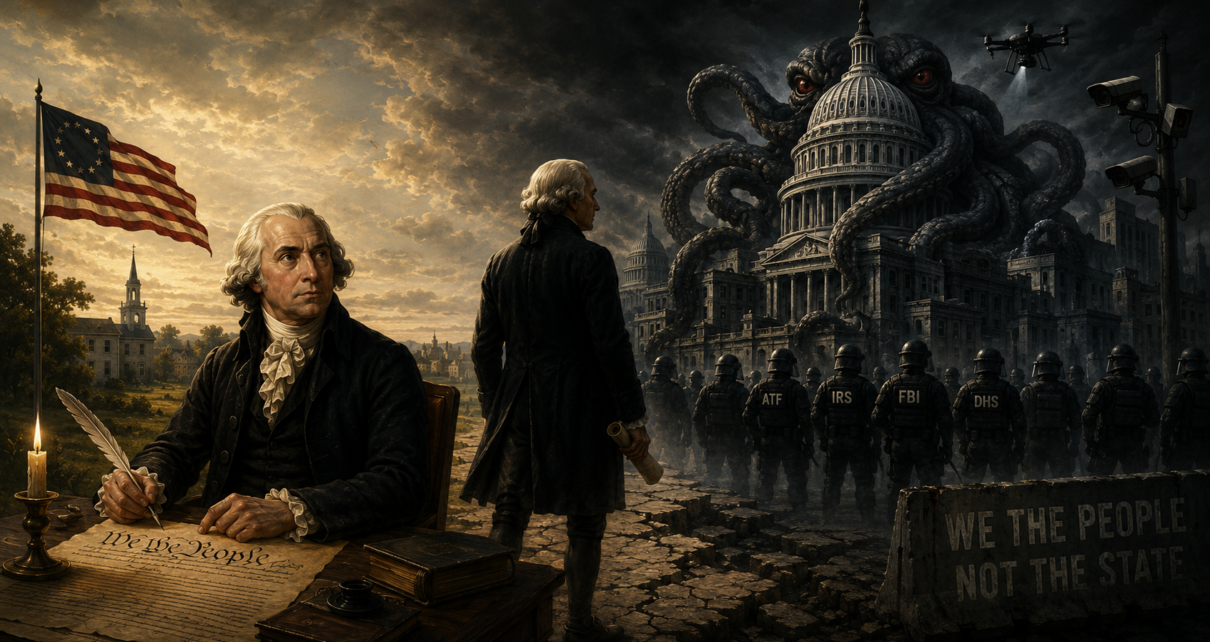
The Fall and Rise and Fall of a Founding Father
It has long been the custom of civilized nations to adorn the memory of their founders with such quantities of marble, bronze, and reverence that no ordinary citizen dares inquire whether those gentlemen ever committed the smallest error. We are often instructed to regard them as Roman demigods who wandered accidentally into Virginia plantations, occasionally pausing between miracles to throw tea into the Charles or draft constitutions. Such treatment is undoubtedly conveneint, for statues ask no questions, biographies edited by victors reveal few embarrassments, and a people persuaded that their ancestors possessed infallible wisdom may be more easily persuaded that their descendents inherited it. Yet, if there be any profit in history beyond mere patriotic decoration, it must consist in examining not merely what great men intended, but what their ideas produced once entrusted to men considerably less virtuous than themselves.
Among these celebrated architects, none deserves more admiration than James Madison, father of the Constitution. Neither, I suspect, deserves more pity and scrutiny! For if there exists a single statesman whose life illustrates the peculiar tragedy of political genius, it is surely the man who spent half his career constructing a stronger national government and the remaining half warning the nation what stronger national governments invariably become. His story is not merely the history of one man; it is the history of liberty herself, first persuaded to loosen her dour chains for the sake of efficiency, then astonished to discover that chains, once lengthened, possess a remarkable tendency to continue growing.
I conclude that Mr. Madison’s first error was not born of any form of wickedness per se, but rather of excessive confidence, which has ever been the most respectable parent of disastrous ideas. The Articles of Confederation had revealed certain defects. For starters, Congress struggled to collect revenue. The states quarreled. Commerce lacked uniformity. The Union appeared, to many discerning observers, too feeble for its own preservation. These complaints were not entirely without merit. Yet, it has always been among mankind’s favorite habits to conclude that because one thing proves in any way insufficient, its opposite must therefore be perfectly proportioned. A hungry physician prescribes gluttony, a cowardly general recommends perpetual war, and a statesman who finds government weak immediately imagines that government strengthened shall somehow remain forever content with precisely the additional powers first alotted to it.
Accordingly Mr. Madison arrived in Philadelphia ready and willing to stage an invariable coup!
Oh, yes, there are those who grow faint whenever the Convention of 1787 is described as a Constitutional Coup, as though this term itself is far more scandalous than the events it attempts to describe. This is laughable. For one naturally is compelled to ask: by what gentler name would posterity ought to call an assembly commissioned merely to revise the Articles of Confederation and instead discarded them altogether and drafted an entirely new frame of government!? The delegates themselves appeared to appreciate the delicacy of their undertaking. The proceedings were conducted under extraordinary secrecy! The windows of Independence Hall were shut despite the oppressive Philadelphia summer; the doors were carefully guarded, and the members sworn to silence, lest the public observe too soon that their appointed mechanics had quietly become architects of something more gross and unapproved by them. To be clear, Mr. Madison arrived not carrying a list of proposed amendments to the existing framework, but instead a remarkably comprehensive blueprint for a fundamentally different constitutional order that had been prepared well in advance. The Articles themselves required unanimous consent of the states for amendment, yet the Convention proposed that an entirely new Constitution would become binding upon only nine states once ratified. How, then, is this not a coup? Such procedural acrobatics would surely be denounced as revolutionary were they attempted by any modern legislature. We are instructed, of course, that because the result proved durable and eventually secured popular ratification, the means deserve little examination. History possesses an amusing habit of renaming successful revolutions “constitutional conventions” while reserving the word “coup” exclusively for unsuccessful ones. Whether one chooses the harsher or gentler label, the essential fact remains unchanged: the delegates in Philadelphia exceeded the authority originally entrusted to them, betting that the American people would ultimately approve what had first been acccomplished entirely without their knowledge or permission. In that gamble they were spectacularly successful; yet, success, however magnificent, has never been accepted in any other field as conclusive proof after every preceding step was entirely lawful.
But I digress. Madison, as explained, arrived at the Philadelphia Coup in 1787 bearing his laudable Virginia Plan, proposing not the repair of the existing confederation but the construction of something far more ambitious and, unfortunately, far more pernicious. In fact, it is interesting to note that his original design would disastrously have empowered the national legislature to negate laws passed by the states themselves, a proposal which today would strike even many defenders of federal authority as rather immoderate! We are nevertheless assured now, in retrospect, that this represented absolutely no danger to liberty, because wise men had thoughtfully drafted constitutional limitations upon the very government they proposed to enlarge. Yet such naive reasoning has always confused me. It resembles the gentleman who enlarges his kennel for the comfort of his ornery mastiff while confidently observing that the animal has solemnly promised never to bite anyone beyond the garden fence.
To great historical credence, the Constitution, ultimately ratified, proved considerably more restrained than Madison’s earliest aspirations. The federal government was one of enumerated powers, carefully divided among competing branches. Madison himself assured a skeptical public in Federalist No. 45 that “The powers delegated by the proposed Constitution to the federal government are few and defined. Those which are to remain in the State governments are numerous and indefinite.” There is every reason to believe he wrote these words sincerely. Yet sincerity has seldom been the principal difficulty in political philosophy. The difficulty lies rather in imagining that ambitious men shall forever interpret constitutional language according to the modest expectations of those who first composed it.
At this point Providence, with her usual sense of irony, introduced Mr. Alexander Hamilton, ESQ. Historians commonly portray these gentlemen as opposing philosophies. I venture another opinion. Hamilton was not Madison’s contradiction but his inevitable consequence. He did not invent centralized authority any more than the first ambitious priest invented organized religion. He merely discovered the opportunities already latent within the institution. Madison opened the door and supplied a larger and less restricted government. Hamilton demonstrated what larger governments naturally attempt once established. If Madison built a handsome carriage, Hamilton merely observed that horses possess an unfortunate inclination to move.
Thus emerged the national bank, the assumption of state debts, the doctrine of implied powers, and that wonderfully elastic interpretation of the “Necessary and Proper” Clause which has since displayed greater powers of expansion than any piece of constitutional language previously committed to parchment. It was Hamilton who first showed how a government expressly confined to delegated powers might nevertheless discover new authorities whenever sufficient ingenuity met sufficient ‘political necessity.’ The camel, as the old proverb instructs us, first requests permission only for his nose. However, Hamilton displayed admirable efficiency by dispensing with the request altogether.
Now comes the most fascinating chapter in Madison’s life, for it is here that he distinguishes himself from the ordinary politician. Most public men spend their lives defending yesterday’s errors because pride renders confession intolerable to them. Yet, Madison possessed the uncommon virtue of learning. Watching Hamilton’s system insidiously unfold following Madison’s successful coup, he gradually perceived that constitutional language alone could not restrain those determined to interpret every ambiguity in favor of additional authority. The nationalist of 1787 began transforming into the constitutional sentinel of 1798. It is one of history’s richest ironies that the man who had done so much to strengthen the federal government soon found himself leading the opposition against its expansion.
His Virginia Resolutions reveal a man profoundly chastened by experience. There he defended the principle that the federal government remained one of delegated powers, and that the states retained an indispensable role in preserving constitutional liberty. Elsewhere he famously warned that “There are more instances of the abridgment of the freedom of the people by gradual and silent encroachments than by violent and sudden usurpations.” Observe the melancholy wisdom contained within that sentence. No longer does Madison fear merely anarchy or disunion. He now fears the quiet accumulation of authority through precedent, convenience, and habit… the very mechanisms by which nearly every government in history has enlarged itself while assuring the public that nothing of consequence had changed following his coup!
One cannot read those later writings without wondering whether Madison had begun to suspect that Hamilton’s constitutional innovations were not unfortunate accidents but perfectly natural consequences of the premises accepted at Philadelphia. For once it is conceded that a central government must possesss broad authority sufficient to preserve the Union, every subsequent generation shall discover entirely new reasons why preserving the Union requires still broader authority. Dire emergencies form and then multiply! Exceptions become precedents. Temporary powers naturally, by an intrinsic law of the universe, acquire permanent residences. Constitutional limitations gradually assuume the charming function of decorative trim upon an edifice whose architects have long since ceased consulting the blueprints.
Yet history, being composed by Providence rather than philosophers, refused Madison the satisfaction of ending his story as liberty’s triumphant prophet. During the War of 1812, confronted with genuine national crisis, he accepted measures he had formerly resisted, including the chartering of the Second Bank of the United States. His staunch defenders explain that circumstances required adaptation. Perhaps they are be correct? However, circumstances always “require adaptation.” Every enlargement of state power since Pharaoh has arrived carrying impeccable reasons for its necessity. Emergencies possess an astonishing habit of proving the permanent usefulness of powers described only yesterday as temporary. Governments, like gentlemen who borrow umbrellas, rarely discover suitable occasions for returning what necessity once permitted them to acquire.
This should not tempt us toward the childish conclusion that Madison was a hypocrite. On the contrary, I believe his tragedy is infinitely more instructive. He appears to have believed throughout his life that intelligent statesmen could discover precisely that quantity of centralized power necessary to preserve liberty while somehow preventing future generations from demanding more. It is a touching belief, much as one is touched by the innocence of children who suppose wolves distinguish carefully between sheep intended for supper and sheep reserved for breeding.
What, then, has become of Madison’s Republic? We are repeatedly assured that we continue to imhabit it. Congress now delegates legislative authority to administrative agencies whose regulations possess the force of law. Presidents dispatch armies across the globe with declarations unnecessary. The national debt has ascended into figures so astronomical that accountants increasingly resemble astronomers. States once jealous of their sovereignty now compete enthusiastically for federal grants, waivers, subsidies, mandates, matching funds, and administrative permissions, displaying toward Washington the affectionate dependence of grown sons who continue requesting allowances from elderly parents while adamantly insisting upon their complete independence!
And the Constitution itself of course remains greatly honored by politicians, much in the same the way babies are honored before they are kissed on the head. These noble politicians quote it incessantly, courts interpret it creatively, professors explain that its original limitations have matured beyond recognition, and every fresh expansion of federal authority arrives accompanied by solemn assurances that this newest exercise of power is perfectly consistent with a document once described as conferring powers “few and defined.” Ah, one cannot help admiring the Constitution’s miraculous fertility! It has somehow produced authorities never imagined by its authors, powers nowhere enumerated in its text, and institutions that eighteenth-century Americans might have mistaken for ministries of some enlightened European monarchy.
So I ask: would the Madison of 1798 recognize the feral government now operating under the Constitution he forged with a coup of his making and his own design? I suspect he would first search vainly for Hamilton, imagining such achievements could only belong to his old adversary. Upon discovering instead that generations of Republicans, Democrats, judges, presidents, bureaucrats, and legislators had each contributed faithfully to the enterprise, he might finally perceive the cruel truth: Hamilton did not defeat him; no, Hamilton merely demonstrated what inevitably follows once centralized power is accepted as the preferred instrument of political improvement. The subsequent centuries merely completed the experiment.
Thus the saddest irony of James Madison’s remarkable life is not that he changed his mind nor that he got everything via his coup that he wanted and for which he dreamed. It is that he changed his mind too late and had not the foresight to see that power is unmercilessly corruptable. He spent his youth believing liberty could safely entrust greater power to government because constitutional parchment would restrain ambition. He spent his maturity warning that liberty is more often destroyed by gradual encroachments than sudden usurpations. And had he lived to witness our own age, where the federal government extends into nearly every province of American life while still claiming constitutional fidelity, I suspect he would discover the bitterest lesson of all: that the parchment had not failed because it lacked wisdom, but because no parchment has ever yet succeeded in containing men who have first persuaded themselves that necessity is superior to limitation.
For if the elder Madison were permitted one final address before the Congress of the United States, they would undoubtedly honor him as the Father of the Constitution before proceeding unanimously to ignore almost everything he had learned after.
