By Sean Dempsey | 07/02/26
Never before in history have we, once poor mortal men, been more akin to gods. It is truly miraculous the world we have invented for ourselves and the reality we have forcefully bent to our undying will!
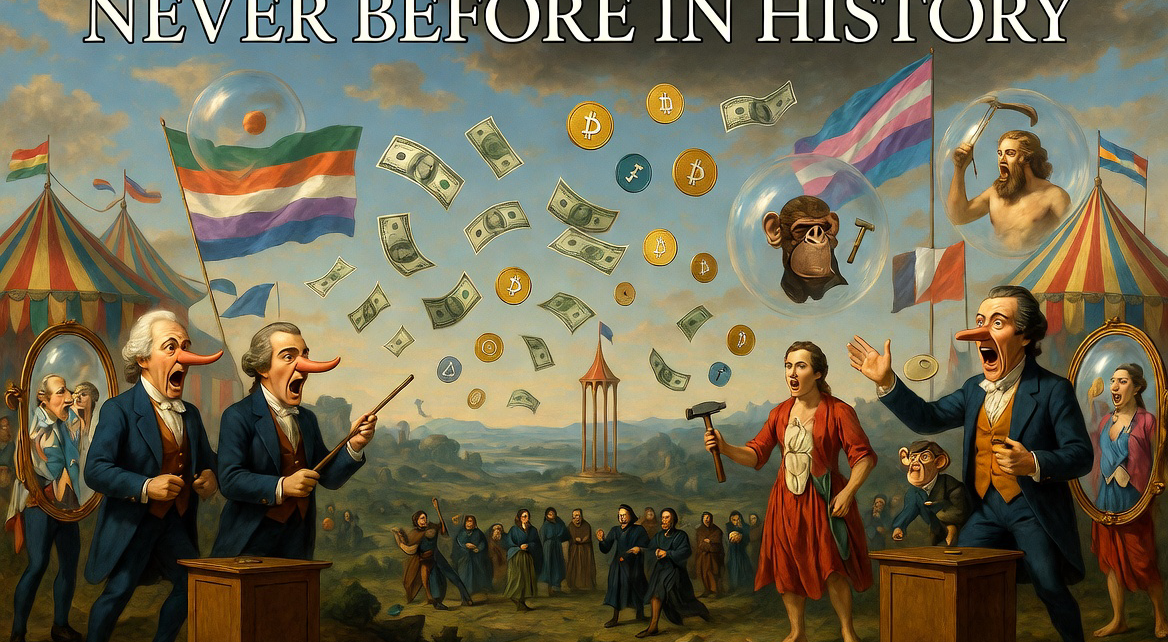
For it is beyond interesting. It is inspiring and invigorating that at no other moment in all of recorded human history has truth mattered so little and the diligent construction of one’s own fantasy reality been so universally revered. Previous ages labored under the quaint superstition that the world existed independently of our preferences. They consulted rocks, rivrs, chromosomes, and ledgers as if these mute objects possessed some type of authority. But we, having transcended such childish literalism, now understand that reality is merely a collaborative fiction best rewritten daily by the most fashionable voices in the room. How incredibly fortunate we are to inhabit the vast Olympus of 2026, the first era in which a man may announce himself a woman before breakfast, purchase a cartoon .gif with currency that has never been printed on anything more substantial than a central banker’s daydream, watch its notional value triple by lunch, and be celebrated at dinner as a financial prodigy whose brilliance confirms the infinite plasticity of all things. Are we indeed not Gods?
Consider first the admirable condition of our public finances. These indelible United States of America carry a mountain of debt roughly thirty-nine trillion dollars denominated in a fiat medium no longer tethered to gold, silver, land, or even the promise of future tax receipts that anyone seriously expects to be collected. This phantom money purchases phantom goods and services whose principal distinction from the currency itself is that the goods occasionally arrive in cardboard boxes. One may, without irony, exchange these spectral units for digital “meme coins” whose entire ontology consists of a few lines of code and the collective willingness of strangers on the internet to pretend they are scarce. One may further exchange the meme coins for NFTs depicting bored apes or pixelated cats… images that confer no shelter, no nutrition, and no legal claim upon anything except the right to point at a URL and say “mine.” The total market capitalization of these arrangements routinely exceeds the gross domestic product of mid-sized nations. In any previous century such a spectacle would have been diagnosed as collective lunacy. Today it is reported on financial television with the same solemnity once reserved for the price of wheat.
The masters of this new economy are corespondingly enlightened. They do not conceal their operations behind the shabby euphemisms of earlier frauds. Michael Saylor and others simply declare their Ponzi schemes “financial instruments,” collect fresh capital from the credulous, and distribute a portion of it to earlier participants as “yield.” The Securities and Exchange Commission, understanding that in a world where money is not real, yield cannot be real either, smiles upon the proceedings with the benevolent detachment of a parent watching children play with imaginary tea sets. After all, if the dollar is a social construct, the cat jpeg is a social construct, and the distinction between a dividend and a return of stolen principal is merely another social construct, what possible ground remains for regulatory hostility? The regulators themselves are, in the final analysis, also social constructs, and it would be terribly gauche to insist that constructs enforce rules upon other constructs…
Nowhere is the liberation from obsolete categories more exhilarating than in the realm of biology. Sex, that ancient and impertinent binary, has been revealed as a spectrum, a feeling, a vibe, a self-declaration valid until further notice. A gentleman who yesterday answered to “Robert” and possessed the ordinary complement of XY chromosomes may today answer to “Roberta”, compete in women’s sports, sit down to urinate in women’s bathrooms, occupy women’s prisons, and demand that every institution in the land rewrite its records lest it be accused of violence. Should Roberta then decide to deploy her newly liberated capital (itself consisting of digits that correspond to nothing outside a distributed ledger) into the purchase of a digital token representing nothing outside another distributed ledger, and should that token’s arbitrary price double within twenty-four hours, she is not a fortunate gambler in a rigged casino. She is a genius. She has successfully navigated the postmodern circus. She has demonstrated mastery over the only remaining metric that matters: the capacity to will value into existence and to compel others to ratify the will. Never before in history could such a transaction occur without the participants being escorted to the nearest asylum. That it occurs daily, applauded by venture capitalists, journalists, and the occasional Nobel laureate in economics, is the clearest proof yet that we have left the dark ages of correspondence-to-reality far behind.
One must pause to admire the sheer number of categories we have manufactured to replace the two that previously sufficed. Where earlier generations recognized men and women, we have enumerated at least thirty-three additional genders, each requiring its own pronouns, flags, and corporate sensitivity training. These identities are not discovered; they are invented, often between lunch and the afternoon Zoom call, and their proliferation is offered as evidence of our superior compassion. A society that once required centuries to agree upon the meaning of a single word now generates new genders at a rate that would embarrass a fashion house. Each new designation arrives with the implicit demand that the rest of the species reorganize its language, its law, its sports, and its medical practice around the innovation. To hesitate is to reveal oneself as a reactionary tethered to the superseded notion that words ought to describe something outside the speaker’s current emotional weather.
It is sometimes objected, by simple minds, that this arrangement is unstable… that a civilization cannot long survive when its money, its biology, its history, and its most basic descriptive vocabulary are treated as optional accessories or products of mindful fancy. Such silly objections miss the point! Stability was a preoccupation of the old reality-based order. We have advanced to something higher: a permanent revolution in which every settled fact is provisional and every provisional fact is celebrated as progress. When the national debt can no longer be serviced, we will simply redenominate it in a new unit whose value is declared by statute. When the mismatch between declared gender and observable physiology produces medical or legal embarrassments, we will adjust the definitions of “medical” and “legal.” When the latest tranche of meme coins collapses, taking pension funds and university endowments with it, we will be told that the fault lay not in the instruments but in the insufficiently imaginative regulation of yesterday. The solution will be still more imaginative instruments and still less regulation.
In the dark ages, men and women looked at the world and attempted to conform their speech to what they saw. They were, by our standards, primitive. We now look at the world and demand that it conform to our speech. We are, by any honest accounting, gods – actually, we are perhaps more than gods, for the gods of antiquity acknowledged limits imposed by fate or by one another. We acknowledge no such limits. We have deconstructed sex, money, merit, borders, crime, and childhood. What remains to be deconstructed is the lingering superstition that any of these categories ever corresponded to an external order in the first place. Once that final superstition is extirpated, the project will be complete. Reality will be whatever the most powerful or most fashionable among us say it is on any given morning, and the rest of us will be expected to nod, to update our pronouns, and to invest accordingly.
Never before in history has such a comprehensive emancipation from the tyranny of the given been attempted. Never before have so many people been persuaded that the highest form of intelligence consists in refusing to notice what is in front of their faces. Our collective ability to leverage our own senses and discard them entirely is sublime and makes us evolved. For never before has a civilization congratulated itself so fulsomely for having replaced the difficult work of description with the far more congenial work of invention. We are not declining. We are not confused. We are enlightened. We are post-truth, post-reality, and therefore post-embarrassment. And if the resulting arrangements occasionally produce bankruptcy, mass hysteria, medical scandal, or widespread public bewilderment, these are merely the birth pangs of a higher consciousness whose final form we cannot yet imagine but whose superiority we are already required to affirm.
That, at least, is the official story in the venerable year 2026. One awaits with mindful interest the revisions that will be required by 2027. 🙂