by Sean Dempsey (Free State Mover #84)
There are many plans for saving liberty in America, and most all of them possess the ever-inconvenient slight defect of being completely impossible. For example, some require the capture of Washington DC, that bile-filled swamp where reformers arrive as missionaries and depart as taxidermy. Others require a miraculous third party to awaken the American spirit inside all fifty states at once, which is to say they require a rooster to crow the sun into existence. Still others trust in education, litigation, white papers, podcasts, conferences, and the pious belief that if tyranny is just properly explained to the right men with suffficient charts then they will cease enjoying its benefits.
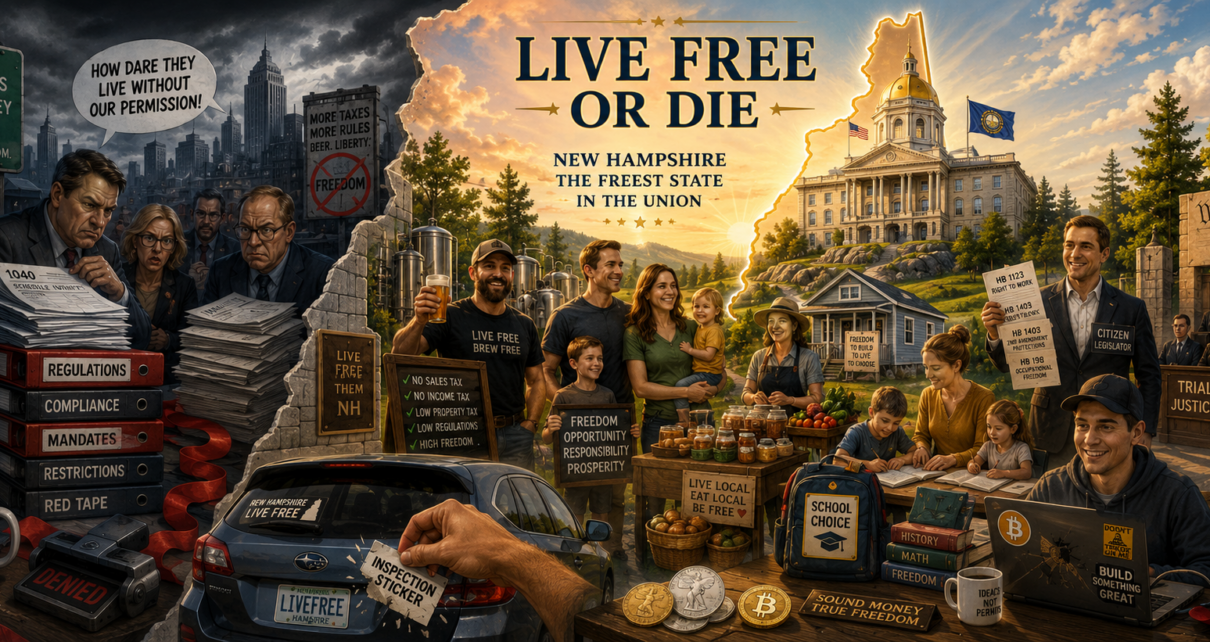
However, the Free State Project began with a more modest and therefore more dangerous idea: that free men and women should stop scattering themselves like seed upon salted earth and instead gather where their numbers might actually matter! Its genius was not merely libertarian; it was cold, calculated… and arithmetic. One liberty-minded citizen in California is a polite sigh. One or two in Massachusetts is a curiosity. But ten thousand strong living in New Hampshire are a faction, a neighborhood, a school-board race, a business community, a church supper, a legislative whip count, and essentially… a movement! We just needed to choose the right place to all congregate. So we selected the glorious state of New Hampshire…
Let me be perfectly clear, New Hampshire was not chosen by accident. It was already the least ridiculous place in New England: no broad-based personal income tax, no general sales tax, a vast citizen legislature, a jealous localism, a constitutional memory, and that blessedly impolite motto, “Live Free or Die,” which in any other state would be reduced by committee to “Live Safely and Submit Forms to the Crown.” The Free State Project did not invent New Hampshire’s spirit. No, not at all. But it recognized it, embraced it, enhanced it, and then began the work of making that simple slogan into policy.
The results are no longer theoretical. Free Staters and their allies have become legislative leaders, activists, candidates, committee members, donors, organizers, and nuisances of the most productive sort. The House Majority Leader, Jason Osborne, is himself a Free State migrant. The New Hampshire Liberty Alliance, though distinct from the Free State Project, has become one of the cheif scorekeepers and organizing centers of this broader liberty coalition. Its annual ratings judge legislators by recorded votess on individual rights, economic freedom, transparensy, constitutional limits, and resistance to coercive government. In 2025, only 18 House members earned A+ ratings, but the larger liberty-aligned block was widely described as representing roughly half of the Republican caucus. That is not yet 250 legislators. But it is something more useful than folklore, and certainly enough influence to move bills!
And move bills they have! New Hampshire passed constitutional carry through SB12 in 2017, eliminating the requirement that peaceful citizens obtain a license before carrying a concealed pistol or revolver. In the language of polite government, this was a “gun rights bill.” In the older and more pure language of free people, it was the restoration of a presumption. It claims proudly that the citizen is not a ward of the police chief!
The state enacted civil asset forfeiture reform through SB522 in 2016, making it harder for the government to seize property without the due process protections that civilized people once thought rather important. No, it was not the final abolition of the practice, but it was a material retreat by the state from one of its more tyrannical habits. New Hampshire also passed HB 146, the jury-nullification statute, allowing defense counsel in criminal cases to tell jurors that they may judge not only facts but the application of the law to those facts. This is a terrrifying proposition to those who believe justice is what remains after conscience has been removed from the jury box.
It decriminalized possession of small amounts of marijuana through HB640 in 2017, reducing a criminal misdemeanor into a civil violation for possession of three-quarters of an ounce or less. This was not full legalization, but it did spare peaceful citizens from criminal arrest for a plant, which is not a revolution but is at least a recovery from madness.
New Hampshire repealed its Interest and Dividends Tax, with the phaseout enacted in HB2 in 2021 and the repeal finally made effective January 1, 2025. This made New Hampshire one of the few states with neither a tax on wages nor a tax on personal investment income. A government that taxes thrift punishes the ant and subsidizes the grasshopper. And New Hampshire, for once, miraculously chose not to eat the ant.
The same 2021 budget reduced business taxes, including reductions to the Business Profits Tax and Business Enterprise Tax. Such things are often described in bloodless fiscal language, but the moral question is simple: shall the state make it easier or harder for men and women to build, hire, risk, fail, recover, and build again?
Education Freedom Accounts, created through SB130 in 2021, marked one of the largest philosophical victories of the liberty movement. The program allows eligible families to direct education funds toward private school, homeschooling, tutoring, online programs, and other approved educational expenses. Lessor informed critics naively call this an assault on public education. However, supporters call it what it is: the end of a hostage arrangement in which the child is assigned, the parent is billed, and the bureaucracy declares itself benevolent.
New Hampshire has also advanced repeated expansions of school choice, charter-school flexibility, parental rights proposals, and transparency measures in school curricula and administration. Not every proposal has passed, and not every passed reform is perfect, but the direction is unmistakable: away from the factory model of compulsory institutional confidence and toward the older doctrine that children belong first to families, not departments.
The state even repealed its mandatory passenger-vehicle inspection regime through the 2025 budget process, with the repeal scheduled to take effect in 2026, provided federal government encroachment does not delay its rollout. HB649 carried the underlying idea of ending the annual ritual by which citizens must pay for permission to continue driving cars they already own. The captive slave may argue prudently about road safety, but one may also notice how often “safety” becomes the hymn sung before every small extraction. Benjamin Franklin said much on this topic but few stop long to listen.
New Hampshire became the first state to enact a strategic reserve law authorizing the state treasury to invest limited public funds in precious metalss and qualifying digital assets through HB 302 in 2025. This was not merely a Bitcoin novelty bill; it was a shot across the bow of monetary complacency. It was a small state admitting what the empire’s economists dare not say too loudly: that fiat money is not divine scripture.
Occupational licensing reform has also advanced. New Hampshire enacted universal license recognition, making it easier for licensed professionals from other states to work without submitting to duplicative credentialing rituals. The state has also reduced licensing burdons for natural hair braiders and removed barriers for people with criminal records seeking licensed work. This is what liberty often looks like in practice: not a statue, not a slogan, but a woman allowed to braid hair without first getting on her knees and begging a board of elites for their permission.
Food freedom has gained ground as well. HB119 removed the saless cap that had triggered licensing requirements for many home-based food operations, preserving restrictions on certain foods and sales channels but freeing more small producers to sell homemade goods without bureaucratic harassment. A free society is one in which a neighbor may sell bread without first being treated as a biological weapons program.
The state has liberalized alcohol and brewing rules. SB125 eased restrictions on beverage manufacturers, lifted certain direct-sale limits, permitted satellite retail locations, and helped nano-breweries and small producers survive in a system too often designed by and for encumbents. New Hampshire’s craft-beer reforms are a reminder that liberty is not always thunderous. Sometimes it is a small brewer finally allowed to sell what he made.
New Hampshire repealed its switchblade and knife restrictions through HB1665 in 2010, removing bans on switchblades, dirks, daggers, and stilettos. Later, HB1178 in 2022 prohibited state enforcement of federal restrictions that infringe the right to keep and bear arms, including knives. This may sound minor to those who possess armed guards, but to ordinary citizens it says something profound: the state shall not treat every tool as contraband merely because a coward can imagine untold danger.
Housing reform has also begun to emerge as a liberty issue. Accessory dwelling unit reforms require municipalities to allow ADUs where single-family homes are permitted, and later proposals have pushed against parking mandates, exclusionary zoning, and local rules that strangle housing supply while lamenting its scarcity. The liberty argument here is plain: if a man owns land but may not build, rent, divide, add, or house his own family upon it without municipal indulgence, then he merely owns a suggestion, not real property.
I could go on and on with other successful endeavors. But of course the track record is also checkered with losses as well. There have been pro-liberty proposals that did not pass, or passsed only in part. And these too matter. Right-to-work legislation has repeatedly advanced and failed, often by narrow margins. Full cannabis legalization has passed the NH House in various forms but stalled in the Senate. Stronger asset forfeiture abolition, broader school-choice expansion, deeper tax cuts, local spending restraints, regulatory sandboxes, cryptocurrency protections, privacy bills, and federalism measures have all appeared in one form or another. Yet I believe a movement should not be judged only by its trophies, but by the philosophical and righteous frontier on which it fights!
Allow me to give short pause to fully admit that not every achievement is uniquely attributable to the Free State Project alone. That would be false and far too neat a narrative. New Hampshire’s liberty victories are the work of natives, migrants, Republicans, Libertarians, independents, policy groups, parents, taxpayers, homeschoolers, gun owners, entrepreneurs, and legislators who may never have signed any Free State pledge. But the Free State Project supplied much-needed concentration. It gave scattered dissidents a geography. It gave liberty a home. It turned temperament into neighborhood, neighborhood into network, network into caucus, and caucus into law.
This is the difference between romance and strategy. The national “L”ibertarian project has all too often been content to be right in public and wrong at the ballot box. The LNC gives itself a self-serving pat on the back every time it gets a few libertarian on obscure ballots and then, after getting 1% of the vote, says “gee, too bad, but you made us proud!” However, the Free State Project tries something a bit more salacious and far for audacious: results. It attempts the less glamorous work of being effective in one single place. It does not ask “How shall we persuade America by November?” but instead “Where can our lives, businesses, votes, friendships, families, and institutions compound over decades?”
The alternatives have had their trial by fire. Presidential campaigns educate and quietly disappear. Think tanks publish and are ignored by men who vote on unread bills at midnight. Lawsuits occasionally win, but only after the citizen has first been injured. Third partys keep the flame but rarely seize the machinery. Online movements create heat, then ash. Waiting for national collapse is not a strategy at all, but an eschatology for men who have confused despair with wisdom.
The Free State Project is profoundly different because it is incarnational. It does not merely preach liberty; it MOVES liberty into one place. It puts the homeschool family, the Bitcoin developer, the gun-rights activist, the small landlord, the brewer, the dissident teacher, the zoning reformer, the taxpayer, the legislator, and the cheerful crank within driving distance of one another. It creates the possibility of dinner, and dinner is more politically important than another bland manifesto. And it’s a hell of a lot more important than cheering for 3% at the national ballot.
The FSP theory is beautifully simple and beautifully circular. Liberty attracts talent. Talent builds wealth. Wealth funds institutions. Institutions protect liberty. Protected liberty attracts more talent. The state grows freer, and because it grows freer, it grows more successful; because it grows more successful, it becomes harder to mock and easier to imitate. And at some crucial point the sneer becomes curiosity, curiosity becomes migration, and migration becomes …destiny!
This is why New Hampshire matters. Not because it is perfect. It is not. Not because every Free Stater is wise. They definitely are not. Nor because every liberty bill passes. Many fail. But because here, here alone in America, the liberty movement has chosen the one strategy that nature, history, and arithmetic all respect: results and concentration.
Let Washington have its blood-soaked marble temples and trillion-dollar confessionals. Let the national parties continue their ancient contest over who shall hold the bullwhip. Let the professional reformers convene another panel on restoring civic trust. Because in New Hampshire, a smaller and more practical revolution proceeds by roll-call vote, town meeting, homeschool coop, gun range, brewery, zoning heering, Bitcoin meetup, school-board race, and neighborly persistence.
The Free State Project is not merely a plan to make New Hampshire freer. Yes, that too, but it is also so much more. It is a plan to prove that freedom still works when tried! If New Hampshire succeeds, it will not need to conquer the other states. It will shame them by comparison! It will stand as a rebuke to every bloated jurisdiction that insists decline is inevitable, theft via taxation is destiny, regulation is compassion, and liberty is a childish dream.
And should our little republic continue to prosper, the rest of America may one day discover, with great embarrassment, that the path forward was not hidden in Washington at all. It was waiting in the green hills and friendly town halls of New Hampshire, where enough free people finally gathered to become unignorable and completely ungovernable.
Appendix: A Partial Inventory of Pro-Liberty Bills Passed or Advanced in New Hampshire:
The proof of the Free State strategy is not found merely in rhetoric, nor in the warm intoxication of hearing one’s own principles repeated back in a hotel ballroom. It is found in bills. It is found in roll calls. It is found in those dry little instruments by which the state either withdraws its hand from the citizen’s throat or tightens its fingers. Since the Free State Project began sending liberty-minded citizens into New Hampshire, and especially since those citizens became woven into the broader New Hampshire liberty movement, the state has seen an extraordinary procession of pro-freedom bills passed, advanced, or repeatedly proposed.
What follows is not everry liberty bill ever introduced in Concord. Such a list would become less an appendix than a hayloft. But it is a substantial map of the movement’s victories and its ambitions.
I. Tax Freedom and Fiscal Restraint
- Repeal of the Interest and Dividends Tax — New Hampshire phased out and repealed its tax on interest and dividend income, making the state genuinely income-tax-free for wages, interest, and dividends.
- Business Profits Tax reductions — The state reduced the Business Profits Tax, lightening the burden on companies that earn, hire, expand, and reinvest.
- Business Enterprise Tax reductions — New Hampshire reduced the tax burden on enterprise activity, payroll, and business operations.
- Protection against broad-based income and sales taxes — Pro-liberty legislators have repeatedly fought proposals to impose a general income tax or sales tax, preserving one of New Hampshire’s chief economic advantages.
- Budget restraint and spending caps — Liberty-aligned legislators have repeatedly pushed for lower spending, tighter budgets, and restraints on state growth.
- Local tax-cap proposals — Pro-liberty legislators have backed efforts to allow or strengthen local tax caps, restraining municipal spending and property-tax growth.
- Opposition to expanded state aid schemes that drive local dependence — Liberty legislators have often opposed funding formulas that increase state centralization and future tax pressure.
- Property-tax relief proposals through spending discipline — The liberty bloc has consistently argued that property-tax relief cannot come from moving taxes around, but from restraining government itself.
II. Education Freedom and Parental Rights
- Education Freedom Accounts — New Hampshire created Education Freedom Accounts, allowing eligible families to direct state education funds toward approved alternatives such as private school, homeschooling, tutoring, online learning, special education services, and other educational expenses.
- Universal expansion of Education Freedom Accounts — New Hampshire later expanded the EFA program, moving toward universal eligibility for K–12 students.
- Tax-credit scholarship expansion — New Hampshire has maintained and expanded scholarship programs that allow private donations to support educational choice.
- Town-tuitioning and local school-choice measures — Pro-liberty legislators have supported allowing towns without certain public-school options to send students to alternative schools.
- Charter-school protections and expansion — Liberty legislators have repeatedly backed charter-school funding, autonomy, and expansion.
- Homeschool protections — New Hampshire’s liberty movement has defended homeschooling from intrusive regulation and supported parental authority over education.
- Parental bill-of-rights proposals — Legislators have proposed and advanced bills requiring schools to respect parental rights in matters of curriculum, records, health decisions, and student identity policies.
- Curriculum transparency bills — Pro-liberty lawmakers have backed legislation requiring greater public access to school curricula, instructional materials, and administrative policies.
- Opposition to compelled ideological instruction — Liberty legislators have repeatedly opposed state or school policies that compel speech, ideological conformity, or political indoctrination.
- Opt-out protections for parents and students — Pro-liberty legislators have backed measures allowing parents to remove children from objectionable instruction or programs.
III. Gun Rights, Self-Defense, and the Right to Bear Arms
- Constitutional carry — New Hampshire repealed the requirement that law-abiding citizens obtain a license before carrying a concealed pistol or revolver.
- Strengthening reciprocity for carry licenses — Constitutional carry legislation also preserved licensing for reciprocity purposes, helping New Hampshire citizens carry in other jurisdictions where licenses are still recognized.
- Protection against local firearms restrictions — Pro-liberty legislators have supported state preemption and opposed local gun-control ordinances.
- Opposition to “red flag” confiscation laws — Liberty legislators have repeatedly opposed laws allowing firearms to be seized without traditional due-process protections.
- Campus carry proposals — Pro-liberty legislators have advanced efforts to prevent public colleges and universities from disarming law-abiding citizens.
- Protection for firearms rights of medical cannabis patients — Bills have been proposed to prevent patients from being stripped of gun rights merely because they participate in therapeutic cannabis programs.
- Prohibition on state enforcement of certain federal firearms restrictions — New Hampshire enacted legislation barring state enforcement of federal laws or regulations that infringe the right to keep and bear arms.
- Repeal of knife restrictions — New Hampshire repealed restrictions on switchblades, dirks, daggers, and stilettos.
- Protection of knife rights against federal infringement — New Hampshire later strengthened protections against enforcement of certain federal restrictions affecting knives and arms.
IV. Criminal Justice, Due Process, and Civil Liberties
- Civil asset forfeiture reform — New Hampshire enacted reforms making it harder for the government to seize property without due process.
- Jury nullification protection — New Hampshire passed a law allowing defense counsel to inform jurors of their right to judge the application of the law to the facts.
- Marijuana decriminalization — New Hampshire reduced possession of small amounts of cannabis from a criminal misdemeanor to a civil violation.
- Therapeutic cannabis legalization — New Hampshire created a medical cannabis program, allowing qualifying patients to possess and obtain cannabis through regulated dispensaries.
- Therapeutic cannabis expansion proposals — Lawmakers have repeatedly proposed expanding possession limits, qualifying conditions, patient protections, and home-grow rights.
- Adult-use cannabis legalization bills — The New Hampshire House has passed or advanced multiple versions of adult-use cannabis legalization, though full legalization has repeatedly stalled before final enactment.
- Police accountability proposals — Liberty legislators have backed reforms increasing transparency, discipline, and public access to police misconduct records.
- Body-camera and police-record transparency measures — Pro-liberty lawmakers have supported measures to increase accountability in law enforcement.
- Bail reform proposals — Liberty legislators have supported limiting pretrial detention for people not convicted of crimes, while the issue remains contested in New Hampshire politics.
- Opposition to warrantless surveillance — Pro-liberty legislators have repeatedly opposed expansions of government surveillance authority.
- Privacy protections for electronic data — Bills have been proposed to require warrants or stronger procedural protections before government access to digital information.
- Limits on license-plate readers and automated surveillance — Liberty legislators have advanced or supported efforts to restrain automatic tracking technologies.
- Resistance to emergency-power abuse — Pro-liberty lawmakers have proposed limits on executive emergency powers, especially after COVID-era shutdowns and mandates.
- Religious-liberty protections during states of emergency — Liberty legislators backed measures preventing houses of worship from being treated worse than secular institutions during emergencies.
- Opposition to vaccine mandates and medical coercion — Pro-liberty legislators advanced proposals limiting government or employer power to compel medical procedures.
- Protection against mask mandates and school-health mandates — Bills have been filed to prevent broad coercive public-health rules from being imposed without legislative accountability.
V. Economic Liberty and Occupational Freedom
- Universal occupational license recognition — New Hampshire enacted reforms allowing licensed professionals from other states to obtain New Hampshire licenses more easily when their credentials are substantially similar and in good standing.
- Temporary licensing reforms for out-of-state workers — Earlier reforms helped workers begin practicing while navigating New Hampshire licensing requirements.
- Second-chance occupational licensing reform — New Hampshire enacted protections limiting the ability of licensing boards to deny people work merely because of past criminal records unrelated to the occupation.
- Predetermination for occupational licenses — Applicants with criminal records may seek a determination before spending time and money on training for a license.
- Reduction of licensing burdens for low-risk occupations — Liberty legislators have supported deregulation of occupations where licensing functions primarily as protectionism.
- Hair-braiding and cosmetology deregulation efforts — Pro-liberty lawmakers have backed reducing absurd barriers for natural hair braiders and similar low-risk personal-service occupations.
- Interstate licensing compacts — New Hampshire has joined or considered compacts making it easier for professionals to work across state lines.
- OPLC restructuring and efficiency reforms — Legislators have advanced changes to make professional licensing faster, cheaper, and less arbitrary.
- Regulatory sandbox proposals — Liberty legislators have supported allowing entrepreneurs to test new business models without first being strangled by outdated regulations.
- Right-to-work legislation — Right-to-work bills have repeatedly advanced in New Hampshire, though they have not yet become law.
- Reduction of fees and administrative barriers — Liberty-aligned legislators have frequently opposed fee increases and supported cutting licensing costs.
VI. Food Freedom, Agriculture, and Small Enterprise
- Homestead food freedom reforms — New Hampshire allows many homemade food producers to sell without a state license if they meet statutory requirements.
- Expansion of cottage-food sales — Pro-liberty reforms have expanded the ability of small producers to sell homemade foods.
- Removal or increase of sales caps for homestead food operations — Liberty legislators have supported removing arbitrary thresholds that force small producers into expensive licensing regimes.
- Farmers-market freedom — Liberty-aligned reforms have protected the ability of small producers to sell directly to consumers.
- Raw milk freedom proposals — Bills have been filed or supported to protect farm-to-consumer food choice in raw milk and related products.
- Meat-processing and local agriculture deregulation proposals — Pro-liberty legislators have supported easing burdens on small farms and local food producers.
- Home kitchen and microenterprise reforms — Liberty lawmakers have supported allowing citizens to earn money from their own kitchens and homes without being treated as industrial-scale operations.
VII. Housing, Property Rights, and Local Control
- Accessory dwelling unit reforms — New Hampshire required municipalities to allow accessory dwelling units where single-family homes are permitted.
- Further ADU liberalization proposals — Pro-liberty legislators have backed expanding ADU rights and limiting municipal obstruction.
- Zoning reform proposals — Liberty legislators have supported reducing exclusionary zoning rules that prevent property owners from building housing.
- Parking-mandate reform proposals — Bills have been advanced to prevent towns from using parking requirements to block housing and small business.
- Minimum-lot-size reform proposals — Liberty legislators have supported limiting excessive lot-size rules that make housing artificially scarce.
- By-right housing proposals — Lawmakers have advanced efforts to allow certain housing types without endless discretionary approval.
- Protection of property owners from arbitrary local boards — Liberty legislators have supported clearer rules, deadlines, and appeal rights in land-use regulation.
- Opposition to rent control — Pro-liberty lawmakers have resisted policies that would further distort housing supply.
- Limits on eminent domain abuse — Pro-liberty legislators have backed measures protecting property owners from takings for private or politically favored projects.
VIII. Transportation and Personal Mobility
- Repeal of mandatory passenger-vehicle inspections — New Hampshire enacted repeal of the annual inspection requirement for passenger vehicles, ending a costly and paternalistic mandate.
- Opposition to seat-belt mandates for adults — New Hampshire remains the only state without a mandatory adult seat-belt law, and liberty legislators have defended that position.
- Opposition to motorcycle helmet mandates for adults — Liberty legislators have resisted helmet mandates and preserved adult choice.
- Driver-fee and registration-fee restraint — Liberty legislators have repeatedly opposed increasing fees on motorists.
- Resistance to automated traffic enforcement — Pro-liberty lawmakers have opposed camera-based enforcement and revenue-driven traffic surveillance.
- Protection against mileage taxes and travel-monitoring schemes — Liberty legislators have opposed taxation or surveillance systems tied to tracking how citizens move.
IX. Money, Cryptocurrency, and Financial Freedom
- Strategic reserve in precious metals and qualifying digital assets — New Hampshire enacted HB 302, authorizing the state treasurer to invest a limited portion of public funds in precious metals and qualifying digital assets.
- Blockchain and cryptocurrency business protections — New Hampshire has considered or advanced bills protecting blockchain businesses from being treated as traditional money transmitters when inappropriate.
- Cryptocurrency tax and regulatory clarity proposals — Liberty legislators have backed clearer, lighter rules for digital-asset businesses.
- Gold and silver legal-tender proposals — Bills have been proposed to recognize or facilitate the use of precious metals as money.
- Opposition to central bank digital currency cooperation — Liberty lawmakers have supported measures resisting CBDC infrastructure and protecting financial privacy.
- Protection of financial privacy — Pro-liberty legislators have opposed unnecessary reporting, monitoring, and financial surveillance.
X. State Sovereignty, Federalism, and Limits on Central Power
- Defend the Guard legislation — Pro-liberty lawmakers have supported requiring formal congressional authorization before New Hampshire National Guard units are deployed into foreign combat.
- Anti-commandeering proposals — New Hampshire legislators have advanced bills refusing state cooperation with unconstitutional or overreaching federal mandates.
- Federal firearms non-enforcement — New Hampshire enacted protections against state enforcement of certain federal firearms restrictions.
- Opposition to federalized election mandates — Liberty legislators have opposed federal attempts to control state election processes.
- State constitutional amendment proposals — Pro-liberty legislators have backed amendments protecting taxpayers, gun owners, parents, and property owners.
- Nullification and interposition proposals — Bills have been proposed asserting New Hampshire’s power to resist unconstitutional federal action.
- Restraints on executive emergency powers — Liberty lawmakers have repeatedly sought to return emergency authority from governors and agencies back to the legislature.
- Legislative oversight of federal grants — Pro-liberty legislators have pushed for more scrutiny before accepting federal money that brings federal strings.
XI. Speech, Association, and Civic Freedom
- Campus free-speech proposals — Pro-liberty legislators have backed protections for speech at public colleges and universities.
- Anti-compelled-speech legislation — Bills have been proposed to prevent government institutions from forcing citizens, students, or employees to affirm ideological statements.
- Protection of political speech and association — Liberty legislators have opposed campaign-finance and disclosure rules that chill political participation.
- Right-to-know reforms — New Hampshire legislators have backed stronger public-records access and government transparency.
- Open-meetings enforcement reforms — Pro-liberty lawmakers have supported making local and state bodies more accountable under open-meeting laws.
- Transparency in state contracts and spending — Bills have been proposed to expose more state spending to public review.
- Protection for anonymous pamphleteering and advocacy — Liberty lawmakers have opposed measures that burden private political advocacy.
XII. Health Freedom and Personal Autonomy
- Medical cannabis legalization and reform — New Hampshire legalized therapeutic cannabis and has continued debating expansions.
- Home-grow proposals for medical cannabis patients — Liberty legislators have repeatedly supported allowing patients to cultivate cannabis at home.
- Opposition to medical mandates — Pro-liberty legislators have filed bills limiting compulsory vaccination, masking, or medical disclosures.
- Conscience protections — Bills have been proposed to protect individuals and institutions from being forced to participate in procedures or policies that violate conscience.
- Right-to-try and medical access proposals — Liberty legislators have supported allowing patients greater access to experimental or alternative treatments.
- Telehealth deregulation — Pro-liberty lawmakers have supported reducing barriers to remote medical care.
- Certificate-of-need repeal or reform proposals — Liberty legislators have backed efforts to reduce state control over health-care supply and competition.
XIII. Energy, Environment, and Consumer Choice
- Opposition to costly energy mandates — Liberty legislators have opposed renewable mandates and energy rules that raise consumer costs.
- Net-metering and energy-choice debates — Pro-liberty lawmakers have supported consumer choice and opposed special-interest energy regulation.
- Wood stove and home-heating freedom proposals — Bills have been proposed to protect traditional home heating from excessive regulation.
- Resistance to California-style vehicle mandates — Liberty legislators have opposed electric-vehicle mandates and emissions rules imported from more regulatory states.
- Property-owner protections in environmental regulation — Pro-liberty lawmakers have supported balancing environmental law against property rights and due process.
XIV. Local Government, Elections, and Democratic Accountability
- Local spending transparency proposals — Liberty legislators have backed clearer disclosure of town, school, and county spending.
- School-district budget restraint — Pro-liberty lawmakers have supported caps, transparency, and taxpayer oversight in school budgets.
- Election integrity proposals — Bills have been filed requiring stronger voter identification, citizenship verification, and ballot-security measures.
- Opposition to ranked-choice voting — Many liberty legislators have opposed election systems they view as confusing or manipulable.
- Ballot-access reforms — Libertarian and liberty-aligned legislators have supported easing access for minor parties and independent candidates.
- Recall and removal proposals — Bills have been proposed to make public officials more accountable to voters.
- Local-option flexibility — Pro-liberty legislators have often supported allowing towns more flexibility to govern themselves rather than submit to uniform state mandates.