by Sean Dempsey | 06/05/26
The Great Uncoupling
We are living through a strange and exhausted age: an age in which almost every ancient anchor has been pulled from the seabed and cast adrift.
Truth is no longer truth, but perspective. Morality is no longer morality, but preference. Value is no longer value, but momentum. Money is no longer stored labor, accumulated prudence, or a claim on real production, but a symbol floating above the earth like a weather balloon cut loose from its string. Right and wrong are not abolished, exactly; they are personalized. Nor is reality denied outright; rather, it is negotiated, litigated, and eventually rebranded.
This is not merely a political crisis. It is not merely a monetary crisis. It is not merely a cultural crisis; it is a metaphysical crisis. The modern world no longer agrees on what is truly real.
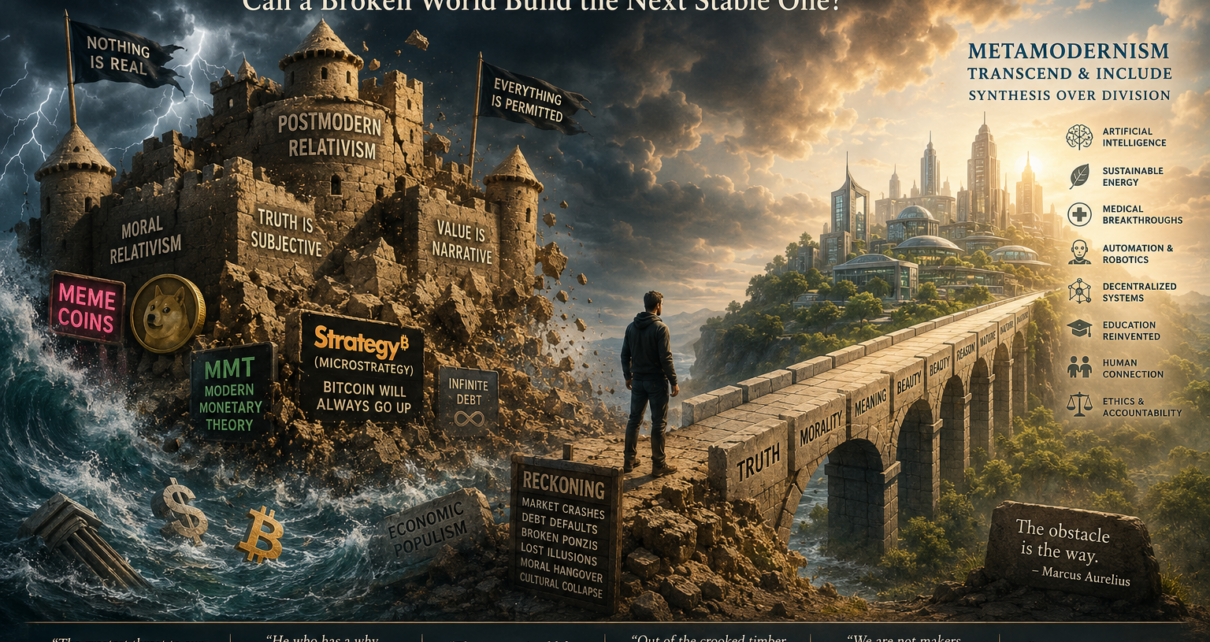
That may sound melodramatic until one looks at the evidence. Meme-coins, created openly as jokes, have commanded tens of billions of dollars in market value. Modern Monetary Theory, once a fringe doctrin, has entered the respectable bloodstream of policy discussion, whispering that sovereign debt is not really debt in the old vulgar sense, provided the printer can still hum. Corporations such as Strategy (formerly MicroStrategy) have transformed themselves from ordinary operating companies into leveraged religious vehicles for Bitcoin accumulation, selling the market not merely a product, but a prophecy: Bitcoin will go up forever, and therefore borrowing billions to buy it is not madness but vision.
Then comes the final absurdity: financial products built atop that promise, offering investors yield from the machinery of belief itself. A dividend paid from the architecture of speculation. Income from conviction. Cash flow from metaphysics.
This is economic populism in its purest form: the revolt against valuation. The crowd declares value into being, and the institution then builds a balance sheet around the declaration. It is a trillion-dollar castle built on shifting sand at the edge of an ocean, while the tide is already moving in.
But the financial world is only the most visible symptom. Culturally, we have seen the same uncoupling. Biology is treated as oppressive if it refuses to yield to identity. Moral judgment is treated as bigotry if it implies hierarchy. Even scientific truth is often permitted only so long as it obeys the preferred moral narrative. Postmodernism began by warning us that power hides beneath claims of truth. It ended by teaching millions that truth itself is only power wearing a stained lab coat.
The ancient Greeks would have recognized the danger immediately. Plato’s great fear was not tyranny but sophistry: the triumph of persuasion over truth. In both The Republic and Gorgias, he warned that a society unable to distinguish appearance from reality eventually falls under the rule of storytellers. Once opinion becomes superior to truth, rhetoric becomes superior to wisdom. The most persuasive man defeats the most honest man. And the most entertaining explanation defeats the most accurate one.
The postmodern mind often replies that truth itself is merely another narrative. Yet Plato’s concern was precisely that argument. Once a civilization ceases to believe there is any reality beneath appearances, politics becomes theater, economics becomes theater, and eventually identity becomes theater. One need not embrace Plato’s entire philosophy to recognize that his warning feels remarkably contemporary. In many ways, ours isa civilization increasingly unable to distinguish between value and valuation, truth and narrative, substance and spectacle.
We should not be surprised that financial markets have become theatrical. They are operating inside a civilization that increasingly treats reality itself as a negotiable proposition.
This Is Not a Libertarian Critique
It is important to say what this argument is not…
This is not primarily a libertarian complaint. A libertarian analysis would say: let the market of ideas operate. Let men buy meme-coins, leverage corporations, invent pronouns, form communes, publish theories, and suffer the consequences of their own experiments. A free society must permit folly because the alternative is an authority empowered to define wisdom.
That is true as far as it goes. But it does not go far enough. The deeper question is not whether people should be free to believe absurd things. Of course they should. The deeper question is why absurd things have become so plausible to so many, and why institutions that once existed to discipline fantasy now amplify it.
The libertarian sees liberty. The philosopher sees atmosphere.
A society does not value things in a vacuum. It values them through a cultural operating system. When that operating system says value is subjective, truth is constructed, morality is contingent, and reality is downstream from narrative, we should not be shocked when financial markets begin behaving like sociology seminars with trading terminals.
The meme stock, the meme coin, the infinite-deficit theory, the Bitcoin treasury company, the identity category that multiplies beyond all contact with biology: these are not isolated phenomena. They are cousins. They are children of the same parent. Each says, in its own dialect, that inherited limits are illegitimate and that reality must yield to assertion.
The old world believed value had to answer to something outside itself: earnings, production, scarcity, virtue, nature, God, reason, duty, beauty, family, nation, civilization. The postmodern world replies: who are you to say?
And when no one is permitted to say, the loudest bidder becomes philosopher-king.
What we are witnessing, therefore, is not merely a financial phenomenon. It is a philosophical phenomenon. The speculative economy is not separate from the culture. It is the culture made visible. The same assumptions that untether identity from biology also untether value from production. The same assumptions that reduce truth to narrative eventually reduce money to narrative. The same intellectual habits that dissolve moral foundations eventually dissolve economic ones.
The economy is often described as a machine. It may be more accurate to describe it as a tarnished mirror.
The Metamodern Need
I’ve often lamented and written that postmodernism is not the final stage of cultural development. It is a bridge, not a home. A necessary acid, perhaps, but not a full meal. It dissolves false certainties, exposes hypocrisy, and teaches suspicion toward systems that once pretended to be neutral while smuggling in power. For that, it had its limited use.
But acid cannot become architecture!
A civilization cannot live forever on critique. It cannot raise children on irony. It cannot build institutons on suspicion alone. It cannot defend truth while declaring truth oppressive. It cannot maintain money, law, science, family, art, or moral courage if every foundation is treated as a social construction waiting to be deconstructed by the next credentialed vandal.
This is where metamodernism enters as possibility. Metamodernism is not a simple returne to old certainty. It is not nostalgia in academic clothing. It does not say “Let us pretend postmodernism never happened.” That would be impossible or perhaps even childish. The old innocence is gone. The village priest, the central banker, the professor, the journalist, the scientist, the corporate board, the politician: all have been seen too closely now. Their robes are stained. Their incentives are visible.
But metamodernism says something braver than cynicism. It says that after deconstruction must come reconstruction. After irony must come sincerity. After relativism must come earned conviction. After the collapse of naive truth must come a humbler, wiser, more self-aware truth.
Truth must mean something again. Morality must mean something again. Value must mean something again. Not because we are too stupid to see complexity, but because we are too wise to worship chaos.
This is perhaps the central insight of the emerging metamodern movement. My dear younger brother and scholar, Brendan Graham Dempsey, frequently describes cultural evolution as a process that must “transcends and includes.” The next worldview does not simply destroy its predecessor; it preserves what was valuable while overcoming what was limiting.
I believe that distinction is critically important. Postmodernism revealed genuine problems. It exposed institutional corruption. It demonstrated that claims to objectivity often conceal assumptions. It reminded us that certainty can become tyranny. Those lessons cannot simply be forgotten. Yet neither can they become the permanent foundation of civilization.
A culture cannot survive forever in a state of deconstruction. Brendan’s vision is therefore not a return to modern certainty or premodern faith. It is an attempt to recover meaning after skepticism, sincerity after irony, and commitment after relativism. It seeks not the innocence that existed before postmodernism, but a wiser innocence that emerges after it.
In this sense, metamodernism is not ‘anti-postmodern.’ It is postmodernism growing up. Waking up. Evolving.
The Coming Purge of Fantasy
The transition will not be gentle.
Civilizations do not usually abandon their delusions because someone wrote a persuasive essay. They abandon them when the delusions become too expensive to maintain. The lie dies when the invoice arrives.
The speculative economy will almost certainly have its reckoning. Crypto will not vanish, but it will be violently sorted. The dollar may not die, but it will be humiliated. The cult of infinite liquidity will meet the discipline of scarcity. The companies that borrowed against belief will discover that belief, like oxygen, is not noticed until it is gone. Structures built on permanent appreciation will face the oldest question in finance: what happens if it goes down?
And when these financial illusions break, they will not break alone. Economic populism and moral relativism are spiritually linked. Both are rebellions against constraint. Both insist that desire can overrule reality. Both confuse naming with creating. Both mistake social agreement for metaphysical truth.
The end of the bubble economy may therefore become more than a market event. It may become a philosophical event.
People who watched “value” vanish from assets they were told could only rise may begin asking whether value was ever as subjective as they were told. People who watched institutions lie, inflate, print, and manipulate may begin asking whether morality can really be reduced to power. People who watched identity, money, language, and truth all become unstable at once may rediscover the old hunger for foundations.
The collapse will be economic. But the wound will be religious.
History suggests that civilizations rarely abandon illusions voluntarily. They usually abandon them when reality makes the cost unbearable. The South Sea Bubble ended because arithmetic eventually defeated enthusiasm. The “tulip mania” faded away because value became recoupled with reality. The railway manias ended because projected profits failed to materialize. The .com bubble ended because internet traffic proved easier to generate than sustainable business models. The housing bubble ended because debt, however cleverly repackaged, remained debt.
Every speculative era begins with a genuine insight. Every speculative era then extends that insight beyond all reasonable limits. The eventual crash is not the failure of the original idea. It is the failure of exaggeration. This observation may prove especially relevant to our own moment. Cryptocurrency may survives. Artificial intelligence may survive. Decentralized networks may survive. New forms of digital coordination may survive.
But the fantasies built around them almost certainly will not. Because reality, my friend, has an undefeated record!
Brutal Irony: The Postmodern Bubble May Fund the Metamodern Bridge!
And yet here is the strange, almost comic possibility: the very bubble economy that reveals the bankruptcy of postmodern culture may also finance the tools of the next order. This may prove to be the greatest irony at the center of our postmodern age.
Speculative mania, cheap money, moral confusion, and valuation absurdity may pour capital into technologies that eventually make a more stable civilization possible. Artificial intelligence, automation, energy systems, medical breakthroughs, decentralized ledgers, robotics, new educational models, new governance tools, new forms of coordination. Many of these may be overfunded, mispriced, fraudulently promoted, and surrounded by charlatans. And yet some of them will be real.
The canal mania helped build canals. The railroad bubbles helped build railroads. The dot-com bubble gave us Pets.com, yes, but also the fiber-optic bones of the internet age. Speculation often arrives dressed as insanity, burns fortunes in public, humiliates the credulous, and then leaves behind infrastructure that sober men later use.
This is not a defense of fraud. It is not a hymn to bubbles. It is merely an observation about history: man often builds the future with motives too impure to deserve it.
Schumpeter called capitalism’s central fact “creative destruction.” Long before Schumpeter, Heraclitus proposed a similarly unsettling idea. “War is the father of all things,” he penned. He was not glorifying violence; he was describing a feature of reality itself. Opposites create tension. Tension generates movement. Movement initiates transformation!
The bow functions because opposing forces pull against one another. The lyre produces music because strings exist in tension. Life itself emerges through perpetual conflict and adaptation. Civilizations may not be very different.
The philosopher Hegel later transformed this intuition into a theory of historical development. Every system contains contradictions. Those contradictions eventally become impossible to ignore. The resulting conflict does not merely destroy the old order. Sometimes it creates the conditions for a brand new one.
This possibility sits at the heart of the metamodern wager. The speculative excesses of postmodern culture may be generating precisely the contradictions necessary to move beyond postmodernism itself.
So the question is not whether chaos can produce order. It can. The question is whether it will. For chaos does not automatically become order. Sometimes chaos becomes barbarism. Sometimes decadance becomes collapse and nothing more. Sometimes Rome falls and the aqueducts break and the libraries burn. Sometimes the dancing star is stillborn.
This is the danger of excessive optimism. The fact that previous bubbles produced infrastructure does not mean every bubble is secretly providential. Some manias leave only debt, lawsuits, and ruined families. Some technologies amplify decadence rather than transcend it. Artificial intelligence could become a tool for truth-seeking, education, productivity, and civilizational repair. It could also become the greatest engine of unreality ever built.
The metamodern hope is therefore not in any way guaranteed.
Can Chaos Bring Order?
So we arrive now at the central irony. The postmodern world may destroy itself by taking its own premises seriously. If truth is narrative, money becomes narrative. If value is subjective, valuation becomes theater. If morality is power, then power will call itself morality. If biology is oppression, then human bodies become political inconveniences. If debt is not debt, then printing becomes compassion. And yet from this absurdity may come the next seriousness.
So here is the rub; for there is a wild possibility that deserves consideration. The mountains of speculative capital currently sloshing through the global economy may ultimately prove more consequential than the speculation itself. Trillions of dollars are being poured into artificial intelligence, robotics, automation, energy systems, biotechnology, advanced computing, and forms of infrastructure whose implications remain difficult to comprehend. Much of this capital is undoubtedly misallocated. Many companies will fail. Entire industries may prove overhyped. Fortunes will vanish. Yet history repeatedly demonstrates that speculative manias often leave behind productive capacities that outlive the mania that created them. The railroad bubbles bankrupted investors but gave civilization railroads. The dot-com bubble destroyed paper wealth but left behind the digital infrastructure of the modern world. Human beings have a curious habit of building the future for reasons too foolish to deserve it.
Artificial intelligence (AI) may represent the most dramatic example yet. Previous technological revolutions amplified muscle. AI has the potential to amplify mind itself. It may accelerate scientific discovery, medical research, education, engineering, governance, and countless other domains in ways that are currently impossible to model. The irony is almost unbearable. A civilization increasingly untethered from truth may accidentally build the greatest truth-discovery machine in history. A culture obsessed with distraction may finance tools capable of unprecedented insight. An age that has dissolved meaning into preference may create technologies that free billions from scarcity and drudgery, allowing humanity to devote greater energy to questions of meaning than at any previous point in history. The bubble believes it is chasing profits. History may someday conclude that it was building infrastructure.
If the metamodern wager is correct, this is how the transition occurs. The next civilization is not built after the collapse; it is built during the collapse. The same speculative excesses that reveal the contradictions of the postmodern age may simultaneously finance the tools that help transcend it. In that sense, the bubble is not merely a symptom of the old world dying. It may be the venture capital fund of the new world being born. The castle on shifting sand may indeed collapse, but before it falls, it may leave behind bridges, roads, machines, and systems capable of carrying civilization toward firmer ground. That possibility does not guarantee a better future. It merely suggests that history’s greatest irony may be that the forces now destabilizing society are also constructing the foundations of its successor.
As such, the self-same unstable capital that inflates the bubble may fund the machines, networks, and systems that survive the bubble. The same civilization that denied reality may, through its collision with reality, rediscover it. The same culture that laughed at foundations may find itself begging for bedrock.
At this point Nietzsche enters the discussion like an unwelcome house guest. Many theories of progress quietly assume that history bends upward. Hegel assumed contradiction eventually generated higher forms of consciousness. Enlightenment thinkers often assumed reason would gradually improve humanity. Even many technologists retain an implicit faith that innovation naturally produces better outcomes.
Nietzsche was not so sure. His declaration that “God is dead” was not a celebration. It was a warning. The old foundations were disappearing. The question was what would replace them. His fear was that nothing would. The death of old truths might not produce higher truths. It might simply produce nihilism. This remains the strongest objection to every metamodern hope. For what if postmodernism collapses and nothing replaces it? What if the bubble economy bursts and leaves only cynicism? What if artificial intelligence becomes an engine of manipulation rather than wisdom? What if the future contains more fragmentation rather than more integration?
These are not unreasonable concerns. History contains examples of renewal. It also contains examples of permanent decline. The Roman Empire did not become a higher synthesis. It became ruins. This is why the metamodern project should not be understood as prophecy. It is better understood as a wager.
Albert Camus, writing in the shadow of nihilism, argued that meaning is not discovered fully formed. It is created through conscious participation in the world despite uncertainty. The absurd hero does not wait for certainty; he acts anyway. This insight may ultimately be closer to metamodernism than many realize. Metamodernism does not claim certainty has returned. It claims commitment remains possible despite uncertainty. Truth can be pursued without pretending omniscience. Morality can be defended without claiming perfection. Meaning can be chosen without becoming arbitrary. This would be wildly ironic, but not unprecedented. History is full of crooked roads to genuine achievement. Medieval cathedrals were not built by saints alone. The internet was not built by monks. Railroads were not laid by angels. Civilization has never been pure at the root. It is always mud reaching toward heaven.
The question is whether our mud still knows there is a heaven…
That is where the metamodern turn must happen. Not in the technology itself. Not in AI. Not in crypto. Not in new monetary plumbing. The turn must happen in the soul of the culture. We must decide again that truth is better than narrative, that value is better than price, that morality is better than fashion, and that reality is not a fascist imposition but the ground upon which all sane life depends.
Perhaps that is the deepest irony of all… For the civilization that spent half a century dismantling every foundation may ultimately rediscover why foundations matter. The culture that mocked sincerity may eventually hunger for it! The age that taught millions to wuestion truth may accidentally teach them why truth is indispensable.
So, then, the speculative bubble may indeed build the bridge to a metamodern better world! The contradiction may generate the synthesis. The obstacle, as Marcus Aurelius observed nearly two thousand years ago, may become the way. Chaos can bring order. But only when a people are willing to become worthy of order. Otherwise the ocean comes in, the sand dissolves, and the castle returns to the sea.
Yet, I’ll conclude by admitting it is truly provocative and unholy to suggest that an unstable world may use charred, broken, and bloodied tools in order to build a new, better society. Sitting here, in 2026’s crumbling postmodern world, it seems almost beyond reason to suggest a blind and deaf artist could paint a masterpiece inspiring awe and admiration of those with unbroken senses. Surely it is a jest to even entertain such a wild revelation! For this is a concept so profoundly ironic and deeply agitating that it deserves to either be completely disregarded… or embraced wholeheartedly. But, like metamodernism itself, it is a theory not to be ignored; for perhaps, just perhaps, this improbable synthesis is unfolding in real time!