Created by Sean Dempsey with sources compiled by AI and some paragraphs tweaked by AI
There is a scene in Titanic that ought to be carved over the entrance to every treasury department, congressional cloakroom, central bank, defense ministry, think tank, and marble-walled office where men with clean fingernails discuss the future sacrifices of people they will never meet. The great ship has struck the iceberg. The wound is not theoretical, nor partisan, nor subject to committee interpretation. The atlantic is entering the hull with that refreshing indifference by which nature corrects the minutes of human meetings. Yet the first instinct of the respectable man tis not repentance, nor alarm, nor even curiosity, but administration.
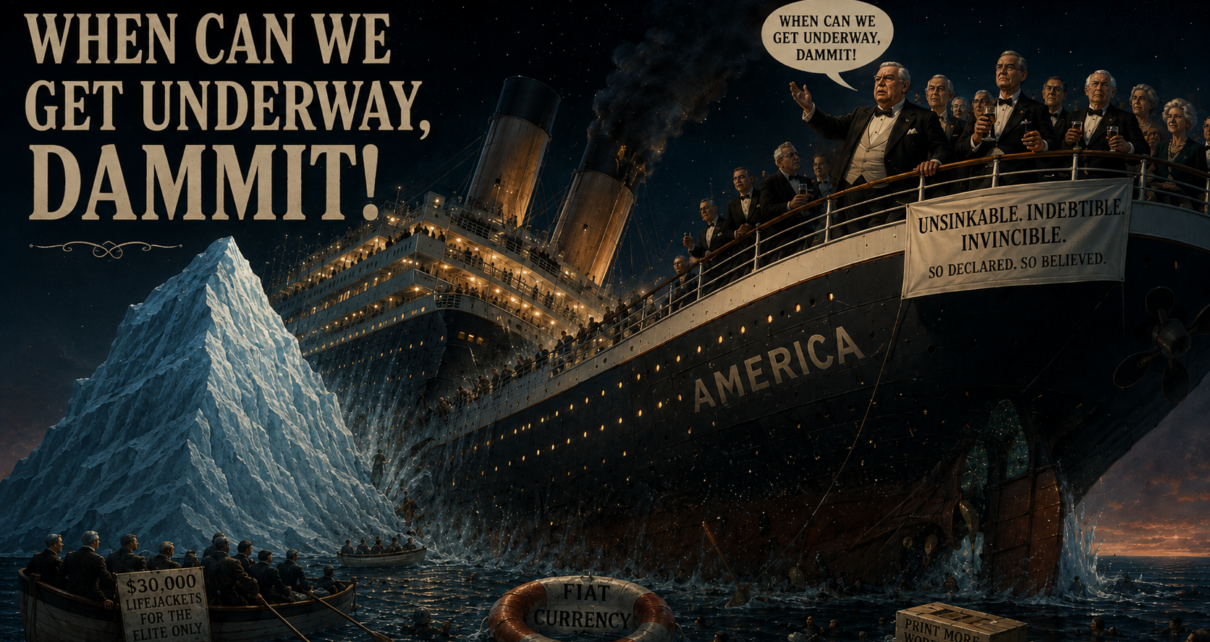
“When can we get underway, dammit!?” he ruthlessly demands, as though the chief defect of the catastrophe is its interruption of the ship’s sacrosanct schedule.
I suppose one must admire the sheer, naked purity of the sentiment. Here is civilization in her evening dress, dripping with manners and stupidity, supposing that because the orchestra has not stopped, the ocean has not entered. Here are the well-born and well-served, encased in wool, brass buttons, polished shoes, and inherited asssumptions, discovering that a ship announced as unsinkable may nevertheless sink if a sufficiently large hole is introduced into its side. Their error is not ignorance, for ignorance may often be simply innocent; no, their error is rank, perfumed, credentialed hubris! They had not reasoned that the ship could not sink. They had merely heard it said by the proper sort of people, in the proper sort of rooms, with the proper sort of confidence. Thus it became true, or at least true enough for a well-mannered dinner engagement.
Such is the present condition of the American republic, which is less a country now than a floating banquet held above a boiler room. We have ordained ourselves emperors of liquidity, monarchs of the reserve currency, pontiffs of paper wealth, and hereditary nobles of the printing press. We do not make errors; we revise forecasts. We do not run deficits; we make investments. We do not debase money; we support aggregate demand. We do not wage wars; we conduct operations, responses, partnerships, missions, deployments, deterrence, and humanitarian kinetic engagements, which differ from wars cheifly in that Congress need not be troubled and the dead need not be counted until after appropriations. A poorer and less enlightened people might call this fraud, but Americans, being such a sophisticated tribe, merely calls it ‘governance.’
The figures, being rude little creatures, speak with less elegance. As of June 3, 2026, the gross national debt stood at $39.20 trillion, of which $31.60 trillion was debt held by the public. In a single year it had risen by $2.99 trillion; in five years, by $10.94 trillion; and over the prior year it had increased at an average pace of $8.19 billion per day, $341.30 million per hour, $5.69 million per minute, and $94,804.90 per second. There is something almost lyrical in such arithmetic. The Republic now borrows with the velocity of a slot machine and the serenity of a bishop. A newborn child, before acquiring the power of speech, taste, reason, or disobedience, has already been admitted to the national partnership and assigned his share of the tab. One wonders why we still baptize infants with water when debt will do.
Yet this, we are told, is not an emergency. For an emergency is a thing with sirens, smoke, and visible panic; whereas a slow fiscal shipwreck conducted in quarterly reports is merely policy. The Congressional Budget Office projects a federal deficit of $1.9 trillion in 2026, rising to $3.1 trillion by 2036, with debt held by the public climbing from 101 percent of GDP at the end of 2026 to 120 percent by 2036, surpassing the post-World War II high. Gross federal debt, in the same CBO projection, reaches $64 trillion by the end of 2036. These are not the numbers of a people preparing for danger. They are the numbers of a people who have discovered that the future has no lobbyist.
I am aware that many ‘learned’ men will object to this melancholy account. They will say, with the air of undertakers discussing floral arrangements, that debt is merely an asset held by someone else, that sovereign currency issuers cannot go broke in the vulgar household sense, that the dollar remains the central pillar of global finance, that financial repression may be managed, that nominal growth may outrun interest costs, that productivity may surprise to the upside, and that charts should not be interpreted by citizens without supervision. This is all very comforting, and in the spirit of national unity I propose we print it upon the lifejackets. But the same CBO analysis observes that interest on the debt is no longer a minor nuisance. Net interest outlays are projected at 3.3 percent of GDP in 2026 and 4.6% in 2036; another estimate notes that interest costs reached $970 billion in 2025, approximately double their 2022 level, and had risen to 18.5% of federal revenues by the end of last year, with a projected climb to 25.8 percent by 2036. The first-class passengers may continue to pronounce the ship elegant, but the ocean has begun charging rent.
Still, the priests of the paper temple insist that we possess a special dispensation. The dollar is the reserve currency; therefore arithmetic has been suspended. Foreigners require our paper; therefore we may manufacture it without limit. The world must hold our debt; therefore we may issue it as a hereditary right. This is a magnificent theory, having only the slight disadvantage of depending upon the permanent obedience of foreigners, the permanent credibility of Congress, the permanent restraint of central bankers, and the permanent willingness of working Americans to exchange their lives for notes increasingly backed by the promise to issue more notes. Even the International Monetary Fund, hardly a monastery of hard-money extremists, reported that the U.S. dollar’s share of allocated official foreign exchange reserves stood at 56.77% in the fourth quarter of 2025, still dominant, certainly, but not a sacrament immune from desecration. And a throne remains a throne until the subjects stop kneeling.
Nor is the monetary hull free of water. In May 2026, seasonally adjusted M2 money stock stood at $23.052 trillion, according to the Federal Reserve’s own H.6 release. This does not by itself prove every grocery bill, rent increase, asset bubble, or political hallucination now afflicting the nation; economic life is more intricate than a pamphlet, though not so intricate as a central banker’s conscience. But it does suggest that our national habit of summoning purchasing power by decree has not been abandoned, merely renamed with that academic tenderness by which poison becomes “liquidity.” John Maynard Keynes, not exactly a backwoods apostle of gold coins and root cellars, warned that by inflation governments may confiscate wealth “secretly and unobserved.” Milton Friedman, from another school and temperament, insisted that persistent inflation was a monetary phenomenon. Hayek’s famous “curious task” of economics was to teach men how little they know about what they imagine they can design. We have answered all three by designing a machine that confiscates invisibly, prints majestically, and calls its ignorance expertise.
The fiscal disease cannot be separated from the imperial one, for Madison saw plainly what modern patriots pretend not to see: war is the parent of armies, debts, and taxes, and these are the instruments by which the many are brought under the domination of the few. Washington, who had the disadvantage of being merely indispensable rather than televised, warned in his Farewell Address against accumulating debt and “throwing upon posterity” burdens that the living ought to bear. His advice has been honored in the usual American fashion: quoted ceremonially, ignored institutionally, and buried beneath a defense budget. From fiscal years 2022 through 2026, total U.S. defense funding amounted to roughly $4.6 trillion, up from $3.6 trillion in the preceding five-year period, with base defense appropriations alone totaling $4.3 trillion. Brown University’s Costs of War project estimates that the post-9/11 wars have cost about $8 trillion, excluding future interest costs, while the future cost of caring for post-9/11 war veterans is projected at $2.2 trillion to $2.5 trillion by 2050. We are a peaceful people, as every empire is peaceful when describing the violence it exports.
The Constitution, poor antique thing, still mutters that Congress declares war. But this, too, has become a lower-deck superstition. Since World War II, the United States has generally preferred presidential military action to formal declarations, and the War Powers Resolution of 1973, enacted over Nixon’s veto, attempted to require reporting within forty-eight hours and termination within sixty days absent congressional authorization. Observe the brilliance of our legal innovation: a war may proceed if it is not called a war, a debt may grow if it is called investment, inflation may rob if it is called policy, and sovereignty may be surrendered if it is called leadership. The first-class passengers do not abolish the iceberg; they merely instruct the steward to refer to it as “floating strategic resistance.”
This is not merely imprudence. It is hubris, and hubris is the oldest respectable poison in political life. Aeschylus warned that insolence bears a harvest of tears. Sophocles filled the stage with rulers who could command men but not consequences. Aristotle, in describing tragedy, understood that the fall of the great is not usually an accident but the flowering of an error rooted in character. Shelley, standing among the ruins of imagined empire, gave us Ozymandias, whose boast to the mighty is answered by sand. We have read these poets, assigned them in universities, quoted them under bronze statues, and learned from them chiefly that their warnings apply to other civilizations. The Greeks had hubris; the Romans had decadence; the British had imperial exhaustion; the Soviets had unreality; Argentina had inflation; Weimar had currency collapse; Pompeii had Vesuvius. America, however, has a PowerPoint.
I think Pompeii actually deserves special attention, for the oppresive volcano did not become a mountain on the morning of the eruption. It had loomed over the city all along, presiding in silence above markets, brothels, villas, kitchens, shrines, debts, quarrels, feasts, and sleeping children. The residents had earthquakes; they had omens; they had the ambiguous mercy of warning signs. Yet daily life has a genius for domesticating danger. Smoke becomes atmosphere, tremors become inconvenience, ash becomes weather, and the mountain becomes scenery until the day it becomes judgment. Pliny the Younger’s account survives because one Roman saw the event clearly enough to describe it; Pompeii died because too many saw the mountain as a background. So it is with us. Debt is scenery, war is scenery, inflation is scenery, institutional decay is scenery, and the iceberg has become part of the view.
It may be objected, by the patriotic optimists and subsidized fools, that America has survived worse. This is true in the sense that a drunkard has survived many previous evenings and may therefore consider sobriety an insult. We survived civil war, depression, world war, stagflation, oil shocks, terrorist attacks, financial crisis, pandemic, riots, bailouts, and the moral theater of ten thousand expert panels. But survival is not proof of immortality. The Titanic floated for a time after the collision. The lights remained on. The tables still had linen. The officers still had titles. The band, according to survivor accounts, played on as the lifeboats were loaded. A doomed thing may retain the appearance of order; indeed, order is often most visible just before it becomes memory.
The modern American solution to the sinking ship will, naturally, be expensive. We shall not repair the hull, reduce speed, rechart the course, restrain the captain, or admit that the ocean has rights. Instead, we shall procure $30,000 lifejackets through a public-private partnership, preferably from a defense contractor with a former senator on the board. They will be carbon-neutral, equity-compliant, AI-enabled, and unsuitable for survival. A commission will be formed to investigate whether the iceberg was misinformation. Economists will propose a temporary facility for transitory water. Admirals will request emergency appropriations to deter further ice. The press will warn that panic over flooding benefits our enemies. Congress will debate whether the lower decks are exaggerating their dampness. The Treasury will issue bonds to finance buckets.
And yet the dark water will continue to enter. This is the great mercy and terror of reality: it cannot be filibustered. It does not care whether one is rich or poor, liberal or conservative, credentialed or common, first class or steerage, old or young, sick or healthy. Reality may be delayed in its appearance, subsidized in its approach, rhetorically disguised, statistically massaged, and morally denounced, but it cannot be repealed. The Atlantic that swallowed the Titanic was around negative two degrees Celsius, cold enough to kill men within minutes; whatever the exact temperature of our fiscal and imperial sea, it will be equally uninterested in our opinions when at last we are in it. A $30,000 lifejacket cannot warm a freezing body. A tuxedo cannot negotiate with hypothermia. A violin, no matter how beautifully it plays, cannot make the icy ocean merciful.
The sin is not that America is wealthy. Wealth honestly earned is a blessing, and national strength prudently husbanded is a defense against barbarism. The sin is that we have mistaken inherited advantage for personal virtue, reserve-currency privilege for divine election, military power for wisdom, debt capacity for wealth, and motion for salvation. We have very likely forgotten Bastiat’s old warning that the State becomes the fiction by which everyone tries to live at everyone else’s expense. We have improved the fiction: everyone shall live at the expense of people not yet born, guarded by soldiers not yet thanked, paid in dollars not yet debased, under laws not yet obeyed, for promises not yet broken.
Thus the Republic glides on, magnificent, illuminated, and fully breached! The banquet continues because the lobster bisque is still warm. The band continues because professionals do not abandon their posts merely because the floor tilts. The captain stands firm at his post because authority dislikes interruption. The financiers continue because there remains paper fiat to sell. The politicians continue because there remains blame to assign to the other side of the aisle. The people continue because ordinary life is hard, and because hope, even when abused, is more comfortable than dread. But the water does not ask whether we are ready. It is already rushing through the hull. We are all dead and we don’t yet know it.
The question before us is not whether America can get underway. She is already underway, and that is precisely the trouble. She is underway with $39 trillion in debt, trillion-dollar interest costs, permanent deficits, monetary sorcery, undeclared wars, constitutional evasions, exhausted citizens, and a ruling class whose chief talent is renaming holes. The question is whether enough passengers will finally prefer truth to elegant music, repairs to vapid reassurance, restraint to pure pageantry, and humility to the suicidal romance of reckless speed…
If not, then let the gentlemen ask their question one more time, with all the grandeur and idiocy it so deserves: when can we get underway, dammit!? The answer, as always, will come not from the ballroom but from deep below.
=====
Sources
- The June 3, 2026 debt figures and pace of increase come from the Joint Economic Committee’s debt update, while CBO supplies the ten-year deficit and debt projections.
- CBO and the Peterson Foundation support the interest-cost claims.
- The Federal Reserve H.6 release gives the May 2026 M2 figure.
- The IMF COFER release gives the dollar’s 56.77% share of allocated official reserves in 2025Q4.
- Defense funding figures come from CRFB, and post-9/11 war-cost estimates from Brown’s Costs of War project.
- War-powers context comes from PBS/PolitiFact’s explainer on Article I, the War Powers Resolution, and post-WWII practice. Washington, Madison, Keynes, Friedman, Hayek, Bastiat, Aeschylus, Shelley, Pompeii, and Titanic musician/hypothermia references are supported here.