by Sean Dempsey | June 25, 2026
It is a matter of great comfort to the people of the United States that, upon reaching the venerable age of two hundred and fifty years, the Republic has at last achieved the maturity of a venerable old man who loudly praises his cherished Bible, meanwhile cheating at cards, abusing his wife, beating his children, drinking away the inheritance, and occasionally setting fire to the neighbor’s house in the name of neighborhood security.
So there could then be no better moment, I dare say, for a great and boisterous national celebration!
For America is turning 250, and our rulers have prepared the festivities with all the humility, sobriety, and Constitutional restraint one might expect from a ruling class that cannot pass a budgt, cannot declare a war, cannot reduce a deficit, cannot leave a foreign country unbombed, cannot read a bill before voting on it, and cannot encounter a limitation on power without regarding it as a regrettable clerical error made by men in powdered wigs.
We are told this anniversary marks “the greatest political journey in human history.” Quite so. For it is indeed a great journey. We began with a Declaration, proceeded through a Constitution, wandered into empire, mortgaged the grandchildren, installed permanent war as a civic habit, discovered that every president is apparently Cesar if he possesses the proper lawyers, and now arrive at the grand semiquincentennial prepared to honor the Great Founders by carefully violating nearly every anxiety they ever bothered to write down.
There will be flags, naturally. And there will be bunting. There will be speeches about liberty delivered by men who have spent their careers enlarging the state. There will be solemn quotations from Jefferson by politicians who would have had Jefferson investigated, audited, censored, sanctioned, or droned if he had written the same things today. There will be invocations of Madison by congresmen who have outsourced their constitutional duties to the executive branch, the administrative state, the intelligence apparatus, the Federal Reserve, the Pentagon, the courts, the emergency powers machine, and whatever intern last stapled together the latest 1,000-page spending bill at 2:00am in the morning.
There will be reverent talk of the blessed Constitution, that most beloved of American relics: praised in campaign ads, cited in speeches, sworn upon in ceremony, and treated in practice like a decorative napkin at a banquet of thieves. For our beloved politicians love the Constitution the way a casino loves temperance. They admire it deeply, provided it does not interfere with business.
This is the comic genius of America 250! We are not merely a broken country attempting to celebrate itself. We are a country celebrating the principles it has learned to admire most sincerely in the abstract and evade most expertly in the concrete. We are hosting a birthday party for a Republic while behaving like the heirs who have already sold off the furniture, forged the old man’s signature, and begun arguing over the silverware.
Of course, the pageantry will be magnificent. The National Mall is a fine place for this sort of thing. A rally in the shadow of monuments. Military flyovers overhead. Politicians beneath them, explaining liberty to the people between appropriations for foreign wars and domestic surveillance. The sacred texts will be quoted. The founders will be praised. The veterans will be applauded. The children will be told they are inheriting the freest country in the world, though it would be impolite to mention they are also inheriting the invoices. And invoices, unlike liberty, do not fit nicely on a bumper sticker.
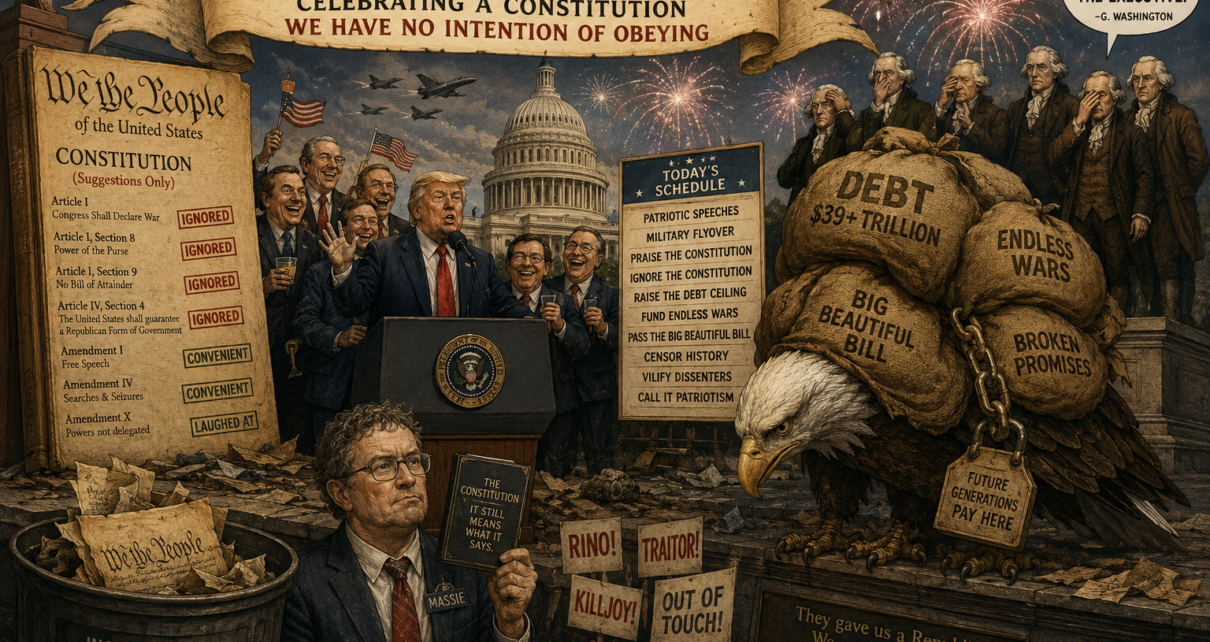
The national debt now hangs over the Republic like an albatross on the neck of the Bald Eagle. The bird still appears in all the proper seals and patriotic montages, but one notices it has begun to fly rather low. It flaps heroically, yes, but beneath the weight of trillions in debt, unfunded promises, military commitments, entitlement obligations, corporate favors, emergency packages, tax gimmicks, subsidies, bailouts, and the annual ritual by which the government solemnly announces it has reached the debt ceiling and must therefore raise the ceiling, as a drunkard might solve his problem by purchasing a taller bottle.
This, too, will be called responsibility! The debt ceiling is one of the great theatrical inventions of American government. It gives Congress the pleasure of pretending to resist borrowing after having already authorized the spending. It is like a man ordering a banquet for 400 guests, eating half of it himself, and then making a brave speech against the immorality of paying the waiter.
The so-called fiscal conservative party, once reputed to favor limited government, now objects chiefly to socialism when it is proposed by Democrats. When Republicans devise the same bloat, wrap it in a flag, attach a border-security provision, staple on a tax cut, include a defense increase, and name it something sufficiently infantile, it becomes not socialism, but statesmanship.
Thus arrived the One Big Beautiful Bill, that bloated patriotic dirigible of tax cuts, spending, borrowing, promises, border money, defense money, gimmicks, offsets, slogans, and future liabilities. Had it been proposed by Obama or Biden, conservative media would have marched into the streets dressed as Paul Revere, screaming that Leviathan had finally eaten the Republic. Economists would have been summoned. Charts would have appeared. Pundits would have pounded desks. The ghost of Milton Friedman would have been invoked no fewer than eleven times per hour.
But because this monstrosity was assembled by Republicans, it became a “transformational legislative win,” “the most comprehensive and consequential set of conservative reforms in our nation’s history,” and, most astonishingly, an act of fiscal responsibility.
This is because words in Washington do not describe things. They launder them. A deficit becomes investment. A subsidy becomes security. A bailout becomes resilience. A surveillance program becomes safety. A censorship regime becomes misinformation control. A war becomes a kinetic operation. An empire becomes leadership. A tax-and-spending leviathan becomes conservative reform. And a debt ceiling increase becomes proof that serious adults are in charge.
We have, in short, become governed by a class of men who believe the Constitution is a very useful document for limiting the power of the other wretched and most dreadful party. And the pure irony would be less severe if they did not speak so beautifully. That is the real cruelty. If they were merely corrupt, one might forgive them as ordinary specimens of the species. But they are corrupt in the language of virtue. They wear the robes of the Republic while selling tickets to the circus. They stand before cameras and declare that “each branch of government must adhere to the Constitution,” and then, upon discovering that the Constitution assigned Congress the power to declare war, become suddenly very creative readers of Article II.
War is the best example because war reveals the truth of a political order. Budgets expose appetite. Emergencies expose instinct. But war exposes the location of actual sovereignty.
The Founders, for all their sins, were not stupid men. They understood ambition. They understood vanity. They understood the glamour of command and the intoxicating power of martial urgency. They understood that executives love war as wolves love dark forests. Madison warned that the executive is the branch “most interested in war” and “most prone to it.” George Mason did not wish to entrust the power of war to the executive because it was not “safely to be trusted with it.” The framers did not hide their meaning in a cave. They put the power to declare war in Article I.
Congress, my friends, “shall have power to declare war.” I say again: Congress and Congress alone!
Not ‘the president shall have power to discover war on television and announce it on social media.’
Not ‘the president shall have power to bomb first and brief Congress later…’
Not ‘the president shall have power to commence hostilities provided cable news approves and leadership can find a pollster to call it strength.’
And certainly not ‘the president shall have power to wage war so long as Congress lacks the moral courage to stop him.’
Congress!!
That was the design. The legislature, being slow, divided, argumentative, vain, and generally intolerable, was precisely the body intended to deliberate before the nation killed and died. War was meant to be difficult to begin. Peace was meant to be easier to pursue. This was not an accident. It was the point.
But modern America has improved upon this antique arrangement by discovering that Congress may retain the ceremonial duty of praising the troops while surrendering the constitutional duty of deciding when to deploy them. This has many advantages. The president receives the glory of action. Congress retains the ability to complain. The people are spared the inconvenience of a real debate. The media receives dramatic footage. Defense contractors receive invoices. Think tanks receive panels. And the Constitution receives another patriotic eulogy from the men who buried it.
The Iran war has made the spectacle especially rich. Here we have a conflict of grave consequence, precisely the kind of question the constitutional structure was designed to force through Congress. Yet the executive acts, Congress sputters, leadership delays, and the people are told that objections to undeclared war are somehow dangerous, naïve, unserious, or insufficiently supportive of the troops.
Observe the trick. The Constitution assigns Congress the war power. A president proceeds without Congress. A member of Congress objects. The objector is then accused of undermining America.
This is like accusing a smoke alarm of arson.
Thomas Massie, among the few members of the American political apparatus who appears to have read the Constitution as something other than campaign stationery, stated the matter plainly: the executive branch cannot unilaterally commit an act of war against a sovereign nation that has not attacked the United States; Congress has the sole power to declare war. This was once called constitutionalism. It is now treated as eccentricity, disloyalty, isolationism, performative obstruction, or, worst of all, failure to clap.
Massie’s real offense was not opposing war. His offense was holding up a mirror. The party looked and saw its face. Naturally, it attacked the ever-spiteful mirror.
This is how our system now handles men who take the written order seriously. They are mocked as cranks. They are vilified as purists. They are told they do not understand the real world, by people whose understanding of the real world has produced $39 trillion in debt, undeclared wars, collapsing trust, permanent emergency, unaffordable housing, institutional decay, and a ruling class with all the self-awareness of a peacock at a funeral.
Today when a Constitutionalist idly suggests Congress should declare war, he is treated as if he has proposed replacing the Air Force with Quaker pamphlets. When he says the federal government should perhaps spend less than it takes in, he is dismissed as unrealistic and a veritable fruit-cake. When he says legislators should read bills, leaders laugh at his childlike immaturity. When he says the Constitution means what it says, his own party begins looking for a primary challenger.
This is the fate of Constitutionalists in a constitutional republic: they are tolerated as mascots until they become obstacles. Then they are summarily removed. This is why America 250 is so bleakly and darkly funny. The country will spend months celebrating the Founders while punishing anyone who sounds too much like them.
Imagine, for a moment, James Madison appearing in modern Washington. After recovering from the size of the federal register and the discovery that the capitol has metastasized into a permanent imperial court, he asks whether Congress still guards its war powers. He is informed that Congress prefers not to be bothered until well after the bombs fall on unsuspecting brown children. He asks whether debt is restrained by republican virtue. He is shown a debt clock and offered a commemorative coin. He asks whether laws are still made by legislators. He is introduced to administrative rulemaking, judicial policymaking, executive orders, emergency declarations, and omnibus bills named by marketing consultants. He asks whether the people retain their liberties. He is told they do, subject to national security, public health, financial stability, platform terms of service, intelligence classification, civil forfeiture, licensing regimes, speech codes, tax enforcement, and the good and righteous judgment of the expert class.
At this point Madison would either faint or ask directions back to Montpelier. For the Founders would not merely be rolling in their graves; they would be filing amicus briefs from them.
This is not to claim the Founders were all saints. They were not. They were men of contradiction and moral blindness. Men of ambition yet also genius. Men of courage, hypocrisy, and greatness. They built a constitutional order that compromised, while also planting within that order the moral explosives later generations would use against it. The American founding was not always innocent; yet it was serious. That is what distinguishes the Founders from many of their descendants. The Founders sinned against principles they at least had the courage to articulate.
But the politicians of today sin against principles they have reduced to cheap merchandise. For this is the Postmodern paradigm! It bifurcates and divides. It deconstructs and judges with ironic distain. It fosters fault lines of the two political parties and celebrates the differences with blood-stained lips and righteous zeal!
The Right wants reverence without repentance. The Left wants critique without gratitude. One wishes to celebrate America by airbrushing the blood from the marble. The other wishes to condemn America by pretending the marble itself has no beauty. One wants a Fourth of July without Juneteenth. The other wants Juneteenth severed from the Fourth. One treats American history as a sacred pageant. The other treats it as a criminal indictment. Both are inadequate. Both are evasions. Both are spiritually childish.
But there is a further problem now. It is not merely that the Right refuses repentance and the Left refuses gratitude. It is that the regime itself refuses obedience. America 250 is therefore not only a fight over memory. It is a fight over hypocrisy.
What exactly, then, are we celebrating…?!
The Constitution? No. Certainly not. For we do not follow it.
Limited government? No, we do not practice it.
Congressional war powers? No, ee have outsourced them.
Fiscal responsibility? No, for we have embalmed it and placed it in a museum.
The rule of law? No. We invoke it against enemies and negotiate it among friends.
Federalism? No, we remember it chiefly and only when our side is out of power.
Free speech? No. We support it in proportion to its usefulness.
Due process? No. We cherish it unless an emergency is declared, a foreign threat is named, or the accused belongs to a class currently unfashionable.
The Fourth Amendment? Ah, what a charming antique, suitable for schoolchildren and ceremonial litigation.
The separation of powers? Now this is a lovely doctrine, isn’t it? Though it’s rather inefficient in wartime, pandemics, financial crises, border disputes, climate directives, student-loan schemes, public-health mandates, and whatever else the executive branch has decided cannot wait for representative government.
Ah, friends. No, the government has become a machine for converting constitutional restraints into procedural inconveniences. And every single branch participates. Congress delegates power and then fundraises off the consequences. Presidents discover emergency authority the way prospectors discover gold. Courts alternately restrain and bless the arrangement, depending on doctrine, timing, personnel, and mood. Agencies regulate vast territories of life no voter ever knowingly assigned to them. The intelligence state classifies its sins. The monetary state taxes through inflation. The welfare state purchases dependency. The warfare state purchases obedience. The media state manufactures panic. The parties manufacture permission.
And through it all, politicians keep quoting the Founders like saints and heroes of old. They quote Washington while hiding Washington’s enslaved people when the exhibit becomes inconvenient. They quote Jefferson while despising the decentralization he cherished. They quote Madison while surrendering Congress’s powers to the presidency. They quote Franklin while printing, borrowing, subsidizing, and consuming as if future generations were merely a rumor. They quote the Constitution the way medieval nobles displayed relics: not to obey them, but to borrow their holiness.
This is why the fights over national-park exhibits are not trivial. A nation that cannot tell the truth about George Washington owning enslaved people cannot be trusted to tell the truth about liberty. But a nation that can only tell that truth in a spirit of contempt cannot be trusted to preserve liberty either. Washington was not only a slaveholder. He was not only a founder. He was both. The country was not only a miracle. It was not only a crime. It was both.
A serious people could bear this. An unserious people edits the exhibit… or burns down the museum entirely.
So perhaps America 250 should proceed with full honesty. Let us have the paraade! Let us have the fireworks. Let us have the flyovers and songs and speeches. But let us also include a few additional ceremonies more suitable to our condition.
First, Congress should gather on the steps of the Capitol and read Article I, Section 8 aloud, after which leadership may explain why it no longer applies except during Republican primaries and Democratic lawsuits.
Second, every president, living or dead by proxy, should be awarded a small crown labeled “Commander in Chief of Whatever We Have Decided Not to Declare.”
Third, the national debt clock should be projected onto the Washington Monument, so that citizens may contemplate the true height of our achievements.
Fourth, every member of Congress who voted for massive spending while campaigning on fiscal restraint should be required to wear two lapel pins: one American flag and one tiny invoice addressed to the unborn.
Fifth, the One Big Beautiful Bill should be printed in full and stacked beside the Constitution, so that schoolchildren may compare the governing document of the old republic with the sacred tablet of the new one.
Sixth, all candidates should be required to take the oath of office twice: once in the traditional manner, and once with the honest addition, “except when inconvenient, unpopular, expensive, strategically disadvantageous, or opposed by donors.”
Finally, a bronze statue should be erected to the Unknown Constitutional Conservative, a tragic figure holding a pocket Constitution in one hand and a primary challenge notice in the other.
This may seem excessive. But excess is the idiom of the age. The federal government cannot merely spend. It must spend historic sums. It cannot merely legislate. It must pass transformative packages. It cannot merely celebrate. It must launch a branded national spectacle. It cannot merely go to war. It must do so without admitting it is going to war. It cannot merely borrow. It must borrow while praising fiscal discipline. It cannot merely censor history. It must call the censorship patriotism. It cannot merely ignore the Constitution. It must do so while quoting it.
This last point is essential. Hypocrisy is not a side effect of modern politics. It is its operating system. A party does not abandon its principles by announcing the abandonment. It preserves the slogans and changes the meaning. Limited government comes to mean government limited to things our faction wants. Constitutionalism means our lawyers have found a theory. Fiscal conservatism means the deficit is regrettable but necessary. Peace through strength means war through euphemism. America First means foreign entanglements arranged in the proper order of donors. Freedom means obedience to the right authorities.
The metamodern question is whether anything can be recovered after such cynicism. The modern myth said America is good, progress is inevitable, institutions are noble, and our leaders are guardians of liberty. The postmodern critique replied that America is power, progress is propaganda, institutions are masks, and our leaders are managers of domination.
The metamodern task is more painful: to believe again after the exposure, but not to become naïve again. To love America after learning the truth. To preserve the Constitution after watching its custodians defile it. To celebrate the founding not because the founders were pure, but because their best ideas remain better than the alternatives now being offered by empire, technocracy, socialism, identitarian fragmentation, managerial oligarchy, and the cult of executive power.
A broken country can celebrate itself only if celebration becomes confession. Not confession as national self-hatred. Not confession as progressive theater. Not confession as another opportunity for elites to accuse the dead while imitating their worst habits. Real confession. The kind that says: we inherited a Republic and turned it into a machine. We inherited constitutional restraints and converted them into talking points. We inherited a warning against executive war and built a globe-spanning presidential war apparatus. We inherited a suspicion of debt and built a civilization on borrowed time. We inherited federalism and built centralization. We inherited self-government and built government by emergency.
That confession would not destroy patriotism. It would make patriotism possible again. Because patriotic love is not the belief that one’s country is innocent. That is not love. That is idolatry. Patriotic love is the willingness to tell the truth about what one refuses to abandon. It is the opposite of propaganda and the opposite of contempt. It says: this country is guilty, noble, ridiculous, beautiful, corrupt, brave, hypocritical, inspired, exhausted, and worth saving.
But saving it will require more than pageantry. It will require remembering that the Constitution is not a brand identity. It is not a prop. It is not a campaign accessory. It is not a slogan for people who prefer monarchy when their man is king. It is not a suicide pact, no; but neither is it a suggestion box. It is a structure of restraint built by men who understood that power does not become safe because the right person temporarily holds it.
The Founders feared concentrated power because they had read history and, unlike many modern politicians, had understood it. They knew that executives drift toward war. They knew legislatures drift toward corruption. They knew factions would disguise ambition as virtue. They knew debt could become a form of bondage. They knew standing armies could threaten liberty. They knew republics do not usually die from one dramatic act of betrayal. They decay by convenience.
One undeclared war at a time. One emergency at a time. One debt-ceiling increase at a time. One unread bill at a time. One executive order at a time. One surveillance expansion at a time. One judicial improvisation at a time. One “temporary” program at a time. One patriotic lie at a time.
And then… finally and at last, the good people are invited to a venerable birthday party.
The cake is decorated with eagles. The candles are arranged in the shape of 250. The speeches are moving. The fireworks are splendid. The politicians place their hands over their hearts. The crowd cheers. The debt grows. The war continues. The Constitution glows warmly under glass, safe at last from the danger of practical application.
Perhaps that is too cynical. Perhaps the Republic can still recover. Perhaps America 250 can become more than a spectacle. Perhaps the anniversary can awaken in some citizens the old suspicion of power, the old hunger for self-government, the old conviction that rights precede the state, that war requires deliberation, that spending has moral consequences, that future generations are not livestock to be milked by the present, and that a country cannot remain free if its people cheer every violation committed by their own side.
That would be a celebration worth having. Not a celebration of innocence. Not a celebration of empire. Not a celebration of party. Not a celebration of curated history. A celebration of the unfinished promise… and a reckoning with the men who betrayed it while praising it!
The Right must learn that reverence without obedience is costume jewelry. It may glitter under stage lights, but it is not gold. To revere the Constitution while ignoring its restraints is not patriotism. It is constitutional drag. The Left must learn that critique without gratitude cannot build a country. It can expose hypocrisy, but it cannot inspire sacrifice. It can tear down statues, but it cannot raise children into citizens. It can diagnose, but it cannot heal.
America needs something harder than both: truthful love. Truthful love can say that George Washington owned enslaved people and still mattered. Truthful love can say the Declaration was hypocritical and still world-altering. Truthful love can say the Constitution has been abused and still deserves defense. Truthful love can say Congress has become cowardly and still demand that Congress reclaim its powers. Truthful love can say the presidency has become too powerful even when the president is popular with one’s own side. Truthful love can say the military deserves honor while the wars deserve scrutiny. Truthful love can say the poor should not be abandoned and the state should not be worshiped. Truthful love can say the market is not God and government is not savior. Truthful love can say America is broken without concluding America is dead.
So, dear friends and comrades in this socialist empire of our making: let America turn 250. Let the fireworks rise. Let the bands play. Let children wave flags. Let old veterans cry. Let families gather. Let the monuments stand. Let the exhibits tell the truth. Let the speeches be interrupted by memory. Let the pageantry be haunted by conscience.
And let us ask, beneath all the noise, one simple question:
Do we still want a Republic?
Not an empire with elections. Not a monarchy with polling. Not a managerial state with patriotic décor. Not a debt machine with a national anthem. Not a war apparatus with fireworks. Not a museum of slogans curated by hypocrites.
A Republic.
If the answer is yes, then America 250 cannot be merely a celebration. It must be a rebuke. A rebuke to the politicians who quote the Constitution while evading it. A rebuke to parties that worship power when they possess it and rediscover principle when they lose it. A rebuke to citizens who outsource responsibility to strongmen and then wonder why liberty shrinks. A rebuke to the comfortable lie that America can remain America while abandoning the habits that made America possible.
And if the answer is no, then by all means, continue with the festival. Then bring out the flags. Summon the flyovers.Praise the parchment. Raise the ceiling. Fund the war. Pass the bill. Denounce the dissenter. Edit the exhibit. Quote the founders. Ignore the founding.
And then call it patriotism. Call it greatness. Call it beautiful!
But for the love of everything holy and right and decent, please, dear God in heaven, do NOT call it a Republic without expecting the ghosts of our laudable past to laugh dolefully at us from their graves…