By Sean Dempsey | 08/04/26
“You like shish-kabobs, right?” Papa asked rather impatiently as I emerged from the back bedroom, rubbing sleep from my eyes.
“Good morning, Dad,” I replied, quickly heading outside to the urine-dendrum patch sitting between two large pines. The sun was high in the sky already. I’d slept in well past 10am. The weather was sunny and the birds sang to each other sweet melodies that told of a new day and of a new song worth singing. I peed into the damp leaves.
Yawning again, I climbed up the wood steps, and opened the squeaky screen door to the side porch leading back inside the cottage.
Two small children within made sounds resembling something between a scream and a squeal as they ran around the room, caring not for the destruction they wrought. Well, that’s not entirely accurate; one, the slightly older girl with a penchant for mischief, screamed in a pleading way that demanded of her nearest parent either food or entertainment or attention (or some combination of all these). The other, the youngest with a head teaming with curly sun-colored strands, squeaked to no one in particular in the tenor and high pitch of a braying infant donkey or perhaps a demonic banshee of Irish folklore.
I considered heading back to bed and shutting out the battleground scene playing before me in the sparse living room.
“So?” Father asked, staring at me?
“What’s that, Dad?”
“Do. You. Like. Shish-kabobs?”
“Oh, um, yes. Yes, I do. Love ‘em! Why?”
I went to sit down on the orange couch in the middle of the room. One of the girls proceeded to empty an entire plastic bag of legos on the carpet. I danced around the shards of hard plastic death traps, and plopped down on the seat.
“Good, good. How about Kayla? Does she like shish-kabobs?”
The scene before me was that of a human blizzard. Hands and arms and hair were streaking by my eyes so fast I had a hard time keeping up. Sounds emanated from the two children that desperately sought (and succeeded?) to achieve all seven octaves at once. The room itself exploded with toys, half-eaten food, unread children’s books, and untold bodily fluids wiped with reckless abandon across the small expanse; the souls of those inside the cottage were pulled, like gravity, into the sprawling mass of items and smells and the sonorous tornado of sound.
“Um, I think so. Who doesn’t like shish-kabobs? But you’ll have to ask her.”
The screaming intensified from one of the two girls, and although I’d just sat down, I felt the timing seemed about right to stand back up and exit the scene entirely. It was either too early or too late for the raw level of excitement and pitched volume; I couldn’t fully decide which scratched the senses more. Crossing the small sea of circumstance, I stepped outside again onto the side porch and breathed fresh air while overhead beams of radiant light pierced through the pine green canopy and found purchase on my stubbled cheeks lined with salt and pepper—two seasonings that stubbornly waged a tired war, although I was acutely aware the acrid pepper was sadly losing ground to the tepid salt.
This small cabin had been my summer home for two score and one seasons. Each summer held its own unique memories, and each memory held its own unique joys. These joys weren’t easily categorized or quantified; they existed both in and out of time. They existed in a way that seemed inviolate, isolated, and entirely foreign to real life. They were summer memories… Canadian memories. They were the breathless footfalls of a far younger version of me holding two frogs in either hand, barreling down the woodland path on the way to the sandy beach on the northern side of our property. They were the harrowing ascents and equally terrifying descents into and out of our rickety treehouse. They were the shrill boat whistles beckoning us, always right at the beginning of dinner, to an evening boat ride and obligatory swim with my grandfather who always smelled of pipe tobacco, somehow even when swimming. They were the wind in my hair on a Boston Whaler, the basset hound on the lip of the bow, and the fish always on the horizon—always, surely, around the next bend or under the next stump—just as long as the right $30 Rappela lurer was used to entice them from their elusive hidey holes.
This place felt like I felt as a child. This place was my childhood. It smelled of home. Because it was home. It was home like no other place or feeling could ever be considered home. This is where the concept of Family forged its inexorable way into being, and then bored itself into indelible meaning. I know, because of these memories, that the crucible of heart and home is not formed by fire, but in water: Canadian lake water. In the undrinkable bacteria-filled waters of Lake Weslemkoon.
“Kayla, you like shish-kabobs, right?” Papa’s brutal inquisition wasn’t over. Without issuing a reply, I heard my wife open and quickly exit the screen door and stand next to me on the porch. I kissed her on the cheek and she put a tired head on my shoulder. I felt her mouth move in what I could tell was a well-deserved yawn, and assumed she was trying desperately to salvage the 38th or 39th wink of last night’s unfinished sleep before facing the oncoming day.
Kayla was a fiery and insatiable creature: an Amazon woman forged by ice and fire itself; however, she desperately required every drop of beauty sleep she begged, borrowed, or stole or she was far more akin to fire than ice.
“Morning, sweetie.” I whispered, finally starting to feel awake. She groaned as a naked two-year old threw open the door and ran past both of us screaming and devilishly laughing, one step ahead of her exasperated mother in tow. The gentle wheezing of the tall pines and the singsong melody of the chickadees were temporary obscured by the chaotic scene.
“Want me to make you breakfast, my love?”
“Eggs would be lovely,” she replied demurely, then yawned again.
“I have to go potty,” screamed the younger child, still naked, as my sister finally grabbed her wriggling torso.
I re-entered the cottage and headed to the kitchen. My father was already standing inside it, so I stood patiently at the edge of the five foot enclosure waiting for him to exit. Our cottage kitchen, about the same dimensions as a one-man escape shuttle, held only enough room to allow a single wayward passenger. All too often, awkward attempts were made to temporarily fit two whole persons (in order to attain a quick spoon or serving plate), but these attempts aborted rather abruptly and relationships were never quite the same afterward. The kitchen was better designed for budding lovers, or perhaps small pigmies, certainly not for human-sized persons. The eternal familiarity of family ties can be stretched so far, much like a worn and weathered rubberband, but perhaps not always from within a cramped cottage kitchen…
Dad finished his doings in the kitchen and walked the two full steps to exit, leaving me able to claim the coveted space. I began the preparations of frying eggs. My wife always took her eggs a very certain way, and I meant to see them cooked to her satisfaction!
A few minutes of cooking prep and a few more minutes of egg frying and the meal was nearly ready. There is no great secret or skill to frying an egg, but there is an art to preparing it the way my blushing bride of now four years likes them. It requires tremendous mental energy and skill. And most of all: love and great attention.
Naturally, I botched the job.
I could tell immediately as I pried the eggs from the pan using the metal spatula that one of them had a bit of yoke still runny. The second egg had the opposite problem and the yoke too hard. I contemplated throwing each away, but instead furtively ate them both and quickly cracked two new chicken orbs, placing them in the hot pan to replace the defects.
Eggs made ‘just so or not at all’ was Kayla’s inscrutable rule, and I obeyed it like it were gospel. Her ways and her desires were as unknowable as the wind, as enigmatic as the sea itself. Her temperament, too, was often tempestuous and as hard to read as a storm’s eye. In fact, her mercurial tastes and dislikes were often much alike our ten-year-old daughter’s whims; for, caught between the two, I seemed ever siezed in a whirlwind—a tempest of female thoughts and wild emotions and the elusive subjectivity that was as brittle and fragile as the eggs I had rather poorly prepared. These pensive thoughts found me as I cooked. In fact, they invited a gentle itch to my brain that caused me to bellow a query to my beloved spouse.
“Does Ava want any eggs, you think?” I shouted to Kayla as she was still standing outside on the side porch soaking in the morning light.
“Eggs? What!? Are you eating!?” Papa’s gruff voice bespeckled the room with dour alarm.
“Just making breakfast, Papa.” I replied with mild amusement, “Would you like some eggs?”
“Eggs! You can’t be serious! Sean, you’re going to spoil your dinner!! We’re having shish-kabobs! Come on!”
Ava entered the room at that moment and gave Papa’s legs a bear hug. Ten years old seemed much too young on her, and I felt a pang in my heart every time she entered a room a little bit older than the last time I’d seen her.
“I’ll have some eggs, Dad. Bye!” Without even looking at me, she peeled off her hug of Papa and ran across the room to the door. And was gone. She seemed always running to and fro, between rooms, between friends, between activities, between childhood and adulthood. She was running as far and as fast as her legs could take her. She was running away from me, I felt with a muted pain that throbbed like an old wound. But at the same time, I smiled, knowing she’d be back as long as I kept feeding her.
“Dad, don’t worry; we’ll still be hungry for dinner tonight.”
“Hmmph! We’ll see,” he guffawed, then hastily picked up a pack of low budget, gas-station cigars from the top drawer of a wicker side table sitting center stage in the living room. Without another word, he trudged his consolation cigars outside to the front porch to sit and smoke alone, begrudgingly, in order to lament his failed battle over disallowing all eating of food prior to the far distant dinner hour.
This war won, our breakfast proceeded in another whirlwind of unshattered cacophony and multiple, well-announced potty breaks. The girls giggled, screamed, and wiggled their way through ingestion of their private foodstuffs. My own eggs, like the sky outside, were sunny side up. Thus, breakfast over, I reminded them all of the blazing yolk in the sky, and we dutifully decided it was time to float upon the water.
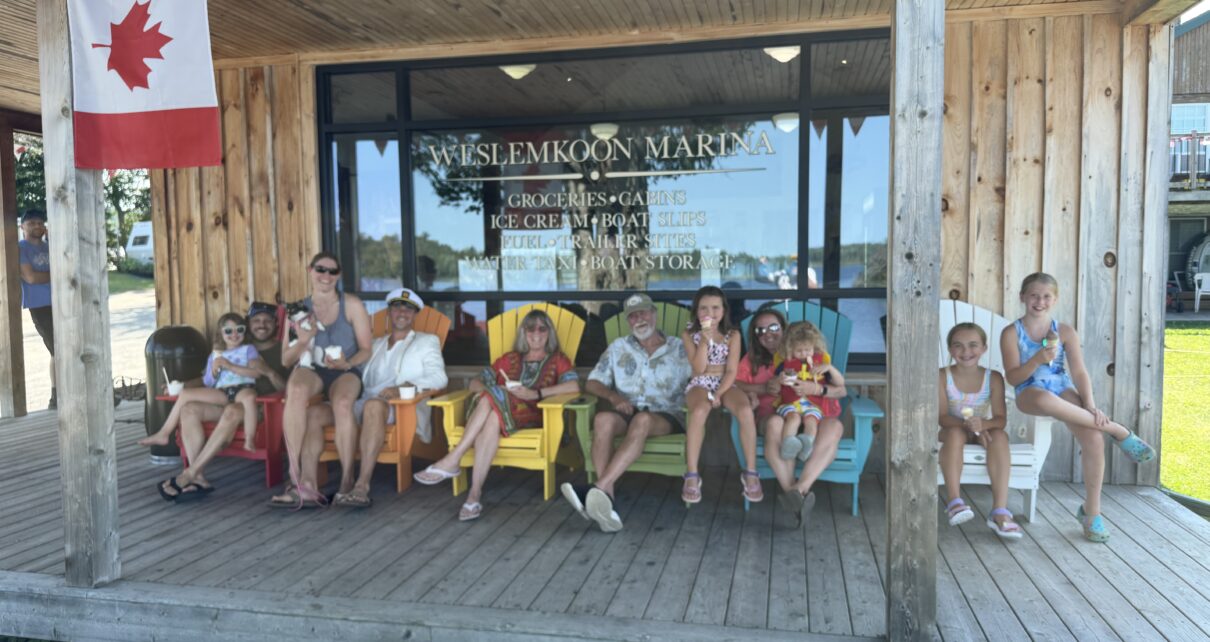
Boat floats were a certain right of passage up at Lake Weslemkoon. And by that I mean that, like any basic right, we took every opportunity to press upon it to the fullest. Papa owned a Bennington, fourteen-passenger pontoon boat. And there was nothing more inherently “Dempsey” than piling all manners of men, women, boys, and girls into the watercraft and attempting to float for untold hours of bliss. All parties were present. Meghann, my smiling sister, plus her two children, five-year-old Amelia and two-year-old Molly, who was decidedly “mouselike;” her generous and ever-illustrious husband, Michael, “the Jew Bean,” as he was called by everyone, was also there with a beer or seltzer to share with others; as was Papa, the patriarch, and Nana, the matriarch. These two latter souls were as different from each other as the sea was from the sky, but both shared the same azure spirit. Then followed myself, Ava, and Kayla. Well-fed now, both my daughter and wife were wide awake and in good spirits. And let me not forget Pippin, our diminutive family pooch—far more cow than canine—followed happily in tow.
Now, you must understand, the movement from land onto water was no trifling thing. One might assume that the act of simply walking onto a boat would be a fairly mundane task after so many practiced years, but not so! Not so, indeed. Perhaps the Dempsey family’s most cherished and self-imposed duty was to make the simple difficult, and the difficult impossible. See, all manner of items needed to be procured, remembered, attained, found, lost, and found again. Towels, snacks and bathing suits were recovered, received, and worn, respectively. Books were grabbed and then left behind when another item was discovered as needed—only to later be grabbed again and the first item discarded in haste. Drinks were desired. Potty was demanded. Screams, protestations, and high-pitched squeals were softly diffused into the woodland surroundings like warm lake water into a well-worn sponge.
Some truthsayers preach that madness often precedes understanding. Or perhaps it is better explained, and carried out in the disorder of living, as chaos having the uncomfortable pattern of preceding order. However, this is too simple an axiom for life on our lake. I believe the same wise men, upon seeing the Family Dempsey attempt to leave its humble shores and disembark on a voyage destined for peaceful conveyance, would later opine that the axioms often lie… that chaos may, or perhaps even must, lead to greater and greater layers of chaos. Like a multilayered cake, the levels of chaos, one upon the next and the next, create a thing of rare delight. A sumptuous morsel that is profanely delicious in the same way moss layered upon moss is both slippery and moist; fragile and beautiful; sublime yet disordered. The way wind-whipped water at the top of the rough surface of a lake is layered into and part of the whole. The ocean becomes the drop, the drop becomes the ocean. So, too, methinks the sacred often is found in the serpentine wanderings of a lost soul. For is not the missed path, whence found, far more rejoiced than had it been followed all along?
Such is the truth found by baring witness to the disjointed embarkation of Dempseys onto their Bennington.
Yet once upon the water, the sun high in the sky, the boat was led out to the middle of the lake by the Patriarch, the veritable captain of our craft. There the engine was shut off and peace settled over the wayward crew.
However, mutiny was in the air!
For as soon as books began to be read, visceral grumblings were made known.
“Momma, I gotta go potty!” The youngest cherub announced with nervous delight.
Luckily a miniature, portable, battery-operated toilet, complete with flushing noise, was brought aboard our craft for such an occasion as this. The child derobed and the toilet availed. Silence then descended briefly as we read beneath the hot sun.
I had brought a copy of Dostoevsky’s “Tales from Underground” to read while aboard. The full weight of the memoirs of the Underground Man were difficult to fully absorb amidst the unavoidable sounds of a simulated flushing toilet, which Amelia activated over and over and over again. Meanwhile, the younger and more naked child screamed “pee pee on the potty” in broken cadence to accompany the digital recording coming from within the miniature toilet. I glanced at Mike, who picked up his phone and took a call to loudly apologize to a guest whose property he was managing. “I’m so sorry about that. Yes, you are supposed to have working power in the unit. Yes. No. No. Yes, and again, I’m sorry that this is happening to you. No, you’re not going to be charged extra for working electricity.” Et cettra. Apparently the property owner had failed to pay the electric bill during their stay. I looked to my sister, who seemed oblivious to the various noises and was lost in her own thoughts and feelings. I didn’t dare deny her this brief respite to voice any question or concern.
It is interesting to know that in times of battle, as was documented after the vast trench warfare fought during World War I, that men could often condition themselves to tune out the anguished sobs of those who were trapped outside their lotus of control. The screaming and death throes of their brothers upon the bloody battlefield became part of the terrain and eventually ignored, as much as the sound of rain battering a tent at night is absorbed by the sleeper. Otherwise bodily rest would be utterly impossible. Otherwise empathy would turn to madness. Men and women alike need a relief valve, if only to preserve their own sanity. If only to maintain their fragile, eggshell-esque, humanity.
“What do people feel about shish-kabobs?” Papa asked suddenly, to no one in particular. The wind rustled the canopy of the boat, a threadbare fabric which was in need of minor repair. Whence no reply came, in turn there was only a piercing scream from one of the children, Ava I believe, as a small fly had alighted near her knee. That crisis lasted only a moment and then the air was still for a single, unbroken moment. Papa returned to reading, as did we all.
Suddenly new alarm was raised and panic in the air.
“Steve…Steve!!” My mother was on her feet staring into the distance. My father looked at her. “Steve…that boat. Do you see the boat? I think it’s going to hit us!”
My father looked up from his Kindle to note the vessel she was gawking at in horror. We all looked, arresting the attention from our reading onto the looming existential danger. However, fortunately the boat in question was several hundred feet away and going in a direction that gave us no reason for fear.
“It’s fine, Lynn. That boat isn’t anywhere near us!” Our captain spoke confidently, then looked back down to resume his reading. “You need to settle down.”
My mother, undeterred, muttered something about the number of times she had saved everyone’s lives by raising the alarm.
Mike got off his phone call, having solved the problem to which he was responding. Another emergency was certainly around the corner, he explained, but for now this particular mole had been sufficiently whacked. He and my mother then entered into a meandering conversation while the rest of us read. The language and cadence of their speaking voices became part of the background, and as I read my book their spoken stories and dialogue blended with the words on my pages. Soon I found myself conflating the thoughts of the Underground Man with those of the conversation around me. Finding it impossible to extricate the two, I lifted my head to join in with a haphazard fashion like a proverbial bull in a shop of delicate trinkets.
“And it’s just funny to hear that from you, as you’re such a two,” my mother was still speaking to Mike about some disagreement they were having. I listened more intently, intending to decipher the context.
“I may be a two, but you only have an issue about this because you’re a six.” He rejoined in mild irritation.
They were talking about their enneagram numbers, I deduced. Numbers that defined human personalities but also had moods and tempers like beasts, as once theorized by Greek philosophers such as Hippocrates and the like. I wondered, and often have, if one’s thoughts and ways and means could truly be summed up by assigning man a simple number. Could that explain things? Could that explain me? I looked into the face of each person on our boat. Could a numerical digit explain these gentle fellows around me, all so different, all so unique? Could a simple integer attach itself to the human soul much like color indelibly belonged to one’s skin? Could it dictate or direct his actions? Could it explain his zeal for life, or abandonment of the same? I’ve often felt the near infinite colors and hues of the light spectrum would better explain the human heart and the actions or inactions one makes. His mood is often as volatile and as unknown to others, and perhaps even himself, as the water on which we rode. To say nothing about the forces that played upon it—to say nothing of the wind that blew its waves, nor the currents that moved beneath its depths, nor even the sun that heated the layered molecules and agitated them to greater and greater agitation. Did not all these factors play a role in the movement and the temperature of the water on which we floated? And how much more complex is man than water?
“Mommy, I want to swim in the water. Mommy. Mommy. Mommy. I want to— Mommy, I want to swim in the water.” A small voice with a single purpose, a single desire rang out, singing a tune to the person reading beside her: the person who encompassed her world entire.
“Molly Mouse wants to swim, Mommy.” A second voice added to the chorus and directed its melodies on the same human object their united song was intended.
Meghann looked up, and noticed the two pairs of eyes pleading for her attention. “Ok, let’s go swimming,” she said closing her book and placing it on the seat next to her.
That matter settled, the young song silenced and a new level of excitement and kinetic energy filled the boat. Lifejackets were procured and secured on the small persons. Soon small splashes rippled the lake and screams… screams… screams galore rippled the gentle silence.
Water, I think, signals a certain purity. Religions use it to demonstrate cleansing of the spirit, of the sins of the past. The earth and all creatures upon it drink it up greedily. Life depends on it. Yet too much of it is deadly. For what is the central fear of every mother (numbered “six” or otherwise) near a deep pool or any body of water? That their child will drown, and the life-giving water will snuff out the precious creature they brought into the world. Too much water means death; yet, is this true of truth as well? Is there such thing as too much veracity? Too much purity? Too much hope? Buddha thought it so. Is there wisdom in the notion that all things, even good things, even the best things, are only excellent because they are not given, or taken, in excess? Excess always brings death. Is this an axiom? I don’t know, and I don’t think I wish to know…
The swimming ended after a while and the sun grew high on the yard arm. Papa asked if we were getting hungry, and asked each person in turn if we all enjoyed shish-kabobs. We all did. Or at least no protest was made. To protest a meal was akin to sacrilege. Such a thing just was simply not done. It was not dreamed of! Papa’s meals were defined before the sun was up, usually a day or two before, in fact. The asking about the meal prior to the meal, on the Day Of The Meal, was a religion in and of itself: it was a Confirmation of the meal; it was a dutiful sacrament to the future meal to be. One did not argue with the choice of the meal. They accepted the meal. They praised the future meal choice and knew that, like gravity or breathable air, some things just were. “I am that I am.” Papa’s supper was what it was to be. Thus affirmed, Papa sat back in his chair and continued to read as he slowly turned the wheel and gently cruised at a snail’s pace back to our shore.
A violent scream suddenly shook the waterway. It came from Molly, her face contorted in sublime sadness and loss. “My legooooo.”
“Oh no!” Meghann said coming to the starboard side of the vessel, explaining to the rest of us that Molly had dropped her Lego into the water. Papa turned the watercraft around and each of us, against the backdrop of a falling sun, proceeded to madly search for the dark speck of plastic in a sea of blackish water, much to the protestations from Mike about “certain actions leading to certain consequences.”
“That’s the sort of thing a one would say,” Mom said under her breath. “You’re a two, but this must be your ‘one’ wing.” Papa seemed confused by the entire affair as we searched the lake for the Lego that was dropped in her water, seemingly quite purposely, by a child now shattered by consequence. Her face was melted with sorrow, and tears streaked down her small face. Ultimately the mission for the lost Lego ended in failure, as were the efforts of her mother to sooth her lament. We headed to the dock, sunburnt and perhaps a little wiser, if not because of ourselves, then in spite of ourselves.
Dostoevsky’s Underground Man pleaded with me as we returned to shore to not forget the lessons we know all too well: that our actions are often not our own. Why do we do the things we do, not to our benefit but all too often to our great disservice? Why do we purposely ‘shoot ourselves in the foot’, so to speak; why do we shout in anger at those we love when a soothing word would provide comfort; why do we wage inner wars with ourselves when they avenge no one and harm only our souls; why do we pity the less fortunate but give them no bread from our own table; why do we sit when we should stand, speak when we should stay quiet, or hiss when we should coo? These things, these passions and Greek tempers are as much apart of who we are as skin and bone are part of our body. We may attempt to number them, as we do our personalities or our thoughts, but these things defy reason itself. The Lego will slip from the small hands of a child in the same way a coarse word slips from the tongue. Such things are what make us human. Such things are what make us all Children out upon the water, clutching onto that which gives us comfort for a time, at least until it slips, entirely bidden and of our own volition, from our fingers and falls away, far far away, into dark, layered waters that teem and broth with endless possibility.
Such is life. Such is life. Such is life that happens to us when we are not looking. It is life that happens when we blink. It is life that turns an infant into a ten-year-old-soon-woman. It is life and its wretched sister, time herself, that allows the gentle water to break the strongest rock. To erode away the ageless lakeshore. Enough life, enough time, brings only change. It is the one thing most absolute. And most profane.
That night we dined on shish-kabobs.
But not before being asked prior to their grilling if they were well-liked. (And again after the meal we were asked the same.) They were. And we enjoyed them much. And as we held hands around the dinner table amid the quiet, if not bemused, murmurs of hungry children awaiting to be fed—confused, as they were, why this sacred ceremony should temporarily keep them from their food—I gave none of this philosophy any thought at all. For what, truly, are thoughts like those mentioned against the foreground of family and of life itself? Family. Love. Community. And God in heaven watching it all. All of these reign supreme; for life happens, I think, perhaps to us, with the more profound thoughts or deeper profundities relegated to the background only. Life is here at the dinner table, amid well-liked shish-kabobs made with love for serving others… amid smiling children with a never-quenchable fountain of energy… amid the faints that break and seize our hearts—whether that be a pestilent deer fly, or a far more pernicious worry that lies deep in the bosom of our brow and will not sleep—and, most of all, amid Family, which is to say heart and home and all the joys and happiness that come with love itself. These, I think, for I have lived them, are truly unique joys of unsung happiness that spring eternal, and will sail forevermore, at our beloved Weslemkoon Lake.