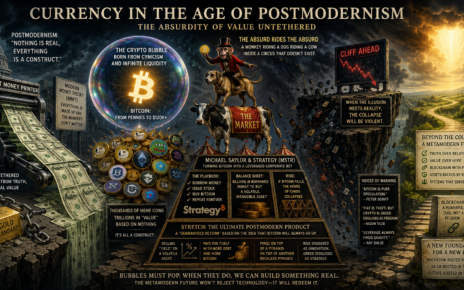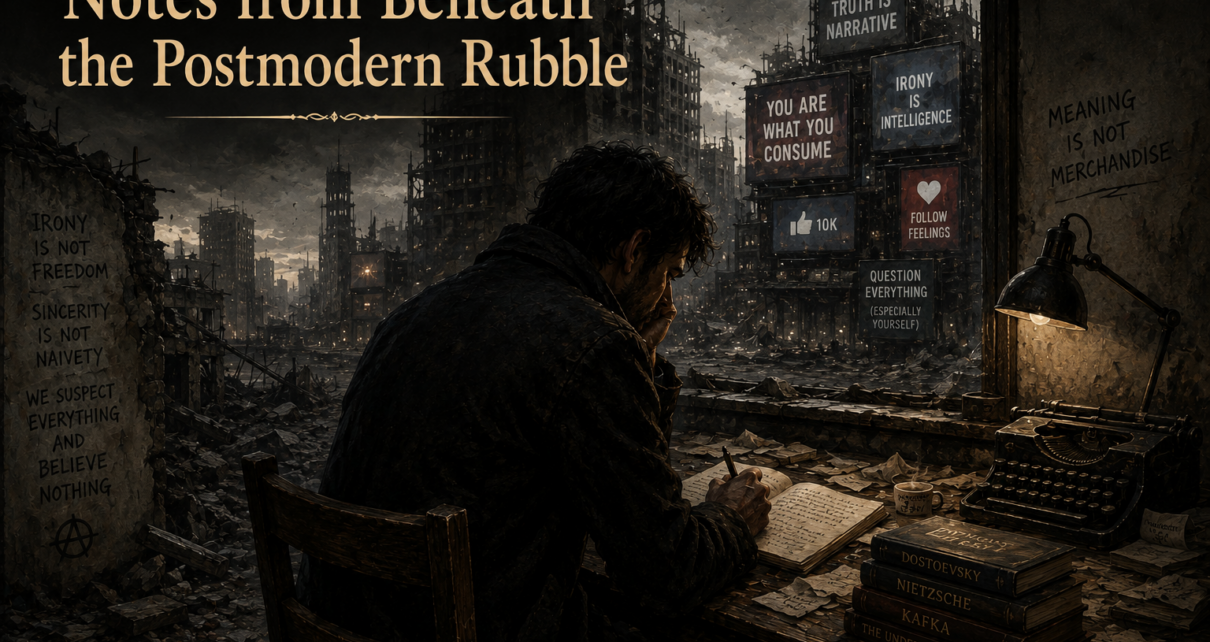
A rather derivative modern adaptation of “Notes from Underground” by the insurmountable F. Dostoevsky.
by S. Dempsey | 07/30/26
I
I do believe I am an earnest man. I am simultaneously a ridiculous one. I am, perhaps, an earnest man precisely because I am ridiculous. No, that is not it either; I have merely learned to say such things because nowadays every man must anticipate the accusation against him and make it himself, preferably with a little smirk, before another fellow makes it with a more jarring rebuke. We have progressed quite far in this respect, yes? One may recall a rather indelicate time when a man confessed because he feared the Almighty God; now he confesses because he fears the online comments beneath the public confession. Ah, progress! ‘Tis not progress divine, and divinity progress?
Last I checked a calendar, the heading said 2026. I therefore have forty-one years to my name. A ripe old age! I mention this of course because forty is the age wisdom descends like the thunder of Thor upon a man and thus I am well into, and beyond, its profound eternal blessing of god-like profundity. I also mention it because past the venerable age of forty, certain men begin speaking of themselves as though they were sacred archaeological sites. “In my day…” they say, and immediately start excavating their childhood for moral evidence of the same. They dig up a broken toy, a 1990s television advertisement, a better-packed cereal box, and from these artifacts easily explain the collapse of modern civilization. I do not blame them. In fact, I have done far worse. Perhaps this manifesto, of sorts, is a cheaper tool for doing just that. For I have often drawn metaphysical conclusions about our current age from the utilitarian design of a local Super Walmart, and certainly from all examples of grotesque modern art.
Truly, we now live in an age which has explained almost everything and understood nearly nothing. That, gentlemen, is my grievance. Though why should it be a grievance, eh? Perhaps it is, in fact, a profound achievement you may say! Perhaps understanding was always an aristocratic vice, and explanation is its democratic improvement. One must not be too ungrateful, right? For we now have contextualized explanations in such abundance that no event or edifice need ever again possess the indecency of meaning only one thing. No, not at all! That would be a great disservice. The theft of property is … taxation (or “modern economics”); a marriage is … a tax break; a church service is … future trauma; a church cathedral is … institutional power; and a mother’s kiss is … an evolutionary arrangement for the distribution of parental care. Everything has been now clarified and properly classified. Nothing remains, I suppose, except to live, and naturally no one really knows how to do that properly, or even why…
You imagine, perhaps, that I am one of those reactionary fellows who wishes to drag mankind backward by the collar, restore the dynastic throne, extinguish the electric light, and compel peasants to sing beneath the stain-glassed windows of a monastery or chapel? You would be wrong, although I confess that your mistake would please me. There is something flattering in my viewpoints being mistaken for a certain Luddite danger of simple regression. Some zealots, I admit, who ardently speak of ‘addition through subtraction’ appeal to me. Especially in moments of deep despair. But in reality I am not against the future; I am, however, greatly offended that it has arrived in such a diseased and vulgar form.
I had expected this period following modernity to be met with fanfare, elation, unrealized profundities, sensation, perhaps even trumpets. Instead, it came as a bulldozer called in to level the cathedral entire simply because the janitor discovered termites in the vestibule. But to be properly inward-looking, I must also examine why I, and so many others, had wished for or expected greatness? Why would we just naturally deserve such brazen wonder? Am I truly so brash, so vain, or so ignorant to expect new heights for my generation simply because I deigned to live within it? Have not all philosophers thought the same thing? Perhaps it is this hubris, the Great Hubris, that is the one central element, the one common thread, of our known universe: “Because I live today, at this time, I expect greatness here and now.” Bah, it is perhaps a blasphemy entertained only by earnest fools and ridiculous miscreants. And such an earnest, ridiculous fool am I!
You will observe that I have already become theatrical. I knew I would. The reader might suggest I see the world as a postmodern melodrama, and paint myself watching from the seats as some passive observer? Again, you would be wrong. I write this from the viewpoint of one in the melodrama; I am an actor in the play as well as an ardent critic of it. Yet, I admit, it is in this latter role that I write most critically. And I also admit I write mostly for myself, as who else would read such a self-serving piece by such a biased judge of a play he himself is part? Add to that – whenever a man, even a so-called earnest man, says he is writing only for himself, he might begin by cleaning the room and dusting the curtains. For, in truth, I am not only writing for myself. I am writing for you, though I must admit that I despise you for being entirely necessary. Do not misunderstand: I do not despise you personally. I do not know you personally, and if I did, I should almost certainly lose the courage. It is far easier to despise mankind in the abstract, just as it is far easier to love in the abstract. The moment mankind sits down opposite you, clears its throat, smells faintly of fast food, brings up politics, and asks to borrow money, philosophy becomes rather difficult.
Yet you are here, are you not? You have opened this rather droll online post expecting either wisdom or entertainment, and I intend, through a laborious and excruciating process, to deny you both! You want me to say what I believe. Very well: I believe in belief. There! You surely laugh. Of course, naturally you laugh. “What a tautology,” you say. “What a sentimental evasion! What does it mean to believe in belief?” Well, it means precisely that I have grown suspicious of the man who can explain his true convictions without fear and trembling. For God is in conviction. And we no longer know nor fear God. So I’ll tell you what this means. It means that after the great dismantling, after we waged unholy war on the heavens, unscrewed the sacred canopic jars of meaning, disassembled virtue herself, raped Science™️, examined love under white light, and found aliens where angels had once been, I still cannot persuade myself that the angels were entirely absent.
But, and here’s the rub: nor I cannot persuade myself that they were entirely present either. I guess that is the postmodern disease that imbues the known universe in which we all live, laugh, and love.
For how’s this for a metaphor: I am a man between sneers. Behind me stands the old believer, indignant that I still hesitate; and before me stands the new unbeliever, indignant that I dare to hope. Surely each demands that I become honest, which means that I must somewhere, somehow, someway agree with him completely. The old man says, “Kneel.” Yet the new postmodern man laughs at my faith and says, “Deconstruct kneeling!” I, meanwhile, remain half bent, which is both physically uncomfortable and, more depressingly, philosophically distasteful.
If I were you I would call this cowardice. And perhaps it is. Truly, I cannot say. But what if cowardice is sometimes merely the body’s resistance to a false choice? Or perhaps the soul’s biting tension against a false binary. A reluctance to declare truth where none is present. No, do not applaud that sentence. I mistrust it already. It has the smoothness of something designed to be repeated by people who have not understood it. Maybe it better belongs affixed to a Twitter meme or stuck to some suburban white women’s Lexis bumper. In our postmodern age every thought dreams of becoming a quotation, and every quotation dreams of escaping its original meaning. That, my friends, is why both the sickness and the cure bleed crimson together. How insidious that it’s nearly impossible to tell the difference!
We seem to have made an industry of vapid fragments and quarter- and half-truths. An industrious man writes four hundred pages so that another, less industrious man, may seize twelve words, place them over an image of a mountain, and attribute them to Ghandi or Marcus Aurelius. This is unabashed culture in a postmodern world, I suppose. It is a sign of the times. It is the clipped and ragged tapestry of our far-from-gilded age.
And do not suppose I am entirely innocent. I too have collected phrases. I too have underlined books with the solemnity of a judge and remembered nothing except the sensation of having underlined them. I too have mistaken vague recognition for true knowledge. But only to a point. Only on the surface. The real danger exists when this action writes itself on the immoral soul. Accepting my vices for what they are, I see the world for what it is and also for what it is not. I mourn equally for the death of innocence and also the institutional idolatry of pure madness. I’ve seen firsthand what happens to our minds when the quote is magnified more than the novel, or the jpeg loved more than the art. When ignorance is sanctified while knowledge is eschewed, that is when Truth is silenced in her crib. Here is one such example, gentlemen, and mark it well. When a vapid thought read online or shared in a viral clip resembles one once encountered before, the postmodern man of course nods vigorously, as though the two of them were old acquaintances. “Yes, yes,” he says, “this is precisely what I have always maintained!” Though, five minutes earlier he maintained the opposite. For his foundations are not just tawdry or crumbling; they are utterly besieged by the very culture of the present day. When the foundation is dissolved in acid, the structure collapses; for acid can only corrode, never build. It is not its nature to rebuild. It does not even posses the language to understand the concept.
Indeed, contradiction is the last private property left to postmodern man. Everything else has been catalogued, advertised, quantified, and offered back as a monthly subscription or mail-in diet pill. His habits are known, his appetites anticipated, his indignation neatly scheduled. Before he has become angry, the machine has selected the object of his anger and placed it before him with a violent, red circle around it. Hate this person, love that one; bomb that country, fund this one! And before the postmodern man has desired, it has suggested what men like him also desired. Before he has doubted, it has prepared an online community of similar doubters, complete with merchandise, a Facebook group, YouTube channel, and a teeshirt to match. And yet we are told we are free because the apparel comes in six colors and the propaganda is well-packaged and displayed on a channel we, ourselves, choose to turn on during dinner.
You think, of course, you know where this is going. You expect me to announce a rebellion. Every mediocre confession online now contains a minor rebellion (usually political or self-serving in nature) by the third page. The writer closes his accounts, throws his telephone into a river, grows vegetables, rants against a certain political figure, and then discovers silence. I shall do nothing of the sort. I still require my phone, thank you. The rank political figures will be there as they always will be, before or after any such words are read or rebellions are mounted. Besides, there are no rivers nearby into which one may throw things without first being observed by another postmodern man recording the event and posting it online for the likes.
No, my rebellion is more contemptible. I intend to mean what I say, at least occasionally. Do you truly understand the audacity of this? In a world where every sentence is first examined for its usefulness, its social position, its hidden violence, its racist subtext, its gender bias, its marketability, its possible misinterpretation, and the professional consequences of its being repeated without context, I propose (only from time to time, naturally) to say something because I believe it to be completely true. I tremble even writing this. Sincerity is no longer a profundity in this age; it is a disease to be weeded out, just as God is now an inconvenient anachronism.
Truth! Truth! Yes, what an indecent word it is. It enters the room dripping wet and wearing dirty shoes. It does not apologize for its shape or its form. It does not declare its pronouns. It does not seek safe spaces to possess or avoid. It does not ask permission to exist. And in doing so, immediately everyone becomes uneasy! “Whose truth?” someone asks, and this is considered a devastating objection, though no one asks whose gravity when an elderly woman falls down the stairs. “Quid est veritas?” is the postmodern lament for all those with broken bones. .
Still, I am not such a fool as to deny that truth can be used as a club. Everything solid can become a weapon; and even God-made tools such as water and fire can be a scourge to man if abused or taken to excess. The postmodern voices in the smoky room were not entirely wrong. That is perhaps what often irritates me most. Had they been fools, we might have dismissed them and gone home. But they were clever, devastatingly clever! They entered the palace of certainty and discovered rotting corpses behind the walls. They showed that reason had corrupt servants, that God-fearing archons often had blood and bile beneath their fingernails, and that universal mankind has forever sought power under the banner of morality or virtue. So, yes, they rightly laughed at the idols, for most of the idols deserved it!
But here’s the issue: the laughter did not stop. It never stops, gentlemen. That is the trouble with laughter elevated to a system. At first it frees the prisoner; afterward it mocks him for wanting somewhere else to go. It tears down the fraudulent temple and then, finding an innocent child kneeling among the broken stones, informs him that kneeling for a corrupt visage is without purpose or meaning. And thus the child, being properly educated, rises. But now, surrounded entirely by rubble, he has no where to turn.
II
Let me deflect for a moment and descend into revery, if you would permit me, that is. In my college years, I recall I once attended a gathering of very intelligent people. (This was surely my first mistake. There are no greater fools found on this earth than in a uniform body of collegiate intelligence.) They were all excellent people, by which I mean that each had devoted considerable effort to ensuring that no one could accuse the other of being a bad apple. Their goodness was visible at once, much like a well-pressed uniform or some other clever idiom I might invent. They spoke gently, and interrupted compassionately to explain why you were often mistaken in your nascent beliefs.
The subject of our discussion was meaning. Naturally, no one believed in it. Ugh, I should scratch out that line. It is both too clever and too on the nose at the same time. Meh, perhaps I’ll keep it.
Anyway, we discussed meaning I think for three or four hours and agreed that it was constructed, negotiated, situated, mediated, inherited, imposed, performed, and often weaponized by the corrupted male power hierarchy. We agreed so thoroughly that I began to feel the sinister desire to disagree, not because I had any firm argument, but because agreement in excess produces in me the same sensation felt during long stretches in a cold basement. For this subterranean room exists without windows and dwells below the rest of the house; and for that reason alone it feels slightly askew and out of place.
So, feeling boisterous, I gently asked whether a constructed meaning might nevertheless still be true. They looked at me with a sort of… muted kindness. Ah, that kindness! I would have preferred a rebuke or even a slap in the face. Open contempt acknowledges one as an opponent; feigned kindness reduces one to a symptom of a malignant or yet-undiagnosed disease. A young man with round spectacles soon patiently explained that my question revealed a nostalgia for totalizing narratives. He said this gently, almost sorrowfully, as one tells a young child that his pet hampster has died.
I thanked him. What else could I do? I had been diagnosed and summarily dismissed. But that night, driving back home beneath those absurdly indifferent stars (NB: the stars are always dragged into these matters, though they have never once consented as far as I know) I wondered whether nostalgia was necessarily evidence against the thing desired. A starving man is nostalgic for bread, is he not? A drowning man becomes rather embarrassingly attached to air. Perhaps mankind’s recurring and undying hunger for the sacred is not proof of transcendence; I do not believe I am so simple to believe that blindly. But neither is it proof of childishness. Why do such enlightened men assume that the appetite is discredited by the meal’s invisibility?
“No,” you say… “because men can hunger for illusions, can they not?”
Ha. Of course they do. You think I have not considered this? Certainly men also hunger for justice! Yes? So shall we abolish courts? Kill the magistrates and the lawyers (however, is this such a bad idea, I wonder?) But – no, of course you see how quickly I become dishonest when excited. I leap from transcendence to courts and expect you not to notice the distance. A writer depends upon momentum. I suppose most philosophies do, if examined closely. And philosophers, as well, for that matter…
Still, I maintain that something indecent happened when suspicion became our only proof of intelligence. A man may now say that love is a disguise for possession, charity a disguise for vanity, patriotism a disguise for violence, faith a disguise for fear, and everyone nods gravely. Yes, yes! Of course such brave words must therefore be true because wise college professors and Hollywood actors both parrot them alike. But let either suggest that possession may sometimes disguise love, that vanity may accidentally perform charity, that fear may kneel and discover faith… well, ha, well then he is of course accused of idealism (or worse yet, romanticism!), which among the intelligent class is regarded as a venereal sin: a raw unfettered infection of the mind. A veritable scourge to postmodern ‘reason.’
My mind races. The center does not hold. The facts in evidence do not belie the consequence. For why must the lowest explanation always be the deepest? Why does exposing the sewer beneath the city prove there are no houses, or even palaces, above it? I ask this merely as an illicit and provocative citizen of the heretofore unseen and surely deplorable city of this venerable age.
No, strike that. I ask as a coward. A citizen of that unseen city might act. I only write. Ha! And I write the way only a ridiculously earnest man might write.
There is in me, I confess, a trite longing for some form of brokenness made whole. True, taken in the right light, the brokenness itself is beautiful at times, but far more often vile to behold. It is profane in its disembodied value, and always lacking in completeness. It is an unfinished and deconstructed tapestry; it is priceless pottery lying broken on the ground because its owner discovered the paint to be fading and artwork blemished. So through this desire for absolution, I reach wildly for some form of synthesis. Truly, I do! I wish to gather up and repair the broken things without pretending they were never broken. I wish to believe after disbelief rocked my world entire… but not by forgetting my underlying disbelief. I wish to pass through this dreadful, pernicious, self-destructive irony and emerge on the other side with righteous sincerity, still breathing, though perhaps limping and missing an eye. This, dear gentlemen, is metamodernism. An ugly word, perhaps. Pretentious? Surely. It sounds rather like a prefabricated new structure built on top of an ancient museum. Nevertheless, I accept it, provisionally, resentfully, with slight embarrassment. It moves me to oscillate. To hold competing truths, unwavering, in my one good and unbroken eye: my mind’s eye, I hope.
That, at least. is the fashionable description of the day. I oscillate between faith and doubt, hope and irony, construction and collapse, as though I were some sort of philosophical ceiling fan. But oscillation is too clean a word. It suggests rhythm. My serpentine movement has no real rhythm. Rather, I collapse and fall; I push my way, bloodied and spent, through mud and mire. I stumble from certainty into suspicion, then crawl back toward certainty because suspicion has become intolerably smug. I embrace some level of hope, discover it selling scalped tickets, and retreat into nihilistic despair; then despair begins congratulating itself on its sophistication, and I flee again to something profound again. It is a delicate and excruciating dance of sorrow and profane elation. For I am no longer balanced between two opposites. Rather, I am pursued by both and neither simultaneously. This sincere yet ridiculous dance dares to hope and breed awe. The movement of the metamodern dance generates power for a magnet that might, just possibly, dare to attract the sacred.
Perhaps this is what it means to be modern after postmodernity: to inherit the ruins, the blueprints, the demolition equipment, and the bloated mortgage at the same time. But I also inherit the fallow land on which it all lays. And, more importantly, upon that land we are told that we may build something… anything! Anything, indeed! We are also told with the same breath that every foundation conceals oppression. Thus we stand in the acid rain, morally superior to the shelter we aim to build.
But I have begun to suspect, only suspect, mind you, that a roof need not be eternal to keep out water. A story need not be infallible to be inhabited with profound truths. A symbol need not descend untouched from heaven to carry someone heavenward. Perhaps, gentlemen, our sublime task is neither to return to the old house nor to celebrate its smoldering ashes, but to build while still remembering the fire. This sounds at least somewhat reasonable, does it not? Ha! Well, that is why I distrust it…
Reasonable ideas have caused no end of trouble. They attract committees. Soon there will be Institutes for Reconstructive Meaning in 2026 and 2027, with conferences, painted tote bags, and a man named Julian explaining sacred renewal beside a sponsored beverage table. Within five years the longing for transcendence and metamodern meaning will have an embossed logo. Within ten, its critics will expose the labor practices behind the creation of that logo. Within fifteen, a revival movement will form around the original, ethically sourced longing. Just make sure to hit the Like and Subscribe buttons on our way out!
For I am weak, gentlemen. I am entirely weak, vain, compromised, and so thoroughly formed by the postmodern world I condemn that even my rebellion speaks in its self-serving and detestable accent. One despises the postmodern marketplace and then perfunctory checks whether his words are still selling. He denounces performance while imagining your applause. He fervently longs for the sacred and in doing so resents any sacred thing that dares to make a demand upon his schedule… Yet perhaps this is where one must begin: not above contradiction, but inside it; not as the purified man addressing the corrupt age, but as the age itself becoming ashamed of itself and its utter ridiculousness.
I shall therefore continue to write. To share. To dream. To podcast. To pontificate. To prophetsy. To listen. To read. And then to write some more…
I shall write both for and against this postmodern world, which is another way of admitting that the postmodern world has entered me, darkened me, and even sees through me. I shall write for meaning while suspecting and deconstructing every meaning I find. I shall address you directly because I cannot bear to be alone, and insult you because I cannot bear to need you. And… should you discover in this inane ranting some usable system, I beg you to destroy it immediately. If it comes from me, a postmodern man, it is surely profane.
But, I beg, do attempt to preserve the ruins. For I may just wish to live there…