by Sean Dempsey | 06/18/26
One hundred years after the United States of America had solved freedom, no one was free enough to say what exactly had been solved.
The red, white, and blue cloth still flew proudly. The anthem still played before public ceremonies. And, yes, the revered USConstitution still existed, sealed, of course, inside a climate-controlled chamber beneath the Department of Truth, where disinterested school children were permitted to view it through 12 inches of protective glass. Above the glass, in clean white letters, the Department had placed the official interpretation:
LIBERTY WAS NECESSARY UNTIL PROGRESS BECAME POSSIBLE.
No one knew exactly when the State had stopped calling itself ‘the State’. One supposed the word had become unfashionable at some point. It suggested force. It perhaps suggested uniformed legions, boots against doors in the night. The new order had no taste for such antiquited bluntness. It preferred empathetic procedure. It preferred mandates, health directives, integration pathways, civic wellness schedules, and compassionate compliance windows.
So the State had become ‘the Administration.’ Then the Administration had become the Department of Truth. Then the Department of Truth became known simply as the Department. Truth, by this time, no longer meant what had happened or what was factual. It meant what was successfully coordinated and condoned. The central doctrine of the Department was Progress.
Not progress, the old word, lowercase and uncertain. This antique word was once used for men who paved roads, or for antibiotics, indoor plumbing, and the suspicious little miracle of hot coffee. Progress now had a capital letter. Progress was no longer something men pursued. It pursued them! It found them in schools, in factories, in hospitals, in voting booths, in bedrooms… in the last silent inch between religious fear and tyrannical prayer. And the very great sacrament of Progress was the Civic Neural Integration Chip.
No one called it a chip officially. The Department disliked old vulgarities. The approved term was the ‘Adaptive Cognitive Health Interface.’ But in the common speech it was simply called the Crown, because it was implanted at the base of the skull and threaded upward through the brain in a filamented halo of living silver. What a clever term for such a clever device!
The Crown made all citizens faster and smarter. It corrected memory. It improved reasoning. It eliminated inefficiencies of mood. It fact-checked private thought before it hardened into speech. It provided every worker with real-time market adaptability, every child with educational enhancement, every parent with risk-managed affection, every voter with a stabilized civic perspective.
The Crown was mandatory.
Well, technically, it was not mandatory.
However, the Department was careful about this distinction, and entire committees of obscenely-paid, toothy lawyers had been preserved for the purpose of maintaining it. On paper all US citizens retained the right to refuse integration. The refusal was entered into the national wellness registry. The citizen was assigned a Legacy Biological Status. Employers were notified. Schools were notified. Insurers were definitely notified. And neighbors were also notified in the interest of informed communal safety. Children of the household were evaluated for inherited resistance tendencies. Travel privileges were paused. Medical priority was adjusted. Public trust scores were recalculated with uninformed prejudice.
But the citizen remained entirely free! He was merely ruined. For this was considered humane and proper.
In practise, by 2126 almost no one refused the Crown. The very, very few who did were spoken of in the hushed tones once reserved for the unvaccinated, plague houses, drunk drivers, and men who coughed openly in grocery stores during flu season. To remain unaltered was not illegal. For that could be pardoned; illegal inclinations could be excused and perhaps even understood. Oh, to be unaltered was much worse. It was dirty. It was selfish! It was anti-social in the most literal sense, a refusal to let society enter the skull and tidy up the ugliness of raw human biology.
The Sterling family were among the last…
Elias Sterling was sixty-one. His wife Miriam was fifty. Their daughter Lydia was seventeen and their son Peter was eight. This was considered an unusually late household formation, but then almost everything about the Sterlings was more than a bit unusual. They ate together without nutritional projection. They read printed books. They prayed quietly before meals to a religious deity, though not in a registered liturgical format. They kept a mechanical clock in the hall: an ornate, mahogany grandfather clock. One that ticked with a stubborn wooden pulse, as if time still belonged to the Sterling house rather than the altruistic Department.
Elias Sterling had once taught literature to receptive minds who devoured the words he chose to share with them. This was before literature had been reorganized into Narrative Responsibility, before tragedy was deemed developmentally unsafe unless accompanied by restorative and contextual framing. This of course was before satire required a licensing review, and before old books had to carry warnings for irony, metaphysics, gendered antiquity, uncorrected grief, and theological residue.
He had been dismissed thirty years earlier for declining the Crown. The dismissal letter had used the phrase “competitive insufficiency.” With a reckless smile, Sterling had framed it proudly on his wall. It hung there with a certain smug defiance.
It existed now above his desk, directly beside a photograph of his family at the ocean. Miriam was laughing in the picture, her hair whipped across her face by wind. Lydia was thirteen, holding a shell as though she had found proof of Jesus Christ Himself hidden in the sand. Peter was roughly four years old, squinting at the sun with the fierce resentment children reserve for brightness and forced family photographs. Elias stood behind them, one hand on each child’s shoulder, looking slightly ridiculous in a straw hat. Not that he believed he looked ridiculous, mind you; he had personally selected the proud hat, believing it to accent his most prominent features… whatever those were he himself didn’t know.
The erudite Department, had it deigned to be aware of such things, would not have understood why anyone would display a humiliation beside a family photograph. That was one of its limitations. It understood irony as a risk category, not as a survival instinct.
=========
On the night the Sterlings were taken, the house was dark except for the slowly ticking wooden clock.
It stood in the hall, ticking with the solid obscenity of an object that had not been updated. It moved, unheard and unobserved, as an austere sentinel guarding time and Truth itself. Outside, the town slept beneath a grid of soft blue surveillance light. The neighborhood was clean, silent, and morally supervised. At two minutes past three in the morning, the front door opened without breaking.
There was no crash. No shouting. No thunder of austere boots. The Department had long ago learned that terror entered more efficiently when it did not hurry. Six officers stepped into the house in matte white uniforms. Their faces were uncovered, but they might as well have worn masks. Each had the faint silver glimmer behind the ear where the Crown entered their skulls. Their eyes moved in perfect coordination. They did not look angry. They did not look cruel. Anger and cruelty were anachronistic, private passions, and private passions had been classified as primitive as weather.
They entered the bedrooms. Miriam woke first. She saw the white uniforms and reached for Elias before she spoke. He opened his eyes to the cold beam of an officer’s flashlight. For one absurd instant, he believed he had overslept for work.
Then he remembered that his work had disappeared for him long. The Department had stolen his vocation, just as they had stolen his future.
“Elias Sterling,” said the lead officer loudly yet with temperance. “Miriam Sterling. Lydia Sterling. Peter Sterling. By directive of the Department of Truth, you are kindly requested at this time to appear before a Progress Review.”
Elias sat upright. His hair stood in white disarray. His face, still heavy with sleep, arranged itself slowly into annoyance, then suspicion, then to resigned amusement his wife knew all too well.
“At three in the morning?” he asked laconicly.
The officer did not answer the question. It had not been registered as a question.
“Dress in plain civilian coverings. No personal artifacts. No printed matter. No mechanical devices. Please do not involve an attorney at this time as they will not be permitted to attend your optional hearing.”
From the room across the hall came Lydia’s voice, sharp with fear. Peter cried out once, then stopped, which was worse. Miriam’s hand tightened around Elias’s wrist. He looked at her. His amusement thinned.
“Come now! What is the meaning of this precisely? What do you want of us?” he demanded.
“Progress Review,” the officer repeated without emotion.
The phrase came without emphasis or exclamation. Not coldly… not exactly. Coldness still belonged to the human condition. No, rather the reply came in the same manner as a door slides open. His reply came as a scale confirms a heavy and oppressive weight.
The Sterling family was given exactly six minutes. Miriam buttoned her dress with trembling fingers. Lydia was brought downstairs barefoot, wrapped in a gray coat over her nightclothes. Peter clutched a small stuffed cow (or perhaps a black-and-white spotted dog) until an officer removed it from his hands and placed it on the table as though it were evidence of infection.
Elias saw his son’s terrified face and immediately stopped smiling sardonically. The Truth officers led them outside.
Every house on the street remained dark, but every window had silently recorded the event. By morning, every neighbor would know. By noon, most would say they had always suspected the Sterlings were unstable. By evening, someone would casually mention that Miriam had once declined a community grief-update after a funeral, and another would recall that Elias made jokes too slowly to be safe. These were surely very unsafe people! It was better for the community they were gone. Yes, their nefariousness would not be missed.
The family was placed in a windowless vehicle. No one spoke during the ride. Elias held Miriam’s hand. Lydia leaned against her mother. Peter sat pressed against his father’s side, trying to keep his breathing quiet. On the interior wall of the vehicle, a Department message glowed softly:
PROGRESS PROTECTS THE WILLING.
Beneath it, in smaller letters:
CITIZENS WILL BE PROTECTED FROM THEMSELVES.
Elias read the second line twice. Despite everything, despite the hour, despite the white officers and his son’s small body shaking beside him, he almost laughed. Almost. It was too perfect. The new world had finally achieved what the old tyrannies had only dreamed of. It had taught the gun to speak in the language of medicine.
The Department of Truth occupied the center of what had once been Washington DC; the old Capitol building remained, but only as a ceremonial shell. Its dome was lit at night for historical continuity, though no laws had been meaningfully debated beneath it in decades. Real law emerged from the Department: a black geometric tower without ornament, without windows, without apparent entrance until one was brought before it. Its walls absorbed light rather than reflected it. Rain did not streak them. Birds did not land on them. Protesters did not approach them. Nothing living seemed to mistake the building for part of the earth. I suppose it was more sacred. More mechanical than metal, and more spiritually dark than mere darkness itself.
Inside, the Sterlings were separated, scanned, tagged, and reunited beneath the sterile floor of the tribunal chamber. A lift carried them upward. As it rose, Elias could hear a sound above them. At first he thought it was machinery. Then he understood it was voices. Ethereal voices. Definitely not speech. Nor chanting in any sense. However, the sound was a repeated monotone, layered and vast, coming from the tribunal’s unseen public galleries. A chorus of insidious voices in deadly, beautiful harmony.
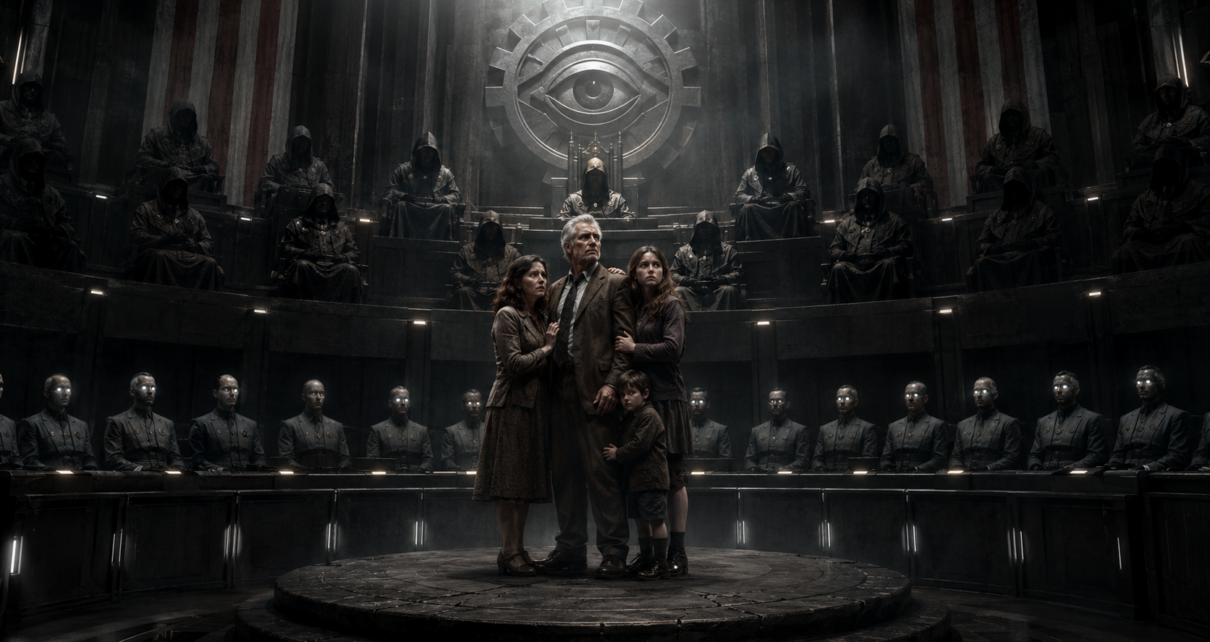
The lift opened. The Sterling family stepped into a circular chamber half-shrouded in darkness. At the center was a pale stone platform. Around it, rising in tiers, sat the dour magistrates. There were seven of them, each robed in black, each hooded so deeply that no face beneath the hood could be seen. Only the lower halves of their heads caught the dim light, and even those seemed less like flesh than unfinished statues. Behind them hung the eternal emblem of the Department of Truth: an open human eye encircled by a metallic gear.
And above the emblem were the profound words:
WHAT PROGRESS REQUIRES, TRUTH RECORDS.
Below the magistrates, in a semicircle of black metal, stood the Chorus of Civic Assessment.
They were not judges. They were not witnesses. They were not prosecutors in the old sense. No! They were the voice of Departmental conclusion. They wore no hoods, for they had no individuality to conceal. Their heads were shaved. Their eyes were silvered by full Crown integration. When they spoke, they spoke together in a single flat tone, neither male nor female, neither loud nor soft. These were the pure, ungendered ones who spoke for Truth to the truthless and sought guile from the guileless.
Yet at the far end of the chamber stood the redoubtable Administrator. His name, as would be known later to the Sterlings, was Orson Vale, ESQ. He wore a pale gray uniform without decoration. His skull was visibly altered. Silver conduits ran beneath the skin from the base of his neck into his temples. His eyes had no fixed color, only a liquid metallic brightness that adjusted according to the movement of the light. He was handsome in the way surgical instruments are handsome when newly polished.
He did not preside over his audience. No, not at all; he… he inspected. He observed. He registered. The magistrate presided. Progress accused the condemned. And he recorded it.
The Sterlings stood together on the platform. Peter reached for Elias’s hand, and Elias took it. For several seconds, nothing happened. Then the central magistrate spoke.
“The family Sterling stands, optionally, before Progress.”
The Chorus answered: “Progress has observed refusal.”
The magistrate continued. “Their refusal is optional and concerns Civic Neural Integration.”
“Integration is health,” sang the Chorus in unison.
“The family Sterling has declined the Adaptive Cognitive Health Interface across three eligible biological persons and one pending dependent.”
“Refusal is harm. Refusal is detrimental. Refusal is regressive.” The voices sung back as through a liturgical chant.
“The family Sterling has maintained a private household culture of non-integration.”
“Privacy is where harm grows root from seed.”
“The family Sterling has preserved printed objects, unsupervised memory forms, mechanical timekeeping, uncorrected religious practice, and unmoderated parental influence.”
“Legacy contamination is confirmed. Society has been harmed.”
Elias quietly looked in silent horror from the magistrates to the Chorus, then to the hooded darkness above them. At first, some old instinct in him reached for mockery. It was all so comically theatrical in his mind. The dark hoods. The ritual. The forced language as though from a priesthood. He felt a bitter little laugh take rise in his throat.
Then Peter squeezed his hand. The unformed laugh died. Instead, the central magistrate turned slightly toward him and addressed him.
“Elias Sterling. You are principal biological authority within the household. Do you accept Progress?”
Elias swallowed. “Uh, well, yes. That is, yes, I accept medicine. I accept tools. I accept machines where they serve human life. But I do not accept the seizure of the mind. I do not accept placing a Department-sanctioned intelligence inside my children’s heads and calling that health. I do not accept that my family must be edited before we are permitted to belong to the human race.”
The chamber absorbed his words. The Chorus answered:
“You are… obsolete.”
It was not exactly a logical rebuttal or rejoinder he expected. It sounded more like a classification.
Elias looked at them, still not fully comprehending the shape of the danger.
“Respectfully, I am not obsolete. I am human. My wife is human. My children are human. We are not refusing progress because we distain the future. We are refusing your version of it because there must remain some portion of man that is not owned, optimized, corrected, or improved by permission of the almighty Department.”
“You are obsolete,” sang the Chorus again.
Miriam’s hand moved to her throat. Lydia stared at the hooded magistrates with the hard, frightened defiance of a young woman trying not to become a child in public.
Peter looked at the floor. The central magistrate raised one pale hand with rigid authority.
“You may choose to proceed to assessment.”
Above the platform, the air filled with images beamed in by the computers.
They were not projected. They simply appeared, as if the unused space itself had been instructed to remember. The Department displayed the Sterling family’s civic deficiencies with the sterile elegance of an human autopsy.
Elias Sterling. Occupation: former literature teacher. Productivity rating: negligible. Cognitive speed: below civic baseline. Emotional expression: unmoderated. Humor: irregular. Historical attachments: excessive. Religious metaphors: persistent. Manual reasoning: slow.
Miriam Sterling. Occupation: former nurse. Empathy: high but unsupervised. Medical obedience: inconsistent. Grief patterns: unprocessed. Maternal attachment: possessive. Household stabilization: risky.
Lydia Sterling. Academically capable but unintegrated. Abstract reasoning delayed by biological cognition. Social acceptance impaired by Legacy status. Romantic future: statistically compromised. Workforce competitiveness: catastrophic.
Peter Sterling:. Pending integration delinquency. Parental contamination: likely. Dream irregularity detected through school sleep survey. Reported preference for “being himself,” a phrase marked in dark crimson red, the shade of blood.
The Chorus spoke after each entry.
“Obsolete.”
The word fell again and again, without drama, without hatred, without even a trace of triumph. That was what made it quietly terrible. Hatred might have implied uncertainty. Triumph might have implied conflict. The Chorus merely filed the family under the correct heading it had identified.
However, Elias vainly tried again to reason with them, “Excuse me. No. You cannot measure a soul by processing speed.”
The Chorus answered: “Obsolete!”
“My daughter is not a defective machine.”
“Obsolete!”
“My son does not belong to you.”
“Obsolete!”
“My wife’s love is not obsolete to me. It defines me.”
“Obsolete!”
“I have the right to remain what God in heaven made me.”
At this, the chamber changed. Not visibly, and not at first. But something in the machinery of its attention tightened. The hooded magistrates leaned forward by a fraction. Administrator Vale’s cold, metallic eyes shifted focus. The Chorus paused one full second before answering all together.
“Theological residue confirms obsolete cognition.”
Elias felt Miriam’s hand close around his arm. He understood then that he had made no argument at all. He had only provided more evidence. This was a trial and he was condemned.
Witnesses appeared as recorded fragments over the course of the next several hours. A neighbor reported that the Sterling household possessed several unregistered paper books. A school functionary reported that Peter had once inquired whether people without the Crown could be wise even if they were very smart. A medical compliance officer reported that Miriam had delayed Lydia’s preliminary integration appointment by filing a moral objection, a category that remained legal but was monitored as a predictor of irrational contagion. An employment auditor reported that Elias Sterling had contributed nothing measurable to the national knowledge economy for more than eighteen years.
After each testimony, the Chorus chanted in unison:
“Obsolete.”
No one asked whether the family had harmed anyone. That question belonged to an older world, the world of crimes, accusers, motives, proofs. This world had gone beyond guilt. Guilt was a bit too narrow. Too definite. A man could be harmless and still stand against Progress simply by remaining uncorrected. A child could be innocent and still represent delay. A family could be loving and still produce anti-social continuity by loving one another too strongly or outside proper state supervision.
Elias’s first emotion had been indignation. Then fear. Then rage. Then something more primitive than rage: the animal horror of a father watching invisible hands reach toward his children.
He stepped forward.
“You can call me obsolete,” he said. “Call me slow. Call me useless. Call me every dead word your machines have embalmed. But my children are not obsolete. They are children! Let them go. Crown me, cut me, kill me if you must. But let them remain unpunished for my refusal.”
The central magistrate did not move.
The Chorus answered:
“The family is the carrier of obsolete continuity.”
Miriam made a small, almost animal-like, sound. Elias turned toward the Administrator. Vale stood motionless, recording. His face had no empathy in it. Nor had it any cruelty either. It was procedural, which made it less understandable to Sterling than something primal like hate or cruelty, which were human sensibilities.
“You have a family?” Elias asked him.
Administrator Vale did not respond.
The magistrate answered instead. “Biographical inquiry irrelevant.”
“They are children.”
“Dependency does not erase contagion.”
“But they have done nothing.”
“Failure to Progress is hereditary when maintained by household authority.”
“They can choose when they are older.”
“Delay is injury.”
“They are human beings, children of God, and have sovereignty of their own minds and bodies!”
The Chorus answered him then:
“Humanity without Progress is obsolescence.”
At that, Elias’s face changed. Any hope he clung to drained away. All humor had long since died. The funny old teacher, the man who had survived thirty years by laughing at memos, acronyms, slogans, and the solemn idiocy of administrative evil, was gone. In his place stood something older and less manageable: a father whose fear had burned through politeness.
“My original humanity is not a disease!” he screamed in raw desperation. “It is not a defect. It is not some sort of infection in need of your shining little wires. Before your Department, before your Crown, before your polished voices and hooded cowards, there was man. Slow, yes. Broken, yes. Sinful, of course. But capable of great love without any calibration, courage without simulation, grief without therapeutic adjustment, thought without state permission. You have not improved humanity. You… you have merely made a faster, more efficient prison and taught the prisoners to mislabel the bars wings!”
The chamber remained silent after this. It was the longest silence of the trial. Then the Chorus spoke.
“You, Mr. Sterling, are obsolete.”
Something in Elias seemed to fold inward. The words had not defeated him by argument. They had defeated him by refusing argument. One cannot debate a wall. One can only bruise one’s hands upon it.
The magistrates conferred without sound. They whispered to each other inside their minds, through the cloud-connected AI chips embedded in their brains. The united parts of them that was no longer human processed and analyzed, but did not think. It was harmony of will and thought; it was a beautiful unseen dance of unification and solidarity of the computerized hive-mind.
Above them, the emblem of the eye and gear glowed brighter and brighter, pulsing in the darkness around it. The public galleries remained invisible, but Elias could feel the watching. Gazes were on him. Emotionless gazes. Somewhere beyond the chamber, perhaps beyond the building, perhaps across the whole coordinated nation, millions of Crowned citizens were being shown this family as a cautionary image. His plight was being broadcast. A father trembling. A mother pale. A daughter holding her chin high. A boy trying not to cry. Progress had found them in their beds and brought them here to instruct the healthy and showcase the horrors of the disease of noncompliance.
The central magistrate rose.
“The family Sterling has been assessed.”
The Chorus answered:
“Assessment complete.”
“Elias Sterling, Miriam Sterling, Lydia Sterling, and Peter Sterling have refused Civic Neural Integration, maintained Legacy Biological Continuity, transmitted obsolete identity, and denied the moral necessity of Progress.”
“Obsolescence confirmed.”
“The sentence is Removal by Compassionate Discontinuance.”
Miriam gripped Elias so hard that her nails broke skin. Lydia did not speak. Her eyes filled, but she did not lower them. Peter whispered, “Dad?”
Elias could not answer. The central magistrate continued.
“Because Elias Sterling is principal authority and origin point of household refusal, he will be granted the Legacy Privilege of Selection.”
A list appeared in the air above them. Methods of death, each renamed until the words no longer seemed to belong to death.
Sleep Transition. Metabolic Quieting. Breath Reduction. Neural Mercy. Family Continuity Archive. Historical Witness Discontinuance.
The sterile tenderness of the phrases was almost unbearable. At last the list stopped swirling. The magistrate spoke softly but firmly, “Choose now.”
Elias looked at the list, then at Miriam, then at his children. His mouth opened. Nothing came. The Chorus filled the absence.
“Obsolete.”
He closed his eyes. When he opened them again, there was something different in them. Not hope. Not quite yet. Something smaller. A remnant of the old sardonic spark, buried under terror but not extinguished. His mind, slow and unassisted, moved not in straight lines but in the crooked human way, through memory, grief, absurdity, and a sentence he had once read in an obsolete legal appendix because he had distrusted clean language long before it came for his family.
He looked the magistrate in the eyes for the first time. “I choose Historical Witness Discontinuance.”
This was not the gentlest death. Quite the opposite, in fact. And most humiliating, for it was the most public form of execution. The condemned would be permitted to speak until the Department certified that his final testimony had been received by an authorized witness; only then would the room commune the sentence of death. The judgement would be executed very often with brutality, so as to allow for maximum conveyance of Truth to the citizenry who would gain utmost value from witnessing justice exercised with such prudence. The obsolete flesh would die. But first, it would be made into evidence so the spectacle would be unforgettable and a proper example to all of the Department’s unending mercy.
Hearing this unusual request, Administrator Vale’s metallic eyes shifted. For the first time, he appeared interested.
The central magistrate said, “Selection accepted.”
The air darkened.
“The condemned will be removed to the Witness Room. The principal biological authority will provide final testimony prior to Discontinuance. The Department will record the event for civic instruction.”
The Chorus answered:
“Progress is sacrosanct. Process shall be witnessed.”
Elias looked toward Administrator Vale. For one brief second, the old teacher returned. Not smiling, nor laughing. But perhaps something close to it. Or as close as his thin sensibilities at this moment allowed.
“Yes,” he said quietly, almost in a whisper. “It will.”
They were taken below. The Witness Room was beneath the Department of Truth, below the tribunal chamber, below the archive, below the glass case that held the Constitution like a relic from an extinct religion. It was a small room by Department standards. Its walls were pale and bare. In the center stood four chairs facing a recording apparatus shaped like a black lens. The chairs were arranged not like a family table, but like items awaiting cataloging.
On one wall was a clock with no hands. On the opposite wall, a phrase glowed in white:
THE END OF ERROR IS MERCY.
Miriam sat beside Elias. Lydia sat beside her mother. Peter sat beside his father. No restraints were visible. They were not necessary. The room itself was a restraint. The Department had learned that visible chains made people think of freedom. Invisible systems made them think of procedure.
For an hour or perhaps more, not a soul entered.
In that hour, the Sterling family returned, briefly and terribly, to themselves. Miriam held Lydia’s face in both hands and pressed her forehead against hers. Peter climbed into Elias’s lap though he was too old for it and Elias was too old to hold him easily. The boy shook without sound. Elias wrapped both arms around him and looked over Peter’s head at the blank wall where the Department had written its little theology of mercy.
He wanted to say something grand. Profound. Something that would give solace to his family. To emit some strength even when he felt none.
Yet, nothing grand came.
Instead, he told Peter the story of the mechanical clock in the hallway. How Elias’s grandfather had repaired it after the old pendulum cracked. How the clock had stopped the night Peter was born, then started again before dawn for no reason anyone could explain. He told Lydia that the shell in the ocean photograph was still in the blue bowl beside the kitchen window. He told Miriam that he remembered the first time he saw her, she had been hotly arguing with a dour pharmacist near their first home and staunchly winning the battle. He retold the old story of Jesus refusing to argue with Pontius Pilate, nor to engage with his obstinate questioning around the subjectivity of the concept of Truth, even with His very life on the line. He told these stories in a mindless haze, not knowing why or for what purpose, only than to occupy his mind and to help occupy theirs.
At last the door opened. Administrator Orson Vale entered alone.
His uniform had changed. He wore ceremonial gray, with the silver emblem of the Department at his throat. Behind his right eye, a recording light pulsed faintly. He had come not merely to observe but to transmit. The national audience would see through him, hear through him, receive through the Crown-filtered channel the final demonstration of obsolete humanity reaching its merciful end.
He stood before them with his hands at his sides.
“The Witness Discontinuance will begin,” he stated flatly. His voice was neither pleased nor displeased. It was a document being read by a mouth.
Elias did not rise. Yet Vale continued…
“You selected this method. Your testimony will be recorded and assessed. The biological family unit will then be discontinued in sequence. Your final civic contribution will be the public demonstration of obsolescence.”
Peter buried his face against Elias’s chest. Elias’s hand moved slowly through the boy’s hair. The Administrator looked at him.
“You may begin.”
Elias looked into the black lens, then into Vale’s artificial eye teaming with AI-powered circuitry.
The Department expected speeches. Men condemned by systems usually spent their last minutes trying to persuade the system it was wrong. The Department had models for this. It had rebuttal overlays, emotional dampeners, contextual warnings, theological residue filters, sentiment neutralizers, paternal manipulation alerts, martyrdom suppressors. It was prepared for argument. It was prepared for rage. It was prepared for prayer.
But, it was not prepared for memory.
Elias began with his wife Miriam.
He started not with her face, or her eyes, or her unyielding love. No, he began with the color of her dress on the day they met. Yellow, though she later insisted it had been cream. He described the pharmacy light buzzing overhead. He described the way she had looked at him when he laughed too loudly at something that was not quite funny enough to merit such a boisterous laugh. He described their first apartment, the bad radiator, the clumsy water stain on the ceiling shaped vaguely like Vermont. He described her singing when she thought no one could hear her. He described the first time she held Lydia, terrified and exhausted and more beautiful than any clinically-improved thing the world had ever manufactured.
The Administrator’s eye recorded. The Crown transmitted. The Department categorized the testimony as spousal sentiment: low civic value.
Elias moved to stare into Lydia’s misty eyes.
He spoke of the ocean. The shell. Her first question about death. Her habit of reading the last page of books before the first because suspense offended her heightened sense of justice. The night she had fever at six and Miriam stayed awake counting her labored breaths. The time Lydia put an earthworm in her pocket to save it from rain but forgot it until dinner. The way she now stood upright in the tribunal because terror had not yet taught her to bend!
The Department categorized the testimony as parental idealization: manipulative.
Elias turned to Peter. His voice nearly failed.
He spoke of the boy’s hands as a baby, always opening and closing as if trying to grasp the air before the world could explain itself. He spoke of Peter’s stuffed cow. Or was it a dog? No one really knew. They had humorously called it a puppy-cow for many months. He bragged of his utter hatred of carrots. His secret drawings of machines with wings. His question, once, at bedtime: whether God could hear thoughts before they became words.
At that, the Administrator’s eye flickered. Only once.
But Elias saw it.
There it was…
Not emotion. Or not exactly. Something before emotion. A disturbance in the channel. A pressure point, perhaps. The Department could classify arguments, but memory entered differently. Memory had weight. It had a sort of smell. It had useless detail. It carried the irrational density of the lived moment. It did not submit itself neatly to civic value because its value was precisely that it had happened only once, to these specific people, in this order, and could never be optimized without being destroyed.
Elias had chosen Historical Witness Discontinuance because he knew one buried clause the Department had forgotten to erase.
A witness, to be valid, had to receive. Not merely record. Receive.
The clause was old, older than the Crown, perhaps older than the Department’s perfected language itself. C.S. Lewis, had he been on trial, might have called it “Deep Magic.” It had been written in a bygone era when testimony meant one human being placing truth into the custody of another. When the Department converted the law into procedure, it left the word in place because no machine flagged it as dangerous.
But Elias had. An unaltered mind still stumbled over the rawness of pregnant words. That was its weakness! Or perhaps that was its strength.
The Administrator’s Crown was now required by witness protocol to receive the testimony before transmitting it. Not summarize. Not filter first. Receive it in full. The machine inside him could not merely label Elias’s memories as obsolete. It had to take them in, bind them to image, voice, pulse, sequence, and emotional resonance, then pass them onward as record to a receptive audience.
The Department had built a world where every mind was connected. Elias had found the one legal door through which a human soul could enter the network uninvited.
He continued. He spoke no longer to defend himself. He spoke as though making a family album out of air. Miriam’s hand found his. Lydia began to cry silently. Peter listened as if memory itself were a foreign country itself and his father was smuggling him across the border one sentence at a time.
The Administrator did not move. But the light behind his eye pulsed faster.
Across the nation, citizens watching through their Crowns received what they expected to be a civic lesson. They expected an old man’s final irrationality. They expected to feel pity corrected into judgment, discomfort softened into gratitude, revulsion translated into Progress. Instead, for one ungoverned instant, they felt breakfast in the Sterling kitchen.
They felt the weight of Peter asleep against his father’s ribs. They smelled rain on Miriam’s hair. They saw Lydia’s shell in the bowl by the window. They heard the wooden clock tick in the hall. They felt, not as information but as invasion, the terrible useless holiness of a family that had no civic purpose beyond loving one another.
Millions of Crowns received the testimony. Millions of citizens froze and attempted to intrepret.
The Department attempted to intervene. Important warnings appeared:
UNMODERATED BIOLOGICAL SENTIMENT DETECTED.
LEGACY CONTAMINATION IN PROGRESS.
PLEASE MAINTAIN CIVIC DISTANCE.
But warnings were made of language, and what moved through the network now had gone beneath, or perhaps above, language. It was pre-political, pre-administrative, pre-corrective. It was a child’s hand reaching in sleep. It was a wife’s breath in the dark. It was the ridiculous yellow dress that might have been cream. It was the agony of the particular.
The Administrator’s jaw tightened. For the first time in his adult life, Orson Vale had to carry another man’s love without reducing it to a function. His Crown searched for the correct category. But none held. He raised one hand toward his eye, perhaps to shut the channel, perhaps to steady himself, perhaps because some buried biological part of him still remembered the gesture of non-physical pain.
Elias saw it and understood that he had won all he was going to win. Not escape. Surely not pardon. Definitely not justice. Yet perhaps, just perhaps… contamination. And to bear witness. Only the small human sabotage of making the machine of procedure feel what it had come to sterilely record.
Administrator Vale spoke, and his voice was no longer perfectly flat. “Stop!”
It was one word. And it was almost human. Elias looked at him. Now, at last, he smiled. Not broadly. Not theatrically. Not the old sarcastic grin he used for memos and fools. It was a tired smile. A father’s smile. A man watching a locked door crack open by the width of a hair and air breathing into a moldy room long bereft of life.
“You have recorded us?” Elias asked.
The Administrator did not answer.
“Have you received us?”
The metallic light in Vale’s eyes shuddered. Behind him, the black lens went dark. The Department had cut the broadcast. Too late, but it cut it.
In homes across America, millions of citizens sat in sudden silence. Some wept before their Crowns could suppress the response. Some removed their hands from their children’s heads as if startled to find them there. Some looked at their spouses and saw, not a compatibility partner, not a health associate, not a co-managed household asset, but the bewildering face of a person who would die and could not be replaced by any improvement.
A few even laughed. But not because anything was funny. It was far from funny. But no emotion felt right, and emotion itself seemed foreign and scary. So laughter worked as best as anything. For the old nervous animal of mankind, cornered and condemned and insulted by willful abstractions, sometimes laughs at the gall of the thing itself.
Inside the Witness Room, alarms began without sound. The walls changed from white to red. Officers would arrive in seconds.
Administrator Vale stood helpless before the condemned family. The Department had sent him to record the death of obsolete man.
Instead, obsolete man had used him as a podium.
Elias leaned back in the chair. Peter still clung to him. Miriam’s head rested against his shoulder. Lydia held her mother’s hand. Vale’s face altered by a fraction. It was not repentance. That would be too much. It was not rebellion. Not quite. It was only a mere crack in the smooth surface of completion. A small, intolerable knowledge had entered him: the Sterling family was not obsolete because they lacked humanity. They had been condemned because they possessed too much of it in a form the Department could neither enter nor command.
The door opened. Officers filled the room. The sequence was completed.
The official record stated that the Sterling family had been discontinued under lawful Progress authority after a final demonstration of Legacy instability. It stated that the broadcast disruption had been caused by obsolete emotional artifacts incompatible with national wellness. It stated that Administrator Vale had performed his duties without deviation.
Yet the record did not mention the pause before he gave the final order. It did not mention that his voice failed the first time. It did not mention that, for three seconds, he looked at Peter Sterling and seemed to almost forget the word ‘obsolete.’
By morning, the Department had restored normal service. New slogans appeared in every public space.
PROGRESS IS MERCY.
BIOLOGY IS NOT DESTINY.
UNALTERED LOVE IS UNREGULATED HARM.
The Sterling house was sealed. The books were removed. The mechanical clock was taken for archival disposal. The family photograph was entered into evidence and classified as manipulative domestic nostalgia.
But evidence has a way of escaping when too many people have seen it. A maintenance clerk copied the photograph before deletion. A schoolchild repeated the phrase “original humanity” and was asked where she had heard it. A nurse, holding a newborn scheduled for preliminary neural mapping, found herself unable to hand the child over for thirteen full seconds. The incident was recorded, and the nurse reprimanded. A factory worker turned off his efficiency feed and listened to the silence in his own mind until fear drove him to turn it back on a half hour later. A magistrate dreamed of a yellow dress that may have been cream.
Administrator Orson Vale returned to work. He signed directives. He recorded hearings. He appeared unchanged. The Department certified him stable. But sometimes, during public proceedings, when the Chorus pronounced the word obsolete, his right eye flickered.
Only once. Certainly not enough to prove anything. Only enough to suggest that somewhere inside the perfected machinery of the State, a human memory remained lodged like a rough and obstinate splinter.
The Department had sentenced the Sterlings to death because they refused to Progress. It had called them obsolete because machines could think faster. It had called them obsolete because Crowned workers produced more. It had called them obsolete because altered citizens remembered better, calculated better, competed better, complied better.
And all of this was certainly quite true. Unequivocally true. At least true in the narrow and murderous way the Department understood truth. A human machine could vastly outperform Elias Sterling at nearly everything. It could reason faster. It could speak cleaner. It could predict, sort, optimize, classify, correct, and conclude. It could summarize every book he loved. It could imitate every prayer he whispered on his knees. It could generate a thousand family photographs in the time it took a human hand to reach for a child in the dark.
But it could not be Elias Sterling as he lived. As he loved. As he breathed the air and touched the earth. Nor could it be Miriam singing when she thought no one heard. Or Lydia saving a worm from the rain…only to let it dry up in her pocket before dinner. It could not be Peter asking whether God heard thoughts before they became words.
It could not be that family, in that house, with that dirty, old clock ticking down the hall, loving one another badly, slowly, inefficiently, and certainly without State permission.
So the Department destroyed them. And in doing so, it proved the one thing it had built a century of brutal Progress to deny:
Men were not condemned because they were obsolete; they were condemned because they deigned to remain free. It called them obsolete because it no longer had a word for unowned. For Progress had not truly surpassed humanity. Rather, it had merely learned to master the part of man it could not fully possess.