By Sean Dempsey | 06/17/26
Somewhere in Washington, locked inside a mahogany box, wrapped in red ribbon, guarded by lawyers, lobbyists, oil executives, Gulf princes, cable-news shamans, and at least three retired generals who now sell Raytheon-flavored wisdom on television, there is allegedly a document.
They call it a Memorandum of Understanding.
Of course they do.
Because “peace treaty” sounds too legally binding, “ceasefire” sounds too modest, “we panicked and need gas prices down before the midterms” sounds too honest, and “please clap, we may have accidentally recreated the Iran deal after bombing Iran for not accepting the Iran deal” apparently tested poorly with swing voters.
So we get an MOU.
A Memorandum of Understanding.
Which is perfect, because nobody understands it.
The American people are told it is historic. Tremendous. Brilliant. Many people are saying this is perhaps the finest piece of diplomatic architecture ever conceived by mortal man. A deal so good it cannot yet be shown to us. A peace so obvious it must remain hidden. A diplomatic triumph so transparent it has to be kept in a box.
And that is why, in the spirit of Brad Pitt at the end of Se7en, staring at the delivery of some unspeakable horror and slowly realizing that the people in charge may have made very poor decisions, the only rational question left for the country is:
What’s in the DEAL?!?
Not “what’s in the box?” That was cinema. This is worse. This is American foreign policy.
What’s in the deal?
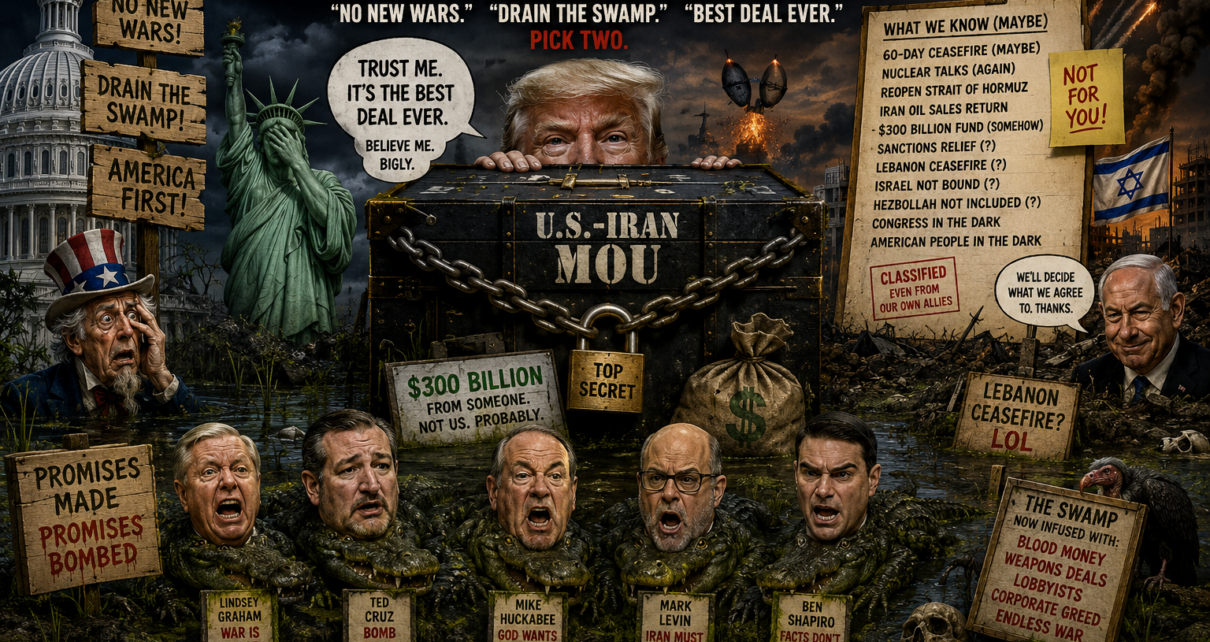
Is it oil waivers? Is it sanctions relief? Is it a $300 billion private reconstruction fund? Is it a promise that Iran will never have a nuclear weapon, despite the awkward little historical footnote that U.S. intelligence has repeatedly said Iran was not actively building one? Is it a promise to reopen the Strait of Hormuz, which was open before we started bombing the country whose retaliation helped close it? Is it a Lebanon ceasefire that Israel may or may not honor, Hezbollah may or may not accept, Iran may or may not require, and Trump may or may not have read?
No one really knows. That’s the “beauty” of the thing. And also its horror.
This is apparently the greatest deal in the history of deals, negotiated by a president who literally wrote a book called The Art of the Deal, and the central feature of the deal is that the public cannot see the deal.
This is like Michelangelo finishing the Sistine Chapel, inviting everyone to look up, and then saying, “Actually, I’d prefer to unveil the ceiling in a more formal setting. Until then, just trust me. Very beautiful angels. Huge angels. The best.”
The administration’s case is simple: the deal is excellent, the deal is secret, the deal is historic, the deal is incomplete, the deal ends the war, the deal depends on future negotiations, the deal reopens Hormuz, the deal needs mines cleared first, the deal includes Lebanon, the deal maybe doesn’t include Lebanon, Israel hasn’t seen the deal, Iran has demands about the deal, Congress is confused by the deal, and the American people should stop asking about the deal because asking about the deal is probably bad for the deal.
This is government by escape room.
The same administration that sold itself as a populist battering ram against the permanent war class is now asking its voters to applaud a secret arrangement stitched together after months of war with Iran, an explosion in oil prices, a shipping crisis, missile strikes, mines, dead civilians, wounded alliances, and a congressional oversight process that has apparently been reduced to lawmakers wandering around like substitute teachers asking, “Has anyone seen the syllabus?”
And the funniest part, if one can still laugh while standing in the geopolitical smoking crater, is that Trump’s original brand was not “let’s invade another Middle Eastern country because Lindsey Graham seems bored.”
No. The pitch was no new wars. The pitch was drain the swamp. The pitch was that the geniuses who gave America Iraq, Afghanistan, Libya, Syria, color-coded terror charts, WMD fairy tales, freedom fries, and “we’ll be greeted as liberators” would finally be banished from respectable life and forced to retire to some think tank basement where they could simulate regime change on a Risk board.
That was the deal with the voters.
That was the real contract.
No more swamp. No more neocon séance. No more turning every American election into a hiring fair for people who believe foreign policy is just demolition with footnotes.
And then, as if scripted by a satirist with a drinking problem, the movement that promised to drain the swamp marched directly into war and refilled the swamp with blood.
The swamp was not drained. It was irrigated. It was fertilized by the usual moral manure. It was watered by the blood of innocents and the pestilence of men who confuse other people’s children with chess pieces.
And up from that swamp crawled the old creatures, smiling.
Lindsey Graham, forever dressed like the ghost of every bad idea America has ever had in the Middle East, found new purpose. Ted Cruz, a man who can apparently locate ancient prophecy faster than he can locate basic facts about the country he wants to overthrow, rediscovered the joys of war fever. Mike Huckabee, Mark Levin, Ben Shapiro, and the rest of the cable-news artillery choir lined up to declare that the president was suddenly statesmanlike, serious, Churchillian, providential, and possibly receiving tactical updates directly from the Book of Revelation.
How strange.
The very people the populist revolt wanted exiled from power became the praise band for the war.
The same crowd that once looked at Trump with horror, disgust, or barely concealed opportunism suddenly fell in love once the bombs started falling. Apparently “America First” becomes much more respectable in Washington when America comes second, the Constitution comes third, and the donor class gets preferred boarding.
For years, the populist right was told that Trump was the antidote to the Bush-era necromancers. He was the orange antibiotic. He would kill the infection. He would stop the endless wars, humiliate the foreign-policy blob, and force the Republican Party to remember that Iowa exists and so does Ohio and maybe, just maybe, the United States government should care more about American towns than about remapping the Levant like a drunken cartographer at AEI.
And then the minute Iran came onto the screen, the old Republican reflex returned.
The swamp creatures did not even need to knock. They had keys.
“Mr. President,” they whispered, “you know what would really drain the swamp? A new war in the Middle East.”
And somehow, unbelievably, that worked.
The populists who had cheered Trump as the anti-war disruptor watched him become the thing he had promised to destroy. The “no new wars” president had a new war. The “drain the swamp” president had swamp creatures doing laps in the Lincoln Bedroom. The “America First” administration was suddenly explaining why American pilots, American money, American ships, American credibility, and American constitutional order had to be put on the line for Israel’s regional war aims.
Then came the split.
Tucker Carlson, Candace Owens, and much of the America First base recoiled. The populist right, or at least the portion that had actually believed the words “America First” meant “America first,” asked the forbidden question: why are we doing this?
Why are we bombing Iran?
Why is Congress an afterthought?
Why is Israel’s war now our war?
Why are the people who lied us into one Middle Eastern catastrophe suddenly being treated like wise elders because this time they swear the mushroom cloud speech is different?
Why does every war begin with “imminent threat” and end with “the intelligence was complicated”?
For this sin, they were denounced. Not debated. Denounced. The new rule was simple: support the war or be accused of isolationism, antisemitism, cowardice, treason, naivety, Putinism, or insufficient enthusiasm for the latest regional “turning point” that will definitely stabilize the Middle East once the explosions stop.
But now the joke has turned again.
Because after losing the anti-war America First base by going to war, Trump appears to be losing the pro-war neocon base by trying to leave it.
This is the rare political feat of betraying both sides of your coalition in sequence, like a magician sawing himself in half and then charging both halves admission.
The hawks cheered when he bombed. They swooned when he escalated. They fawned when he spoke their language. They praised him as strong, decisive, biblical, historic. But now that he seems to be trying to exit the war before it becomes a permanent regional blood machine, the same people are discovering principles.
Suddenly they care about verification.
Suddenly they care about weakness.
Suddenly they care about secret deals.
Suddenly the same people who wanted to entrust civilization to missiles are gravely concerned that diplomacy might be too risky.
It is a beautiful transformation. Nature is healing. The war lobby has molted into the accountability lobby.
How moving.
The reported deal, from what can be reconstructed through leaks, briefings, and the usual anonymous-official fog machine, seems to do several things. It extends a ceasefire for roughly 60 days. It starts future nuclear talks. It begins reopening the Strait of Hormuz. It may allow Iran to sell oil freely under waivers. It may open pathways to sanctions relief. It may release frozen funds. It may include or be paired with a $300 billion private reconstruction and development fund, supposedly not paid by American taxpayers, because nothing says “principled anti-Iran pressure campaign” like creating a gigantic investment vehicle and then insisting the money is morally laundered because someone else wrote the check.
And then there is Lebanon.
Always Lebanon.
Iran says any peace framework depends on Israel withdrawing from Lebanon. Israel says it will remain in Lebanese territory as long as necessary. The White House talking points apparently claim the deal ends military operations on every front, explicitly including Lebanon. Israeli officials reportedly say they are not bound by an agreement they have not seen. Hezbollah is not formally a party to the U.S.-Iran negotiations and has its own view of what constitutes “peace,” which tends to differ from Washington’s PowerPoint version.
This is not a peace deal. This is a diplomatic group project where three members hate each other, one member brought explosives, one member refuses to open the Google Doc, and the professor is Emmanuel Macron saying, “Perhaps this can still receive partial credit.”
The Strait of Hormuz is another masterpiece of absurdity.
Before the war, the strait was open. Then the U.S. and Israel attacked Iran. Iran retaliated and traffic collapsed. Mines, drones, missiles, speedboats, tolls, blockades, shipping insurance panic, global energy disruption, the whole deluxe package. Now the administration is presenting the reopening of the strait as a historic victory.
This is like setting your kitchen on fire, calling the fire department, and then demanding a Nobel Prize because the smoke alarm worked.
Yes, reopening Hormuz matters. It matters enormously. A fifth of global oil and natural gas trade used to pass through that narrow artery. When it closes, the world’s bloodstream clots. Energy prices rise. Food prices rise. Insurance rates rise. Every consumer in America gets to discover that “foreign policy” is not some abstract thing happening far away but the invisible gremlin sitting inside the price of eggs, gasoline, shipping, fertilizer, plastic, and everything else modern life has foolishly decided to depend on.
But again, the question is not whether reopening Hormuz is good.
Of course it is good.
The question is why the arsonists are now wearing firefighter helmets and expecting applause.
Then there is the nuclear justification. The sacred mushroom cloud. The golden oldie. The foreign-policy karaoke song America sings whenever it wants to bomb a country whose internal politics it does not understand.
Iran must never have a nuclear weapon, we are told. Fine. Whatever. Let’s say that a laudable goal. But this is where the record scratches.
The U.S. intelligence community has long assessed that Iran halted its nuclear weapons program in 2003. More recently, America’s own intelligence leadership said Iran was not building a nuclear weapon and that its supreme leader had not reauthorized the suspended program. Verification matters. But “nuclear risk exists” is not the same sentence as “therefore launch an undeclared war.”
That distinction used to matter in a constitutional republic. How quaint, I know!
The more uncomfortable question is whether the nuclear issue was the core reason for the war or the moral costume hung on a much older regional ambition. For decades, Israeli security doctrine has treated Iran not merely as a nuclear problem but as the head of a regional network: Hezbollah in Lebanon, armed groups in Iraq, influence in Syria, pressure on Israel’s northern border, and the broader “axis” problem. The old “Clean Break” worldview did not talk only about Iran’s nuclear ambitions. It talked about reshaping the regional balance, confronting Syria and Hezbollah, rejecting land-for-peace logic, and using strategic pressure across Lebanon, Syria, Iraq, and Iran.
So one has to ask, impolitely because polite questions have gotten us several trillion dollars of rubble: was Iran the target, or was Iran the excuse?
Was the point really to stop a bomb U.S. intelligence said Iran was not actively building? Or was the point to create the military and political conditions for Israel to reshape Lebanon, weaken Hezbollah, expand buffer zones, and force Washington to underwrite the entire operation while calling it “self-defense”?
This is not a conspiracy theory; it is a policy question. It is the kind of question adults should be allowed to ask before the missiles launch, not afterward when everyone is busy writing memoirs called Difficult Choices I Made While Ignoring Congress.
And what happens now if Israel refuses the Lebanan component? Does the deal collapse? Does Iran walk? Does Hezbollah resume attacks? Does Trump blame Netanyahu? Does Netanyahu blame Iran? Does Lindsey Graham blame weakness? Does Mark Levin shout with his annoying pitchy voice until the drywall cracks? Does Ben Shapiro produce a 47-minute monologue explaining that peace is actually war when you adjust for context? Does the White House issue another talking-point sheet explaining that the agreement definitely includes Lebanon, unless Israel says it doesn’t, in which case it includes Lebanon spiritually, aspirationally, in a non-binding sense, like a New Year’s resolution?
The whole thing hinges on whether the United States is actually sovereign in its foreign policy or merely the customer-service department for Israeli regional strategy.
That is the question no one in polite Washington wants to ask plainly.
What is the relationship between the United States and Israel supposed to be?
Allyship is not servitude. Friendship is not obedience. Support is not blank-check militarism. A sovereign nation may defend an ally without outsourcing its constitutional war powers to that ally’s prime minister. A republic may recognize Israel’s security concerns without pretending every Israeli objective is automatically an American obligation.
And yes, the darker question now hovering over the internet should be treated carefully: what does Netanyahu have over Trump, if anything?
People speculate. Of course they do. When a president runs on no new wars, starts a new war, echoes another country’s security rationale, then appears terrified of angering that same country’s political lobby until suddenly he isn’t, people will invent theories. Some whisper about Epstein files. Some imply blackmail. Some imagine secret kompromat locked in a vault beside the deal.
There is no verified evidence for that. But the absence of proof does not erase the political mystery. It simply changes the responsible question. The question is not “prove the blackmail.” The question is: why does American policy so often behave as if blackmail were unnecessary?
Why does Washington lunge toward escalation so naturally? Why do politicians who can barely agree on infrastructure become poets of unity when the subject is bombing Iran? Why do donors, pundits, think tanks, lobbyists, defense contractors, and cable hosts form a perfect human centipede of war enthusiasm every time Israel wants escalation? Why does dissent from that consensus get treated not as policy disagreement but as moral heresy?
Maybe no one has compromising files. Maybe no one needs them. Maybe the system itself is the blackmail! Ah ha! What about that thought, eh?
Maybe the donor class, the lobby ecosystem, the defense industry, the evangelical prophecy market, the think-tank laundering machine, and the permanent career incentives of Washington are enough. Maybe the machine is so well-built that no secret envelope is required. The threat is not “do this or we release the files.” The threat is “do this or we destroy your coalition, your donors, your media support, your access, your legacy, and your next election.”
In other words, no blackmail required. Just politics as usual. Which is somehow more depressing. Trump now finds himself in a trap of his own making. He broke with his anti-war base by entering the conflict. Now he is enraging the hawks by trying to exit it. He fed the swamp and then discovered, astonishingly, that swamp creatures are not known for gratitude. They do not want a meal. They want a habitat.
The neoconservatives did not praise Trump because they loved him. They praised him because he gave them what they wanted: war with Iran. If he stops giving them that, they will turn on him with the moral passion of a defense contractor whose quarterly guidance depends on regional instability.
And so here we are….
A president elected in large part because voters were tired of the war racket now stands before the country with a secret deal to end a war many of those voters believe he should never have started. His old populist base thinks he betrayed America First. His new hawk friends think he is betraying Israel First. Congress wants oversight. Iran wants guarantees. Israel wants freedom of action. Lebanon wants not to be turned into a chessboard again. Europe wants Hormuz open. Gulf states want stability without being mugged for reconstruction money. Oil markets want clarity. The American people want the truth.
And the president wants a formal setting.
Fine.
Set the table. Bring the cameras. Invite Congress. Invite the press. Invite the families of the dead. Invite the voters who believed “no new wars.” Invite the young men and women who were told they might have to die for this. Invite the pundits who cheered the bombs and the populists who warned this would happen. Invite the Israelis. Invite the Lebanese. Invite the Iranians. Invite the ghosts of Iraq.
Then open the box.
Because this is not a game show. It is not a branding exercise. It is not a rally chant. It is not another episode in the long American sitcom where the war party burns down the neighborhood and returns three months later wearing a hard hat.
If the deal is good, show us.
If the deal is bad, show us!
If the deal is unfinished, say so.
If the deal gives Iran too much, let the public judge.
If the deal restrains Israel, say it plainly.
If the deal does not restrain Israel, stop pretending it ends the war.
If the deal depends on Lebanon, explain how.
If the deal does not depend on Lebanon, explain why Iran says it does.
If the deal reopens Hormuz by restoring the status quo before the war, stop selling us the restoration of the furniture as if you built the house.
And if the whole thing is just a desperate attempt to climb out of a hole after spending months insisting the hole was actually a tunnel to victory, have the decency to stop asking the American people to admire the shovel.
Mr. President, you wrote The Art of the Deal. (Or at least you said you wrote it and not some ghostwriter…)
You ran on no new wars.
You promised to drain the swamp.
Yet then you gave the swamp a war, gave the hawks a parade, gave the public a mystery, gave Iran leverage, gave Israel room to freelance, gave Congress a migraine, and gave every sentient voter in America the uneasy feeling that the people in charge are playing nuclear Risk with missing pieces.
So enough. Open the box. Show us the document.
Tell us what America got, what Iran got, what Israel agreed to, what Lebanon means, who controls Hormuz, who pays the $300 billion, what happens in 60 days, and why any of this required an undeclared war in the first place.
Because until then, the only honest slogan for this administration’s foreign policy is not “Peace Through Strength.”
It is:
What’s in the DEAL?!?