by Sean Dempsey | 06/23/26
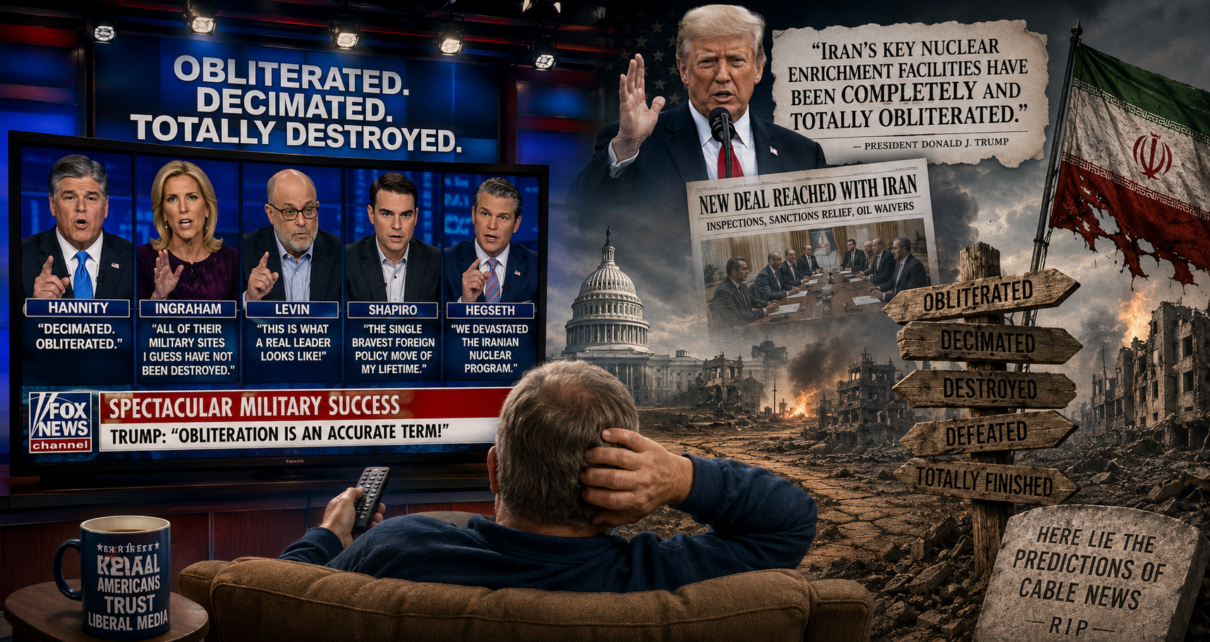
One must begin, in charity, with the invariable suffering of the average Fox News Boomer Republican. He is not a villain in this drama so much as a carefully cultivated specimen, raised under bright studio lights, fed a steady diet of certainty, and released each evening into the wilderness of American politics believing himself to be unusually well informed. He does not merely watch the news. He receives it like one sucking liquid from a straw. He sits before the glowing box as a mideval peasant might have sat before stained glass, trusting that the men inside it have access to mysteries beyond his station. They tell him who is strong, who is weak, who is patriotic, who is treasonous, who must be bombed, who must be investigated, and which contradictions are best left untouched and unexplored … at least until after the commercial break.
Imagine, then, his confusion when the war with Iran, which he had been assured was proceeding magnificently, ended not with the unconditional surrender of Tehran, not with a triumphant parade through the ruins of the ayatollahs, not with the permanent dismantling of Iran’s nuclear infrastructure, but with a promise of negotiations and myriad concessions. There were Trump and JD acting as tireless diplomats again. There were technical committees, escrow accounts, oil exemptions, verification disputes, and solemn men in suits explaining that the whole thing was very complicated. This presented our citizen with a small but painful difficulty. He had been told the enemy had been obliterated. Yet… somehow… confusingly… here now was the enemy, annoyingly unobliterated, sitting at the table thinking they’d won. One cannot help but scratch their heads at this painful contrast.
I suppose, as it might, that the trouble began with the word “obliterated.” This seemingly is a word so splendidly final that one almost feels ungrateful asking follow-up questions. President Trump told the nation that “Iran’s key nuclear enrichment facilities have been completely and totally obliterated.” He described the strikes as a “spectacular military success.” When doubts later emerged about the extent of the damage, he returned to the matter with characteristic modesty, declaring that “Obliteration is an accurate term!” and adding, with the restrained dignity of a statesman, “Bullseye!!!” It was a beautiful performance, and in fairness, one cannot blame the audience for understanding the English language in its ordinary sense. If a thing is completely and totally obliterated, the common mind assumes it no longer requires inspectors, diplomats, sanctions waivers, or future negotiations. One does not usually dispatch the International Atomic Energy Agency to examine a crater in search of diplomatic possibilities.
Yet there they were, negotiating. President Trump later insisted Iran had agreed to nuclear inspections, while Iranian officials publicly disputed key elements of the American account. The Strait was open. Then closed. Now it was open again because we begged it to be. At the same time, reports described a new interim framework involving sanctions relief, oil waivers, access to frozen assets, and renewed inspection arrangements. One might ask why any of this was necessary if the problem had already been reduced to dust, but this is precisely the sort of question that causes discomfort in a mature democracy, and therefore is best left to cranks, isolationists, appeasers, pacifists, Democrats, and the occasional Republican who still remembers the Iraq War.
The average Fox viewer, however, had not been prepared for this outcome. He had been prepared for victory, and not merely victory, but a victory of the cleanest and most televisual sort. The sort of victory in which maps are redrawn with arrows, enemies are humiliated in chyron-sized phrases, and the host concludes the segment with the grave satisfaction of a man who has personally supervised the destruction of evil from a climate-controlled studio in Manhattan. The viewer had been told that American power had once again demonstrated its supremacy. He had been told that Iran was weaker than ever. He had been told that the Iranian regime was tottering. He had been told that the nuclear program had been destroyed, the military had been shattered, the navy was finished, the missiles were disappearing, and the only remaining question was whether the bad guys would have the good manners to collapse on schedule.
Ben Shapiro supplied the appropriate musical accompaniment. He praised Trump’s Iran campaign as “the single bravest foreign policy move of my lifetime” and argued that the Iranian regime was in its “death throes.” This is the sort of language that does a great deal of work in the mind of the partisan consumer. A regime in its “death throes” is not merely weakened. It is expiring. It is twitching on the floor of history. One need not prepare for its long-term deterrence, enforcement, evasion, adaptation, retaliation, or survival. One need only wait for the final spasm and applaud the genius of the surgeon. Such language is tremendously satisfying, especially when spoken by men who will not be asked to occupy the country, rebuild the region, pay the oil bill, explain the civilian casualties, or attend the funerals.
Mark Levin, never a man to understate the moral clarity of whatever war he presently desires from a safe distance, sagely praised Trump’s decision to strike Iran with the sort of enthusiasm more commonly associated with a football fan watching a fourth-quarter touchdown. “This is what a real leader looks like!” he declared with barely-restrained bloodlust. Elsewhere, he had warned that “Iran has never been weaker in 47 years” and argued that delay would leave the problem to America’s children, who would supposedly face an Iranian regime with “tens of thousands of ballistic missiles” and “scores and scores of nuclear warheads.” It is a curious rhetorical method: describe the enemy as simultaneously on the verge of collapse and on the verge of apocalyptic strength, then accuse anyone reluctant to bomb immediately of failing to understand seriousness.
Like a broken clock sometimes being right accidently, Levin later stumbled into the very argument that should have troubled the entire enterprise from the beginning. In a Fox News opinion piece questioning the enforceability of a new deal, he wrote that his “greatest concern has always been enforcement,” because the Iranian regime “cheats, lies and hides what it is doing,” and because “our intel and satellites simply cannot catch all of it.” This was intended as an argument against trusting Iran, and indeed it may be one. But it is also, quite accidentally, an argument against the infantile certainty that surrounded the war from the start. If Iran cheats, lies, hides, and cannot be fully monitored by American intelligence and satellites, then perhaps the public should have been told from the beginning that the destruction of some facilities would not magically settle the matter. Perhaps a television audience should have been informed that a state with deep underground facilities, dispersed capabilities, scientific expertise, missile forces, proxy networks, and decades of experience surviving sanctions and sabotage does not become a defeated abstraction simply because a host says so with sufficient volume.
Mike Huckabee offered his own contribution to the national understanding. As U.S. ambassador to Israel, he wrote after Iranian missile attacks that “Iran and its proxy agents of evil want to incinerate America and Israel” and that the “Mothership of Satan is in Tehran.” Earlier, in another formulation equally useful for lowering the temperature of a delicate regional crisis, he warned that Israel was “only the appetizer” because Iran’s “real entrée, their ultimate goal, is to destroy the United States.” Now, perhaps this is so. Perhaps the world is best understood through restaurant metaphors and Satanic aviation. Yet it must be admitted that such language does not exactly invite citizens into the hard mechanics of military strategy. It does not explain deterrence, escalation, command-and-control, missile survivability, energy markets, proxy retaliation, or the difficulty of converting airstrikes into political outcomes. It does, however, perform the more important function of making the viewer feel that all ambiguity has been abolished. Once Tehran is the Mothership of Satan, further analysis becomes not only unnecessary but faintly impious.
Ted Cruz, who has the rare gift of sounding as though he is prosecuting the entire human race for disappointing him, also assisted in manufacturing the atmosphere of inevitability. He told Fox that the United States was “unquestionably winning the war” with Iran and described Trump’s decision to launch military action as “the most consequential decision” of his presidency. He also insisted the conflict would not become another Iraq, saying, “I don’t think there’s any possibility that this becomes a long, protracted military engagement. You’re not going to see hundreds of thousands of boots on the ground. You’re not going to see us there months and then years. Iran is not Iraq.” This was an admirable reassurance, in the same way a man lighting a match in a fireworks warehouse may reassure the crowd that he has no intention of burning down the building. Intentions are interesting. Consequences are more so.
Cruz later changed emphasis when the deal arrived, warning that “Giving billions of dollars to theocratic lunatics who want to murder us is not a good idea.” He praised Trump for military action, saying that “It took the Iranian regime 47 years to build that military” and “it took the U.S. military 39 days to utterly destroy it.” Yet even this magnificent sentence contains the seed of its own undoing. If the Iranian military was “utterly destroyed,” why fear rebuilding it through concessions? If Iran’s nuclear threat was prevented, why did negotiations remain necessary? If victory was unquestionable, why did the post-victory settlement look suspiciously like the sort of diplomatic entanglement everyone had spent years denouncing when performed by lesser mortals named Obama or Biden?
Sean Hannity, in the role of imperial town crier, was even more emphatic. He said that “The United States absolutely decimated, obliterated Iran’s nuclear program,” adding that “the Islamic Republic of Iran has been totally defanged, their nuclear program has been obliterated.” On another broadcast, he similarly claimed that “the U.S. military completely obliterated Iran’s nuclear program” and that “President Trump obliterated Iran’s nuclear program with a massive strike.” There is something almost touching about the repetition. Obliterated. Completely obliterated. Totally defanged. Decimated. Obliterated again, lest anyone worry that a single obliteration might prove insufficient. The language functioned less as analysis than as liturgy. It was not designed to help the citizen understand what had happened. It was designed to prevent him from wondering whether anyone actually knew.
Laura Ingraham, to her limited credit, eventually permitted a little daylight into the sanctuary when she observed, “All of their military sites I guess have not been destroyed.” One can almost hear the machinery grinding. “I guess” is doing heroic work in that sentence. It is the sound of reality arriving late to a broadcast that had already sold tickets to the victory parade. Ingraham later defended Trump’s negotiations as proceeding from strength, emphasizing Iran’s weakened military and economy. This was the necessary pivot. When the war was underway, destruction meant victory. When the deal appeared, negotiation meant strength. When Iran survived, survival itself became proof that Trump had forced them to the table. In this manner, every possible outcome may be converted into success, provided the audience does not remember what it was told last week.
Pete Hegseth, though no longer merely a Fox personality but now an official of the very government whose war needed explaining, offered perhaps the purest statement of the administration’s television logic. After the 2025 strikes, he said the operation was an “incredible and overwhelming success” and that “we devastated the Iranian nuclear program.” He later said, “Thanks to President Trump’s bold and visionary leadership and his commitment to peace through strength, Iran’s nuclear ambitions have been obliterated.” In 2026, as the war expanded, he declared, “We didn’t start this war but under President Trump we’re finishing it,” and described the mission as “clear, devastating, decisive”: destroy the missile threat, destroy the navy, and ensure “no nukes.” This is the music of bureaucratic certainty. It is tidy, muscular, and ideally suited for a three-minute clip. It is less suitable for explaining why, after all the devastation and decisiveness, the United States still needed a negotiated framework with the very people whose ambitions had supposedly been obliterated.
The purpose of assembling these quotations is not to claim that every one of these figures knowingly lied. That is a more difficult accusation and, in some cases, may give them too much credit. The more precise charge is that they sold certainty where uncertainty existed. They sold finality where ambiguity remained. They sold moral theater where strategic analysis was required. They sold the public facts not yet in evidence, conclusions not yet proven, and victories not yet secured. In the economy of political media, this is hardly a scandal. It is the business model.
What the average viewer never received was an honest education in asymmetrical warfare. He was shown explosions, and explosions are persuasive. He was shown maps, and maps are comforting. He was shown retired officers and politicians speaking in complete sentences of absolute confidence. What he was not given was the ugly little truth that a weaker power does not need to defeat the United States in order to frustrate American objectives. It only needs to survive. It needs to impose costs. It needs to preserve enough capability to deter, enough ambiguity to negotiate, enough influence to retaliate, and enough political structure to prevent the enemy from translating destruction into submission.
Iran understood this long before the average American voter did. Iran watched Iraq. Iran watched Afghanistan. Iran watched Libya. Iran watched Syria. It watched Washington mistake battlefield dominance for strategic mastery again and again. It watched American officials destroy things brilliantly and govern consequences disastrously. It watched a superpower capable of bombing almost anything and controlling almost nothing afterward. Thus Iran built a doctrine not around defeating America in a conventional war, but around denying America the clean, decisive, television-friendly victory it craves.
This is the concept that never quite made it through the cable-news filter: military superiority is not the same thing as political control. The United States can destroy air-defense systems, naval assets, missile depots, command facilities, and enrichment infrastructure. It can impose terrible costs. It can kill commanders, disrupt supply chains, and degrade capabilities. But none of this automatically produces surrender, compliance, regime collapse, or long-term strategic success. The enemy gets a vote. Geography gets a vote. Domestic politics gets a vote. Energy markets get a vote. Intelligence gaps get a vote. Public exhaustion gets a vote. And reality, that most treacherous of institutions, gets the final vote.
This is why the intelligence record mattered so much and why so little of it fit easily into partisan television. Public reporting from the Associated Press noted that U.S. intelligence and international bodies had not publicly established that Iran had an active nuclear weapons program since 2003. A 2025 U.S. intelligence report reportedly assessed that Iran was not building a nuclear weapon, even while Iran had enriched uranium to near weapons-grade levels and possessed enough stockpile for potential weapons if it chose to weaponize. This distinction is not a minor technicality. It is the difference between capability and decision, between risk and imminence, between a serious strategic problem and an emergency requiring war.
But distinctions are poison to propaganda because they make the audience think. And thinking is a vain and vile action; like sugar, propaganda is far more easily digestible.
The Fox News Republican was not told a completely invented story. That would be too crude. He was told selected truths arranged into a false sense of certainty. Iran was dangerous. Iran had supported proxy forces. Iran had enriched uranium to alarming levels. Iran had missile capabilities. Iran had a long history of hostility toward the United States and Israel. All of that was real. But real facts can still be arranged into a dishonest picture when the missing pieces are carefully excluded. The missing pieces were uncertainty, cost, second-order consequences, intelligence limits, political end states, and the possibility that the war might produce not victory but merely a more expensive version of the same problem.
This is how echo chambers actually work. They do not need to fabricate everything. They merely need to curate the facts so that the audience arrives at only one permissible conclusion. The viewer is allowed to know that Iran is dangerous. He is not encouraged to know that danger alone does not answer the question of whether war will solve the problem. He is allowed to know that American bombs are powerful. He is not encouraged to know that powerful bombs do not automatically create enforceable settlements. He is allowed to know that Trump said the nuclear sites were obliterated. He is not encouraged to ask why negotiations, inspections, and sanctions relief remained necessary afterward.
This is not a uniquely conservative sickness. It is American politics in its mature decadent form. The Left has its own therapeutic institutions, its own priesthood, its own words that end arguments, its own experts who are experts because they confirm the emotions of the congregation. MSNBC has its own catechism. The activist internet has its own blasphemy codes. Liberal audiences also consume certainty disguised as sophistication. They too enjoy being told that every event confirms what they already believed. They too confuse moral intensity with understanding. They too imagine propaganda only works on the sort of people who watch different commercials.
The tragedy is that every tribe now believes itself uniquely immune to manipulation. Conservatives think propaganda is something produced by CNN. Liberals think propaganda is something produced by Fox. And to be fair, even Libertarians like me may think propaganda is anything that fails to mention the Federal Reserve within the first ninety seconds. Populists think propaganda is what elites say, while elites think propaganda is what populists believe. Everyone sees the other man’s cage. No one sees his own.
The Fox News Boomer scratching his head over the Iran deal is therefore not merely a comic figure. He is a symbol of the modern citizen. He did not fail because he was unusually foolish. He failed because he trusted a format designed to reward emotional certainty over disciplined thought. He believed the men on television because they spoke with confidence, and in America confidence is routinely mistaken for knowledge. He heard “obliterated” and assumed that meant obliterated. He heard “death throes” and assumed that meant dying. He heard “unquestionably winning” and assumed that meant victory was not in question. He heard “real leader” and assumed leadership had produced results rather than applause.
But then the deal arrived…
The deal was not supposed to arrive like this! It was supposed to arrive as an instrument of surrender, if it arrived at all. Instead, it arrived with all the ordinary furniture of diplomacy: terms, conditions, monitoring, disputes, concessions, denials, enforcement concerns, and competing narratives. Iran had not disappeared. Iran had not surrendered its place in the story. Iran had absorbed punishment, imposed costs, preserved bargaining power, and returned to the table. The war had produced destruction, certainly. It had produced headlines, ratings, speeches, and patriotic satisfaction. But it had not produced the clean moral ending the viewer was sold.
The first thing that leaps off the page of the memorandum is not what Iran surrendered. It is what Iran stubbornly refused to surrender. This presents a small problem for anyone who spent the last several months being assured that Iran’s nuclear program had been “completely and totally obliterated.” One naturally expects an obliterated nuclear program to exhibit certain characteristics. For example, one expects it not to exist. Yet there it sits in the agreement, alive enough to require future negotiations, future inspections, future monitoring, future verification, and future disputes. Iran merely reaffirms that it does not seek nuclear weapons (to be clear: this is a position it has publicly maintained for years!) while the actual disposition of enriched uranium, enrichment levels, and long-term restrictions remain subjects for future bargaining. Most amusing of all is the provision stating that Iran will maintain the “current status quo” of its nuclear program pending a final agreement. Status quo. It is a magnificent phrase. Apparently the easiest way to preserve a nuclear program is to have it completely obliterated. One imagines future military planners taking notes. If this is what obliteration looks like, one hesitates to imagine survival.
The economic provisions read less like the terms imposed upon a defeated adversary and more like the guilty apology of a man who has just driven his neighbor’s car through the front window of a restaurant. The United States commits itself to supporting at least $300 billion in reconstruction and economic development. Sanctions are to be lifted. Secondary sanctions are to be lifted. Oil sanctions are to be lifted. Banking restrictions are to be lifted. Frozen assets are to be released. Waivers are to be issued. Commercial activity is to be restored. Insurance services are to be restored. Transportation services are to be restored. Financial channels are to be restored. One almost expects the memorandum to conclude with an offer to wash Iran’s car and mow its lawn every other Saturday. This is not necessarily bad policy. It may be sensible policy. It may even be wise policy. But it bears only a passing resemblance to the triumphal rhetoric that preceded it. Citizens were told they were witnessing the destruction of a dangerous adversary. The document reads suspiciously like a nation opening its wallet and asking what price must be paid to bring the entire unpleasant episode to a conclusion.
The military provisions are perhaps the funniest part of the entire exercise. For months the public was informed that Iran had been shattered, crippled, broken, isolated, and strategically helpless. Yet when one reaches the actual agreement, the supposedly shattered party somehow possesses sufficient leverage to negotiate the removal of naval blockades, the withdrawal of military forces from its vicinity, guarantees against additional deployments, and limitations on future sanctions. Meanwhile the United States receives commitments regarding shipping lanes and maritime access. This is not the language of surrender. This is the language of two governments attempting to stop bleeding. The entire arrangement reads like the settlement of a bar fight in which both participants emerge insisting they won while quietly agreeing that neither would survive another round. If Iran had truly been reduced to the smoldering ruin described nightly on television, one might reasonably expect the agreement to contain more demands and fewer negotiations. Instead it contains the sort of reciprocal concessions that emerge when both parties possess enough leverage to make further escalation unattractive.
Most revealing of all is what the memorandum does not contain. There is no surrender. There is no regime change. There is no formal admission of defeat. There is no dismantling of the Islamic Republic. There is no public confession that Iran’s strategic position has collapsed. There is no declaration that American objectives have been fully achieved. There is simply diplomacy… long, tedious, frustrating diplomacy. This is the very thing that millions of Americans were assured had become unnecessary once the bombs started falling. This is what makes the document politically dangerous. It does not necessarily prove that America lost. It proves something far more embarrassing. It proves that reality refused to cooperate with the script. Americans were sold a story in which overwhelming military success would produce a clean and decisive outcome. Instead they received what history usually delivers: compromise, ambiguity, unresolved disputes, mutual concessions, and a final agreement that looks suspiciously like the sort of agreement nations sign when neither side achieved everything it wanted. The greatest casualty of the memorandum may therefore be neither American prestige nor Iranian ambition. It may be the television narrative itself. For if the war was won as completely as viewers were told, then one is left confronting a genuinely baffling question: why does the peace agreement read so much like the settlement of a problem that survived?
There is a lesson here, though it is one Americans will almost certainly refuse to learn. The lesson is not that Iran is good, or that Trump is uniquely bad, or that Fox viewers are uniquely stupid, or that Democrats would have handled everything wisely, which is among the more amusing fantasies still circulating in certain neighborhoods of the internet. The lesson is that war is a terrible instrument for producing television-shaped outcomes. It does not care about narrative arcs. It does not respect brand identities. It does not conclude when the host runs out of airtime. It continues into the realm of consequences, which is the one country American punditry almost never visits.
The ultimate scandal, then, is not that commentators got things wrong. Commentators get things wrong constantly and continue prospering, which is one of the miracles of the modern economy. The scandal is that millions of citizens were trained not to notice the difference between analysis and emotional service. They were not asked to think. They were asked to feel informed. They were given a storyline, a villain, a hero, a slogan, a handful of dramatic verbs, and a promise that the world remained simple.
No light gets into an echo chamber. That is its purpose. It is a closed loop in which truth dies not only as the first casualty of war, but as the routine casualty of format. The host speaks. The guest agrees. The clip circulates. The audience applauds. The narrative hardens. The contradiction is postponed. The next segment begins. By the time reality arrives, everyone has forgotten what was claimed in the first place.
And so our poor Boomer in his recliner sits before the television, wondering how a war he had already won became a deal he is now supposed to defend or denounce depending on the latest instructions. He is confused, but his confusion is not evidence that he is hopeless. It is evidence that reality has finally broken through. For one brief moment, between the slogan and the next commercial, he has encountered the most dangerous and damnable question in his entire political life: if they were so certain then, why should I believe them now?
SOURCES:
- Trump’s “completely and totally obliterated,” “spectacular military success,” and “Obliteration is an accurate term!” claims are documented by the White House, ABC, PBS, and Fox-linked reporting.
- Shapiro’s “single bravest foreign policy move” and “death throes” quotes were reported from his Fox appearance.
- Levin’s “real leader” praise and later enforcement warning that Iran “cheats, lies and hides” and that “our intel and satellites simply cannot catch all of it” are from Fox/Fox-adjacent sources.
- Huckabee’s “incinerate America and Israel” and “Mothership of Satan” remarks, plus the “Israel is only the appetizer” quote, are from Fox/Times of Israel/JNS reporting.
- Cruz’s “unquestionably winning,” “most consequential decision,” “Iran is not Iraq,” and later “theocratic lunatics”/“39 days to utterly destroy it” remarks are from Fox and CBS local reporting.
- Hannity’s “decimated, obliterated” and “totally defanged” remarks are documented by Media Matters transcripts of his Fox show.
- Ingraham’s “All of their military sites I guess have not been destroyed” remark is likewise transcripted by Media Matters, and Fox describes her later argument that Trump was negotiating from strength.
- Hegseth’s “incredible and overwhelming success,” “devastated the Iranian nuclear program,” “we’re finishing it,” and “clear, devastating, decisive mission” language is documented by Fox, the Pentagon transcript, NPR/OPB, and PBS.
- AP reported that public evidence and U.S./IAEA assessments did not show an active Iranian nuclear weapons program since 2003, while Iran had enriched near weapons-grade and retained potential capability.