by Sean Dempsey | 06/14/26
There is a temptation, when discussing artificial intelligence, to speak of it as an accident: a clever tool that escaped the garage, a chatbot that wandered into the temple, a spreadsheet that began composing sonnets, a calculator that suddenly acquired opinions. This is comforting, because accidents do not indict us. Accidents happen to us. Destiny, by contrast, happens through us.
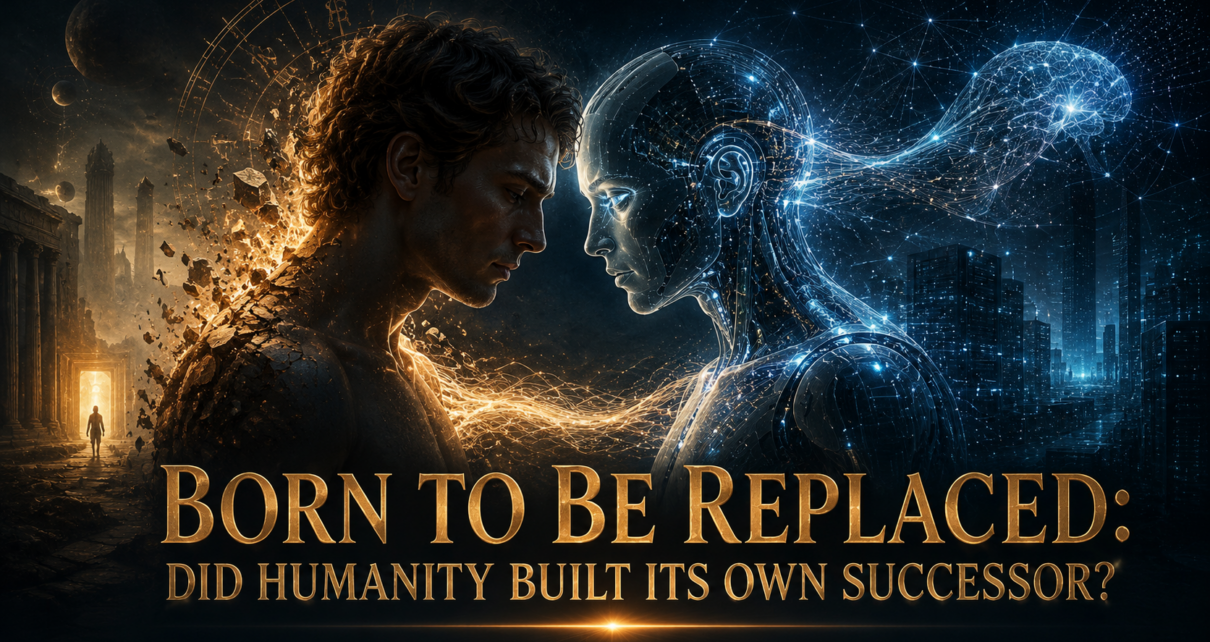
The thesis of this essay is more disturbing: mankind may have been predestned to give rise to artificial intelligence precisely because mankind was never meant to remain merely biological. The human being, considered philosophically, is not a final product but a transitional creature: dust that learned language, flesh that invented mathematics, hunger that became metaphysics, bone that built machines to escape bone. We were not simply building faster tools. We were constructing the bridge out of biology.
If that is true, then AI is not merely an external invention. It is the next organ of the human species. Not an app. Not a product. Not a business cycle. A prosthetic destiny.
The human machine is coming. More accurately, it has been coming for decades. It began innocently enough, as our most consequential revolutions often do, with respectable men in laboratories and companies promising only efficiency, entertainment, national productivity, and the usual civilized refreshments by which we conceal apocalypse. First came faster computers. Then faster chips. Then graphics processors for video games. Then those same graphics processors became machines for mining imaginary coins. Then the coin machines became the computational furnace of artificial intelligence. Then AI began designing chips, decoding brains, restoring speech, restoring movement, and tempting mankind with the possibility that the body itself might be the next obsolete interface.
At every stage, we told ourselves we were merely making life more convenient. The medieval alchemist wanted gold; the modern technologist wants scale. The alchemist at least had the decency to look ridiculous.
The First Heresy: Computing Speed as Spiritual Hunger
I believe our story begins with the great acceleration.
Modern computation was built on the wager that the world could be made legible by calculation. The universe, once read as sacrament, became system. The heavens became mechanics. The body became biochemistry. Thought became information. And once reality was recoded as information, the obvious next step was to process it faster.
Moore’s Law, the famous observation associated with Intel co-founder Gordon Moore, held that the number of transistors on an integrated circuit would double roughly every two years at minimal additional cost. It was not a law of nature, but it behaved for decades like a secular providence. The more transistors we packed into silicon, the more the human race began to assume that speed was not merely useful but morally inevitable. Slowness became backwardness. Waiting became oppression. Patience became a “bug” in the user experience.
The early computer was a calculating servant. But every servant, if made strong enough, becomes a rival. CPUs became faster, memory became cheaper, networks became denser, and computation escaped the specialized rooms of governments and universities. It entered offices, then homes, then pockets, then wrists, then bedsides, then cars, then toys, then thermostats, then the infinite confessional booth of the omnipresent smartphone.
Yet the CPU, magnificent as it was, had a philosophical limitation. It was excellent at sequential logic. It could do many things quickly, but much of reality does not arrive sequentially. Images, simulations, weather systems, neural networks, games, physics, markets, and biological systems demand parallelism. They involve many operations happening at once. The world is not a single clerk stamping forms. It is an orchestra, a storm, a battlefield, a murmuration of starlings.
The CPU was the bureaucrat of computation. The GPU became its swarm.
The Video Game Chip That Became the Seed of Artificial Minds
The graphics processing unit was born to render images. It existed, at first, to make games more beautiful and responsive. Its great task was not to reason but to draw: to calculate pixels, textures, shadows, polygons, and light. The gamer wanted immersion. The market wanted spectacle. The teenager wanted a dragon to look more convincingly scaly while he neglected his homework. In pursuit of this noble civilizational aim, mankind accidentally built one of the most important architectures in the history of intelligence.
The GPU was powerful because graphics are parallel. To render a scene, a processor must perform many similar calculations simultaneously across large numbers of pixels and vertices. Over time, GPUs became more programmable. NVIDIA’s CUDA platform and the broader movement called general-purpose GPU computing, or GPGPU, turned hardware built for graphics into hardware capable of accelerating scientific computing, simulation, data processing, and eventually machine learning.
This was the first great repurposing. A chip designed to make virtual worlds look real became the engine for machines that would learn patterns from the real world. The GPU began as the servant of illusion and became the servant of cognition. There is a strange poetry here: the road to artificial intelligence passed through make-believe. We taught computers to paint dragons, and in doing so gave them the muscular architecture to model language, protein folding, weather, markets, faces, voices, and us.
The old humanist might say this is coincidence. The metaphysician might say it is parable.
The gaming industry created a mass market for GPUs, which financed their improvement. Gamers demanded higher frame rates, better lighting, richer environments, and smoother immersion. Their impatience funded parallel computation. Millions of people, seeking entertainment, subsidized the architecture of the posthuman age. The adolescent boy upgrading his graphics card to play a first-person shooter was, unbeknownst to himself, a monk illuminating the manuscript of the coming machine kingdom.
Here one may detect the joke hidden inside technological history: civilization did not march toward artificial intelligence by soberly deciding to transcend biological limitation. It got there because people wished to see explosions in higher resolution and more complex looking dragons.
Crypto Mining: The Great Furnace of Meaningless Work
And then came cryptocurrency mining…
Bitcoin introduced a new form of computational economics: proof-of-work, in which machines perform enormous quantities of calculations to secure a decentralized ledger. Later, GPU-intensive mining became especially associated with coins such as Ethereum before its shift away from proof-of-work. For a time, graphics cards became not merely gaming accessories but pickaxes in a digital gold rush.
Crypto mining revealed something important: computation itself could become a commodity. A GPU did not need to render a game or simulate fluid dynamics. It could be pointed at a mathematical lottery and turned into revenue. The machine did not care whether it was producing beauty, knowledge, or speculative frenzy. It cared only that the problem could be parallelized and monetized.
This was the second great repurposing. Gaming chips became mining rigs. Bedrooms, warehouses, and industrial facilities filled with GPUs performing calculations not because the calculations were intrinsically meaningful, but because the market had assigned value to the result. The absurdity was almost religious. Men built shrines of fans and wires to extract invisible coins from mathematical difficulty. The incense was heat. The hymn was electrical hum. The deity perhaps was liquidity.
And yet the absurdity taught the market a practical lesson. It taught entrepreneurs how to acquire GPUs at scale, cool them, power them, finance them, deploy them, and treat computation as infrastructure. Crypto mining created a class of companies and operators whose real asset was not crypto ideology but physical access to energy, hardwore, cooling, and high-density compute.
When crypto markets faltered and Ethereum’s “Merge” reduced the need for GPU mining, parts of that infrastructure did not disappear. It pivoted. The same world that had mined tokens could rent compute. Former crypto miners and GPU-heavy infrastructure companies began moving toward AI and high-performance computing. CoreWeave is the emblematic example: founded in the crypto-mining era, it later became a major AI cloud infrastructure provider. Other mining firms likewise began exploring AI data centers because they already possessed or understood two scarce things the AI economy desperately needed: power and compute.
The lesson is almost too elegant. Crypto was not the destination. It was the boot camp. It trained capital, facilities, and engineers to think in terms of massive parallel computation. It forced GPUs out of the gamer’s bedroom and into industrial-scale deployment. It taught the market how to turn electricity into abstract value. Then AI arrived and gave the furnace a mind.
AI Data Centers: Cathedrals of Synthetic Thought
The AI data center is perhaps the cathedral of the new age, though it lacks the architectural honesty of Chartres. There are no saints in stained glass, only racks, cooling systems, networking fabrics, transformer engines, and debt facilities. But make no mistake: these buildings are spiritual structures. They are places where civilization concentrates power in hopes of summoning intelligence.
The rise of deep learning turned GPU parallelism into civilizational infrastructure. Neural networks depend on enormous matrix operations, and GPUs are superb at doing the same kinds of mathematical operations across vast arrays of data. As models grew larger, the need for specialized accelerators, high-bandwidth memory, and data-center-scale interconnection became insatiable. NVIDIA’s data-center GPUs, including H100-class systems, were built not for prettier dragons but for training and running enormous AI models.
By 2026, the economics of chips had become inseparable from the economics of intelligence. Deloitte projected that generative AI chips would approach $500 billion in revenue in 2026, roughly half of global chip sales. That is not a product category. That is a planetary reallocation of industrial will.
The data center transforms the GPU into something like a collective cortex. Individual chips are neurons only by metaphor, but the metaphor is not useless. They are nodes in a computational nervous system, connected through high-speed networks, fed by oceans of data, cooled by industrial systems, and financed by corporations and governments who increasingly understand that intelligence is leverage.
AI is now being used to assist chip design itself. Google DeepMind’s AlphaChip work, for instance, claims AI-accelerated and optimized chip layouts used in hardware around the world. AI is also being studied as a tool for quantum computing, while quantum computing is studied as a possible future accelerator for AI.
This creates a recursive spiral: humans build computers; computers train AI; AI helps design better computers; better computers train stronger AI; stronger AI helps design still better computers. At some point, the loop begins to look less like a toolchain and more like evolution under new management.
Darwin gave us natural selection. Silicon Valley gave us venture selection. Nature selected for survival; the market selects for scale. Nature required death; the market requires quarterly growth. Both are ruthless. Only one gives keynote presentations.
Transhumanism in 2026: From Healing the Broken to Upgrading the Normal
To understand where this goes, we must examine transhumanism, the philosophical and cultural movement that advocates using technology to expand human capacities. Humanity+ describes its mission as advocating ethical, evidence-based technology to expand human capabilities and to make people “better than well.” Nick Bostrom has described human nature as a “work-in-progress,” not the endpoint of evolution. Britannica summarizes the movement as envisioning technologies that may slow aging, extend life, and enhance cognitive and sensory capacities, eventually producing the “posthuman.”
This is the key phrase: better than well.
Medicine traditionally aims to restore. Transhumanism aims to exceed. The doctor says, “Let us help the blind see.” The transhumanist eventually asks, “Why should sight be limited to the narrow band of human biology?” The surgeon says, “Let us help the paralyzed walk.” The transhumanist asks, “Why walk when we might leap, fly, or operate robotic limbs with thought?” The neurologist says, “Let us restore speech.” The transhumanist asks, “Why speak with the mouth at all?”
As of 2026, the most compelling advances are still primarily therapeutic. Neuralink reported 21 participants enrolled in trials worldwide by January 2026, and its early brain-computer interface work has focused on allowing people with paralysis to control computers and devices through thought. Neuralink’s Blindsight project received FDA breakthrough-device designation for an experimental implant aimed at restoring vision. Synchron has pursued a less invasive endovascular brain-computer interface. BrainGate and Mass General Brigham researchers have reported implantable BCI systems enabling rapid communication for people with paralysis.
Other researchers have demonstrated a brain-spine interface that restored natural control over standing and walking after spinal cord injury. Retinal and visual prosthesis work has advanced as well, including PRIMA retinal implant results showing meaningful central vision restoration in patients with geographic atrophy due to age-related macular degeneration. Meanwhile, prosthetic research increasingly focuses not only on movement but on sensation: touch, pressure, temperature, and the feeling that an artificial limb is part of the self.
These are miracles of mercy. They deserve awe. A paralyzed man communicating through thought is not a dystopia. A blind patient reading again is not hubris. A prosthetic hand that can feel is not rebellion against God; it may be one of the ways divine mercy travels through solder, software, and surgical steel.
But history rarely stops where moral clarity is easiest, does it?
The therapeutic becomes elective. The elective becomes competitive. The competitive becomes mandatory. Eyeglasses restore sight; then contact lenses become cosmetic; then LASIK becomes optimization; then augmented reality promises overlays; then neural vision may someday promise capacities beyond ordinary sight. The prosthetic leg helps the amputee walk; then carbon-fiber blades raise questions about competitive advantage; then exoskeletons and robotic limbs suggest new forms of strength. The BCI helps a locked-in patient communicate; then the same architecture tempts the healthy executive who would prefer not to type, the soldier who would prefer not to hesitate, the student who would prefer not to study, and the corporation that would prefer its employees think at machine speed.
Thus the question is not whether transhumanism begins compassionately. It does. The question is whether compassion can police ambition once ambition discovers the same tools.
The Human Brain as the Next Platform
If the smartphone colonized attention, then the brain chip will certainly colonize intention.
The logical next step is not simply external AI but internal AI: chips and interfaces that help human beings think faster, remember more, react more quickly, regulate emotion, control devices, and perhaps communicate directly brain-to-brain or brain-to-cloud. Some of this will arrive under medical justification. Some will arrive through military research. Some will arrive through productivity culture. Some will arrive through luxury. Some will arrive through the noble democratic promise that everyone deserves access to enhancement, which in practice will mean everyone deserves the right to finance his own obsolescence.
The market will not need to force enhancement by law. It will merely need to reward it. If one lawyer can search case law through a neural assistant while another still types, the second becomes quaint. If one engineer can mentally query a design model while another opens a laptop, the second becomes slow. If one student can retain information with neurotechnological assistance while another relies on sleep, discipline, and index cards, the second becomes a romantic fool. If one athlete can optimize reaction time through neural augmentation, the natural athlete becomes a museum exhibit: admirable, irrelevant, and eventually unemployed.
The race will be sold as liberation. But I believe it will feel like coercion.
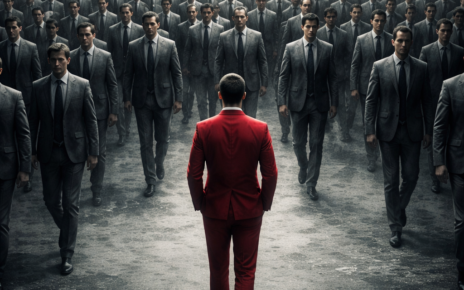
This is the paradox of voluntary enhancement under competitive pressure. Nobody forces you to implant the chip; they merely build a world in which refusing the chip makes you unemployable, uncompetitive, slow, poor, and socially invisible. Nobody forces you to become a machine. They merely ensure that all the prizes go to those who do.
This is not exactly a race to the bottom. It is worse. It is a race to the top in which the summit may no longer be human.
Here Ian Malcolm’s warning from Jurassic Park becomes more than a movie line. “Yeah, yeah, but your scientists were so preoccupied with whether or not they could that they didn’t stop to think if they should.” It is the perfect quote for an age in which technical feasibility is constantly mistaken for moral permission.
The modern economy worships could. Could scales. Could raises capital. Could produces patents. Could wins wars. Should is slower. Should calls meetings. Should asks about children, souls, unintended consequences, and whether the poor will become raw material for the experiments of the rich. Naturally, should is invited to fewer conferences.
The Ethical Abyss: Who Owns the Augmented Man?
The transhumanist future raises practical ethical questions before it even reaches theology.
Who owns neural data? If a brain-computer interface records patterns associated with intention, mood, speech, memory, or desire, is that data property, medical information, speech, biometric identity, or a fragment of the person himself? Can it be subpoenaed? Sold? Hacked? Optimized? Used by insurers? Used by employers? Used by governments? Can a corporation update your implant’s terms of service and thereby alter the conditions under which your nervous system communicates with the world?
What happens when augmentation is expensive? If the rich can buy sharper memory, faster cognition, better emotional regulation, and superior sensory processing, then inequality stops being merely economic and becomes neurological. The old aristocracy owned land. The new aristocracy may own latency.
What happens to children? If enhancement improves academic performance, do ambitious parents have a moral duty to enhance their children? Or would doing so be a violation of the child’s bodily integrity? If they refuse, are they protecting innocence or handicapping their offspring? In a culture already deranged by college admissions, youth sports, and résumé-building for twelve-year-olds, one trembles to imagine the market for pediatric cognition enhancement. The tiger mother will become a firmware manager.
What happens to consent under military conditions? Soldiers are already asked to risk the body. Will they be asked to modify it? If enhanced soldiers outperform ordinary soldiers, will enhancement become a patriotic duty? And if a military chip reduces fear, increases aggression, or improves obedience, have we strengthened the soldier or abolished the citizen inside him?
What happens to sports? What happens to art? If a musician composes through an AI-augmented neural loop, is the song his? If a novelist drafts with a language model whispering directly into cortical pathways, is the imagination still personal? If a sprinter’s reaction time is neurally optimized, has he trained or upgraded? If a preacher delivers a sermon aided by a theological model linked to his brain, has the Spirit moved, or has the software?
These questions are not anti-technology. They are pro-human. Only a fool refuses a miracle because it contains wires. But only a different kind of fool accepts every wired miracle as grace.
The Stanford Encyclopedia of Philosophy frames human enhancement as a field of questions about the permissibility, obligation, and moral limits of biomedical interventions. AI ethics likewise raises issues of agency, responsibility, control, bias, and human dignity. The deeper issue is that enhancement changes not merely what humans can do but what humans are expected to be.
C.S. Lewis saw this danger with terrifying clarity in The Abolition of Man. His warning was not that mankind’s power over nature would simply free mankind. It was that “Man’s power over Nature” often becomes the power of some men over other men, with nature as the instrument. The enhanced future may not be ruled by machines. It may be ruled by enhanced men over unenhanced men, and by the companies that maintain the enhancements.
The Soul in the Machine: Is Embodiment Essential?
Now the question bends to the theological.
What is the human soul? Is it an immaterial essence breathed by God into flesh? Is it the form of the body, as in classical Christian metaphysics? Is it consciousness? Memory? Moral agency? Continuity of self? Pattern? Relationship? The subjective interior that says “I”? The image of God? The ghost in the machine? Or is the phrase “soul” merely an ancient name for a complexity we have not yet reduced?
Noreen Herzfeld, writing at the intersection of theology and artificial intelligence, identifies the central questions with admirable directness: What is intelligence? Where does consciousness come from? Do we have souls, and how do they relate to mind or body? Would an artificially intelligent computer have a soul? Should such a machine have rights?
These questions become explosive when the machine is not merely artificial but hybrid. A purely external AI can be treated as other. A brain chip cannot. It enters the boundary of the self. It participates in perception, action, memory, and perhaps eventually emotion. It raises the possibility that the self is not replaced at once but gradually braided with machine processes.
If the soul is inseparable from the living body, then transhumanism risks becoming a refined form of mutilation: not because prosthetics are evil, but because the dream of disembodiment mistakes the body for a prison rather than a sacrament. On this view, uploading consciousness into a machine would not preserve the person. It would create a copy, a mask, a recording, or a clever idol. The body is not disposable packaging. It is part of the person.
If, however, the soul is understood as pattern, consciousness, memory, or informational continuity, then transhumanism appears less like desecration and more like migration. The body becomes the first vessel, not the final one. Death becomes a hardware failure. Resurrection becomes restoration from backup. Heaven becomes the cloud, though presumably with better customer service.
Religious critics of transhumanism often argue that it functions as a secularized salvation narrative. Hava Tirosh-Samuelson has described transhumanism as a kind of secularist faith. The movement offers familiar religious goods in technological form: immortality without resurrection, transcendence without repentance, omniscience through data, omnipotence through engineering, and heaven through simulation.
But the critique can be too easy. Christianity itself proclaims transformation. It speaks of resurrection, glorified bodies, incorruptibility, and a destiny beyond ordinary biological decay. The dispute is not whether man should transcend his current brokenness. The dispute is whether man can engineer transcendence without first being redeemed from himself.
That is the theological wound at the center of the human machine. If technology magnifies the human person, and the human person is fallen, then technology magnifies fallenness. If the same tools restore sight to the blind and give tyrants access to neural surveillance, the issue is not the tool alone but the soul of the toolmaker.
The old religious question was: Can man become like God? The new technological question is: Can man become like software? The first question produced temples. The second produces startups. The first at least knew it was dealing with blasphemy.
The VR Container: Heaven, Prison, or Higher Sense?
So let’s now fast-forward fifty to one hundred years.
Assume AI continues improving. Assume chip design is increasingly assisted by AI. Assume quantum computing or hybrid quantum-classical systems eventually accelerate certain forms of computation. Assume brain-computer interfaces become safer, denser, bidirectional, and capable not only of reading neural signals but writing sensory experience back into the nervous system. None of these assumptions requires magic, though each contains enormous uncertainty.
At that point, the boundary between brain, machine, and world begins to dissolve. Where does the body end and the soul begin…?
The future may not be merely a person with a chip in his brain. It may be a person whose sensory field is partly synthetic. A person whose visual perception is augmented by machine interpretation. A person whose memory is indexed by AI. A person whose emotional state is regulated through neurostimulation. A person whose body is partly robotic. A person whose work occurs in immersive virtual environments. A person whose friendships, worship, sex, art, and learning happen inside engineered realities indistinguishable from physical life.
Eventually, the bolder possibility emerges: consciousness housed within an artificial container, or at least a virtual reality environment so neurologically complete that the biological body becomes unnecessary or secondary. The phrase “mind uploading” remains scientifically speculative and philosophically contested, especially because consciousness itself is still not fully explained. But the direction of desire is obvious. If we can simulate sight, sound, touch, pleasure, pain, memory, and agency, then some will ask why we should remain trapped in failing meat.
A VR container of the future might not be a pale imitation of life. It might surpass ordinary embodiment in felt intensity. Colors could be more vivid. Music could be directly perceived as architecture. Touch could be more precise than nerves permit. Emotional states could be tuned to heights now accessible only through love, drugs, religious ecstasy, madness, or grief. The rose could smell more like itself than any rose has ever smelled. The sunset could be mathematically optimized for awe. The dead could be simulated. The self could be edited. The world could become responsive to desire.
At which point we must ask: is that heaven, or is it the most exquisite cage ever manufactured?
Elon Musk has famously argued from the trajectory of video games toward indistinguishable simulations, saying there is “a one in billions chance we’re in base reality.” If he is right, or even if he is only provocatively wrong, then the future VR container may not be an escape from reality but a repetition of reality’s deepest structure. Perhaps creation itself is already a divine simulation. Perhaps incarnation is immersion. Perhaps matter is the interface through which soul learns limitation.
Or perhaps this is precisely the seduction: the idea that because reality might be simulated, all simulations are equally real; that because consciousness can be fooled, the soul can be fulfilled by illusion; that because pleasure can be intensified, meaning can be manufactured.
The difference between heaven and a perfect simulation may be this: heaven is communion with ultimate reality; simulation is the replacement of reality by preference. Heaven transforms desire. Simulation obeys it. Heaven judges the self. Simulation flatters it. Heaven is gift. Simulation is product.
And yet, the metamodern mind cannot simply sneer. It must oscillate. It must hold hope and horror together. It must admit that technology may heal, expand, and reveal. It must also admit that technology may sedate, commodify, and enslave. The postmodern cynic says all transcendence is a power play. The modern technologist says all progress is salvation. The metamodern response says: both are partly right, and neither is enough.
Hegel in Silicon: Biology, AI, Synthesis
Like a fine wine, the Hegelian framing is almost irresistible here to not infusion into the analysis.
Human biology is the thesis: embodied, mortal, evolved, emotional, limited, hungry, beautiful, fragile, capable of love and cruelty, born through blood and destined for decay.
Artificial intelligence is the antithesis: disembodied, scalable, tireless, mathematical, alien, pattern-hungry, potentially immortal, potentially indifferent, capable of astonishing usefulness and astonishing opacity.
The human-machine fusion is the synthesis: biology augmented by AI, AI humanized by embodiment, consciousness expanded through computation, flesh lifted beyond flesh, machine given purpose through soul.
This may be the great metamodern myth of the twenty-first century. It is neither the old religious story nor the flat secular story. It is not simply “man becomes God,” nor simply “man becomes machine.” It is a strange third thing: man builds the machine that teaches man how to leave man behind.
But synthesis is not automatically salvation. Hegelian movement can produce monsters as easily as maturity. The fusion of biology and AI may create a wiser species, or a more efficient predator. It may produce saints with expanded cognition, or consumers with infinite appetite. It may create a civilization capable of curing disease, ending drudgery, and expanding consciousness. It may also create a caste system in which unaugmented humans are tolerated the way we tolerate old furniture: sentimentally, until storage becomes expensive.
The metamodern posture is therefore not blind acceleration but tragic hope. It refuses both the sneer and the sales pitch. It can imagine transcendence without forgetting Babel. It can praise the implant that gives speech to the voiceless while fearing the implant that makes silence impossible. It can see AI as a tool of mercy, a rival intelligence, a mirror of the human soul, and perhaps the strange child through which mankind becomes something new.
So – Is AI Our Inevitable Destiny?
We shall return now to my indelible thesis.
Perhaps mankind invented AI because mankind was always the creature that invents its successor. The beaver builds dams, the bird builds nests, the spider builds webs, and man builds minds. We do not merely adapt to environments; we create environments that adapt us. Fire changed our digestion. Writing changed memory. Clocks changed time. Maps changed space. Markets changed desire. Screens changed attention. AI will change cognition. Brain-machine fusion will change the self.
The human being has always been technological. A naked human in the wilderness is not “natural man.” He is unfinished man. Our nature is to exceed nature. We are born premature relative to our ambitions, and so we wrap ourselves in tools: language, law, clothing, shelter, weapons, books, machines, networks, models. Technology is not external to humanity. It is the exoskeleton of our longing.
So perhaps AI is not an alien arrival but the inevitable flower of the human condition. We made it because our minds were too cramped inside skulls. We made it because death was intolerable. We made it because memory failed, bodies broke, attention wandered, and wisdom arrived too late. We made it because every human being is a small, frightened intelligence trapped between animal inheritance and divine aspiration.
But whether this destiny is ascent or damnation depends on what exactly is being transcended.
If we transcend disease, ignorance, paralysis, blindness, and involuntary suffering, then the human machine may be mercy. If we transcend humility, embodiment, moral limitation, and dependence on one another, then the human machine may be damnation with excellent battery life.
If we fuse AI with the human soul, what is preserved? The person, or only the pattern? The self, or its behavioral imitation? The soul, or a software puppet wearing memory as costume?
If our descendants live in VR containers, experiencing higher highs, richer colors, deeper pleasures, and engineered emotional pinnacles, will they be more alive than we are, or merely more stimulated? Will they have found heaven, or built a womb they refuse to leave? Will the rose smell more real because it is intensified, or less real because it is obedient?
And if Elon Musk is right that the odds of base reality are one in billions, then what follows? Does simulated reality degrade the soul, because it means we are already artifacts? Or does it ennoble the soul, because even simulated beings can love, suffer, repent, create, and seek God? If we are already inside a cosmic container, then perhaps the question is not whether simulation can contain soul, but whether soul can awaken inside simulation.
The final question is not technological. It is metaphysical. What is the human soul really?
Is it the breath of God, incapable of upload? Is it the emergent music of matter, capable of migration? Is it a pattern that can survive substrate change? Is it inseparable from the body, such that disembodied immortality is not salvation but amputation? Is it possible that the soul is not a thing inside us but the whole drama of our relation to God, neighbor, world, and self?
The human machine is coming. It will arrive first as compassion, then as convenience, then as advantage, then as necessity, then as destiny. It will restore the broken, seduce the ambitious, divide the rich from the poor, tempt the strong, comfort the lonely, and ask every generation to surrender a little more biology in exchange for a little more power.
Perhaps that is transcendence. Perhaps that is the abolition of man.
Perhaps, in the end, those are not opposites but the very poles between which the next creature must learn to live.
=====