By Sean Dempsey
For roughly two centuries, enlightened man was vainly assured that religion was simply a childhood illness from which civilization would eventually recover. God, so we were told, had served His temporary function. He had frightened the peasants into behaving, decorated the ceilings of Europe, inspired a tolerable amount of organ music, and then, having outlived His usefulness, was to be shown politely to the door by science, democracy, Education, and the social sciences.
The modern world did not merely doubt Christianity. No, it proudly announced its succession. Where Christianity had given man sin, modernity gave him neurocis. Where Christianity had given him salvation, modernity gave him Progress. Where Christianity had given him the Church, modernity gave him the university, the bureucracy, the expert class, the venerable newspaper, the therapeutic office, and, in due course, the sacred HR department. And this was said to be a vast and cherished improvement!
Then postmodernity arrived and, with the ill manners of a starving and wild raccoon, began eating the wiring inside the walls. It did not merely question God; it questioned truth, reason, nature, the self, the family, the nation, the body, beauty, language, history, sex, gender, money, merit, and morality. If modernity had killed God in the name of reason, postmodernity mocked reason itself and called the ruins liberation.
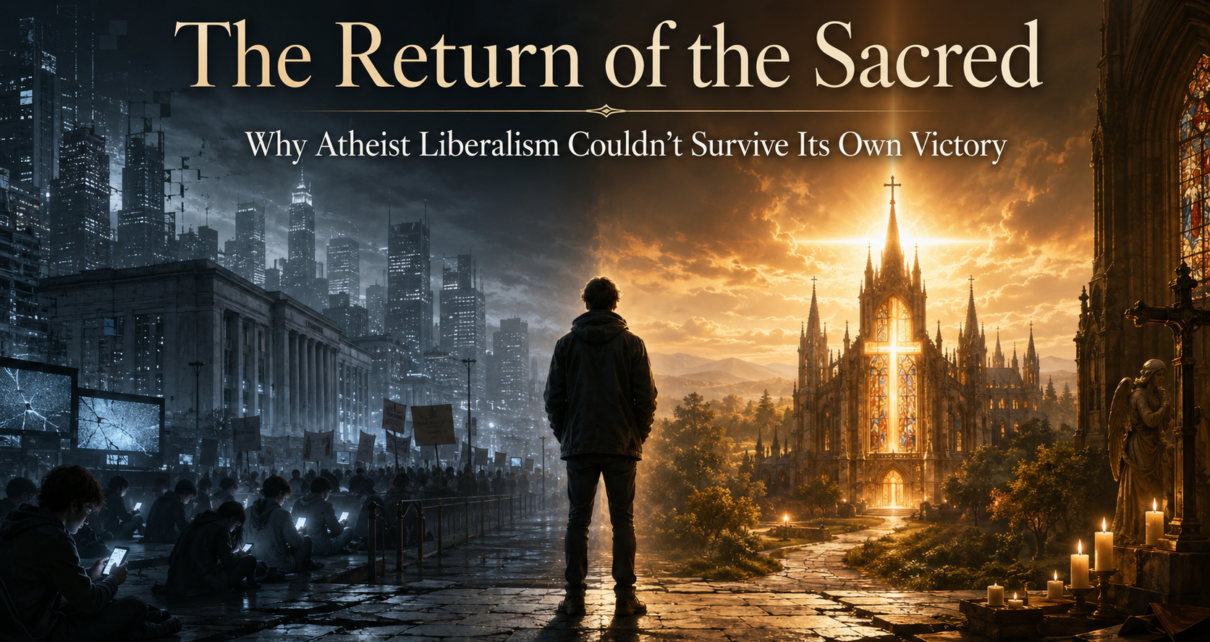
And so now we find ourselves surrounded by a curious spectacle. The old churches are diminished, but the religious impulse is everywhere. The secular age has not produced a race of calm rationalists. It has produced lonely mystics, political zealots, psychedelic pilgrims, gender metaphysicians, algorithmic prophets, climate apocalyptics, wellness ascetics, religious educators, worshipers of almighty Democracy, nationalist revivalists, and young men rediscovering incense, Latin, Orthodoxy, masculinity, fasting, hierarchy, and God.
Atheist liberalism won the institutions, but it did not win the soul. I truly believe that is the thesis of our age: secular liberalism did not abolish religion. It merely abolished Christianity’s public authority, then watched as inferior religions rushed in to the void in order to claim the abandoned altar.
Let me begin, inconveniently perhaps, with the facts, since even dumb prophets should occasionally pretend to check the weather.
There is not yet clear evidence of a mass American return to Christianity. Anyone claiming that the churches are suddenly overflowing from sea to shining sea is peddling either hope, nostalgia, or a Men’s Health subscription. The long decline of American Christianity remains real. In 2007, roughly 78 percent of American adults identified as Christian. By the most recent large Pew Religious Landscape Study, that figure had fallen to about62 percent. The unaffiliated, the infamous “nones,” rose from roughly 16 percent in 2007 to about 29 percent.
This is not a merely trivial change; it is a civilizational fact. A country that once assumed a broad Christian moral grammar now struggles too agree on whether reality itself has grammar at all.
But the more interesting development is not that Christianity declined. We already knew that. The more interesting development is that the decline appears to have slowed, and perhaps, for now, leveled off. Pew’s recent data suggests that the Christian share of the American population has hovered around the low 60s for several years. The unaffiliated share, after surging for decades, also appears to have stabilized.
Yet this does not proove revival. But it does perhaps suggest exhaustion. The secular wave has not crashed, but it may have reached its high-water mark. After decades of institutional secularization, after the collapse of inherited religious loyalty, after every Netflix prestige drama and university department took its obligatory swimg at the priest, pastor, father, mother, soldier, saint, and small-town hypocrite, America has not become purely secular. It has become spiritually disorganized.
Gallup’s data still shows religious participation at low levels. A majority of Americans now say they seldom or never attend religious services. Less than half say religion is very important in their daily lives. So this is not exactly the Book of Acts manifesting itself…
Yet one must not confuse low church attendance with the disappearance of metaphysical hunger. Pew research has found that large majorities of Americans still believe in some spiritual reality beyond the visible world. Most Americans believe people have souls. Many describe themselves as spiritual even when they are not religious. A sizable portion of the country now says, in effect, “I do not trust the church, but I do not believe the universe is dead.”
That sentence may be the seed of the next age. See, I believe Atheist liberalism had a simple proposition: remove oppressive religious structures, and human beings will become freer, kinder, more rational, and more authentic. This was a flattering theory, especially to the class of people who imagined themselves as the freer, kindr, more rational, and more authentic replacements.
But man does not live by debunking alone. Human beings need more than simple choice to become wise or holy. They need meaning. They need rituals for birth, death, marriage, guilt, forgiveness, sacrifice, failure, and renewal. They need a moral order that explains why their carnal appetites should not rule them. They need sacred time, sacred space, sacred obligations, sacred prohibitions, and sacred stories. They need some account of suffering beyond “that is unfortunate.” They need some answer to death beyond “well, technically, your molecules continue.”
Liberal secularism was excellent at liberating the individual from inherited constraints. However, it was far less competent at explaining why the liberated individual should get out of bed in the morning, marry, have children, bury his father, forgive his enemy, restrain his lusts, honor his ancestors, or endure agony without despair.
So into the vacuum rushed substitutes. Politics became religion. Race became religion. Sexual identity became religion. The nation (or the flag) became religion. The market became religion. Education became religion. Therapy became religion. Science, or rather “Science,” became religion. Health became religion. Climate became religion. The body became religion. The self became religion. Ironically, even atheism itself, with its conferences, saints, catechisms, excommunications, and missionaries, briefly became religion!
This is the great and tragic embarrassment of secular man. He did not stop worshiping. He merely became less aware of what he worshiped.He became more ignorant, not more faithless.
Christianity told man he was fallen and needed grace. Secular liberalism told man he was oppressed and needed liberation. Postmodernism told man he was constructed and needed deconstruction. The present age tells man he is anxious and needs medication, affirmation, identity, content, and perhaps a cold plunge before sunrise.
And yet I do not believe it is obvious that this is an improvement…
Modernity could still produce atheists with backbone. The old atheist believed in truth, science, progress, argument, civilization, and moral seriousness. He rejected God but often retained a Christian skeleton. He believed in conscience, duty, dignity, rational debate, and the improvement of mankind. He was, in many cases, a Christian heretic who had misplaced Christ.
Postmodernity produced something stranger: a society skeptical of every inherited truth except its own latest moral panic. It trained people to interrogate power, language, values, and institutions, which was sometimes necessary and often fruitful. But then it forgot to stop interrogating. Eventually nothing was left standing except suspicion itself.
This is why postmodern culture feels spiritually barren and uninhabitable. Yes, it can (and does) expose hypocrisy, but it can’t absolve sin. It can deconstruct myths, but it can’t found a civilization. It can mock God, fathers, priests, kings, churches, borders, traditions, hierarchy, and moral codes, but it cannot explain what should replace them. It is magnificently skilled at clearing land, but remarkably poor at building homes.
Yet the human need for sacred order remains. So even the most postmodern spaces become liturgical. They develop purity codes, forbidden words, public confessions, scapegoats, saints, martyrs, inquisitions, feast days, pilgrimages, icons, blasphemy laws, and rituals of humiliation. The only thing missing is forgiveness.
This is why political religion has become so ferocious. It offers sin without redemption, confession without absolution, community without charity, and apocalypse without resurrection.
To unpack this, it’s important to understand the mechanics. Christianity had original sin. The new postmodern and “woke” religions have inherited guilt. Christianity had repentance. The new religions have cancellation. Christianity had saints. The new religions have influencers. Christianity had devils. The new religions have “problematic people.” Christianity has heaven. The new religions have “being on the right side of history”, which is a phrase almost impressive in its ability to sound pious while meaning absolutely nothing whatsoever.
The sacred did not vanish. It merely metastasized!
This is also why the Trump phenomenon deserves more than the usual partisan sneer or tribal defense. Many of the same Christians who rightly mocked secular people for turning politics into religion proceeded, with magnificent lack of self-awareness, to do precisely the same thing with their own champion. A political leader may claim Christianity, praise Christianity, pose beside Christianity, and promise to defend Christianity, but if his public life is marked by serial deception, sexual scandal, cruelty, vanity, and contempt for the innocent, then true Christians must ask whether they are defending the faith or merely baptizing power. The scandal is not that sinners exist in politics. Christianity has always known that sinners exist everywhere. The scandal is when Christians forget that sin is sin as soon as the sinner is useful to their faction.
This, too, is part of the postmodern condition. Once truth becomes subordinate to narrative, and morality becomes subordinate to power, even Christianity can be repurposed as costume, slogan, tribe, and weapon. Hypocrisy then becomes one of the great wedges between meaning-starved people and the Sacred their souls desperately seek. Many who turn away from institutional Christianity are not fleeing Christ so much as fleeing the spectacle of men who praise Christ while excusing everything Jesus condemned. The church cannot credibly call the world to repentance while acting as though repentance is only required of its enemies. If Christianity is to survive the modern critique and speak to the postmodern soul, it must recover the courage to judge its own idols first!
One of the most interesting countertrends is the apparent rise in religiosity among young men. Recent Gallup data suggests that men under 30 have become more likely to say religion is very important in their lives, rising sharply from earlier measurements. There is also increased attendance among young men.
This evidence should not necessarily surprise us. Young men have been among the great casualties of the postmodern order. They are told by the woke tribe that masculinity is dangerous, the patriarchy is evil, authority is suspect, ambition is oppressive, tradition is embarrassing, discipline is repression, and the past is mostly a crime scene. Then everyone expresses bewilderment when they retreat into pornography, video games, political extremism, steroids, nihilism, or Nick Fuentas clips.
A serious religion offers young men something secular liberalism struggles to provide: order, discipline, sacrifice, brotherhood, hierarchy, moral demand, and a story in which their strength can be redeemed rather than merely denounced.
This is one reason Christianity has become attractive again in certain young male circles. They are not embarrassed by ritual. This refound institution has incense, icons, fasting, history, authority, and beauty. It does not begin every sentence by apologizing for existing. The HR departments are therefore horrified by this exodus to something slightly more firm than the vain platitudes and Tautologies they proffered on the altar of meaning.
Of course, this trend can be overstated. Anecdotes are not a census. A few young men discovering Latin Mass clips on YouTube does not constitute a national revival. Some highly publicized claims of Gen Z religious resurgence have later been challenged or withdrawn because of flawed survey data. Caution is always necessary and proper. But the cultural signal matters even when the statistical wave is still uncertain. The fact that many young men now are looking towards religion hints at something important. They are not merely looking for comfort; they may be looking for form and substance. For a civilization that gives its young men no noble road to discipline should not be surprised when they choose ignoble roads instead.
Thankfully, if religion is in fact returning, it is not returning to the same world its first left. A metamodern religious synthesis cannot simply rewind the tape to 1955. Too much has happened. Science happened. Darwin happened. Nietzsche happened. Freud happened. Marx happened. Biblical criticism happened. Feminism happened. The abuse scandals happened. Trump happened. Institutional collapse happened. The internet happened. The lonely, deracinated, overeducated, medically-managd, algorithmically exhausted modern person cannot simply be ordered back into unquestioning belief as though nothing occurred between the Council of Nicaea and TikTok.
The modern critique must be absorbed. The postmodern critique must be acknowledged. Religious institutions have abused power with reckless apathy and godless abandon. Language can conceal domination. Communities can become cruel. Tradition can become dead habit. Authority can become self-protection. Piety can become performance. But the skeptic has evidence; he is not merely wicked.
However, the skeptic does not have a civilization. A Metamodern Christianity would have to say: “yes, we know the critiques. We know the church can become corrupt. We know believers can be hypocrites. We know texts have history. We know psychology matters. We know power pollutes. We know pluralism exists and eviserates. We know doubt is not always rebellion. We know the old certainties cannot simply be stapled back onto the modern mind…”
“And, yet, still, Christ remains.”
The metamodern religious posture is not naive certainty before the critique. It is faithful return after the critique. It is belief that has passed through irony and doubt and come out the other side, not untouched, but alive and hungry for Truth. It is second innocence, not first innocence. It is not the child who has never doubted. It is the adult who has doubted, suffered, bled, read the footnotes, studied the pain, watched the institutions fail, and miraculously still kneels.
He still finds himself on his knees even after knowing how bitter it feels to be there, and how much the institutions that asked him to be there are fallen and corrupt. He sings to God even as the same religious institutions who praise Trump demand his righteous supplication; yet, still, he prays to the Sacred. He brazenly and humbly seeks the Transcendent, nevertheless.
This is where Metamodern Christianity may have unexpected strength. It is not merely a moral code. It is a story of incarnation, suffering, death, and resurrection. It already knows that the world is broken. It already knows that institutions fail. It already knows that innocence is murdered. It already knows that Truth is crucified by respectable authorities and that politics seeks to wear that truth as a blanket to shield it from criticism. But Christianity does not need a cheerful view of human nature to survive. In fact, it has always regarded cheerful views of human nature with suspicion.
Postmodernism’s great discovery was that man is not as rational, neutral, or innocent as modern liberalism pretended. Yet, I think Christianity discovered this profundity sometime earlier.
The question, then, is not whether the sacred will return. It already has. The question is what form it will take. Some will return to Christianity: Catholic, Orthodox, evangelical, Anglican, Pentecostal, high-church, low-church, house-church, and perhaps forms not yet fully visible. Some will seek “mere Christianity,” tired of denominational squabbles and hungry for the central drama of sin, sacrifice, redemption, and resurrection.
Others will build hybrid spiritualities, such as meditation, psychedelics, ecology, educational supremacy, unfocused prayer, ancestral myth, therapy, and vague theism. Some of this will be shallow and ridiculous. Some of it will be sincere, searching, and perhaps preparatory. But one should not mock every wanderer merely because he has not yet found the road!
Still others will choose far darker substitutes. Political religion will continue to remain very tempting because it gives people enemies, meaning, and moral superiority without requiring holiness or personal sacrifice. Nationalism can become a sacred vessel, sometimes noble in its self-serving love of place and people, but far more often demonic when it forgets that God is not a tribal mascot. Psychedelics may reopen spiritual perception, but they cannot by themselves provide doctrine, discipline, or moral order. Education may be laudable, but does not replace morality or sublime Truth. Nor does naked Democracy and the blind fidelity its ardent supporters so jealously demand. Fitness culture can restore the dignity of the body, but the body makes a poor god; it ages and dies, despite the pricy supplements. Technology can promise immortality, but Silicon Valley’s version of eternal life often sounds like being trapped forever in a customer-service portal.
Christianity may not return as Christendom. In fact, I pray it does not. It may not regain automatic cultural authority. It may not again become the assumed language of public life. But that may be precisely what cleanses and purifies it!
A brave new Christianity chosen freely in a post-Christian age may be smaller, stranger, and stronger than the Christianity inherited lazily in a nominally Christian one of yesteryear. The church may lose its place as cross-shaped wallpaper and recover its place as vital witness. It may cease being the respectable background music of bourgeois life and become, once more, an offense as Jesus intended. For those practicing a new Metamodern Christianity, unselfish love, boundless grace, and Truth in the face of idols may indeed replace sterile orthodoxy, unbiblical judgementalism, and servitude to the cold wills of the Church.
In that sense, Christianity is not necessarily being left behind. Cultural Christianity may be. “Nominal Christianity” may be. The Christianity of vague niceness, political respectability, and civic decoration may be. But I see a Metamodern Christianity as metaphysical rebellion against the empire of death and postmodern rot; and it remains very much in the arena.
Indeed, it may be one of the only things left with enough depth to survive the arena. Perhaps the great mistake of secular liberalism was assuming that religion was an optional accessory rather than a permanent feature of human nature. It imagined that if you removed Christianity, people would become rational humanists, or even just “good people.” Instead, many became anxious idolaters and spiritually-medicated postmodern zombies.
They worship politics and call it justice. They worship appetite and call it healthy living. They worship identity and call it authenticity. They worship the State and call it compassion. They worship the market and call it efficiency. They worship technology and call it transcendence. They worship education and call it intelligence. They worship Democracy and call it freedom. They worship themselves and call it healing.
Man will have gods. The only question is whether they are worthy of him. This is why the return of the sacred is not automatically good news. Religious hunger can lead to saints, cathedrals, families, repentance, beauty, courage, love, and civilization. It can also lead to cults, mobs, blood myths, ideological possession, mass suicide via Koolaid, and ecstatic cruelty. A human soul deprived of true religion does not become unreligious; it simply becomes vulnerable and cold.
The task of the metamodern age is not to pretend we can go back before doubt. Nor is it to remain trapped foreverr inside deconstruction. The task is to recover meaning after disenchantment, sincerity after irony, faith after critique, and sacred order after the collapse of both naive belief and smug unbelief.
And this, frankly, is why I remain a Christian. Not because I have never doubted. Not because I am blind to the failures of churches, pastors, deacons, institutions, denominations, movements, or the many ridiculous little tyrannies men have built while borrowing the language of God. Not at all. During the wretched Covid years I have seen enough of humanity’s vile nature to know that piety can become theater, doctrine can become weaponry, and the sacred can be dragged through the mud by the very people appointed to guard it!
But none of that disproves Christ. If anything, it proves why we so desperately need Him in the first place.
I remain a Christian because I still fundamentally believe in grace. I believe man is fallen, not merely misinformed. I believe evil is sublimely real, not just socially constructed. I believe guilt cannot be therapized away, sin cannot be rebranded as authenticity, and the human soul cannot be healed by slogans, pills, politics, or self-esteem campaigns. I believe Jesus Christ atoned for my sins, not symbolically in some polite literary sense, but truly, mysteriously, and cosmically. I believe in the Father, the Son, and the Holy Spirit. I believe in the sacred God revealed in Scripture, the God who made the world, entered history, suffered under empire, died for sinners, and shattered death from the inside.
And yet I do not believe every person who searches outside the church is merely wicked or foolish. Most are doing what all honest souls do in a disenchanted age: groping blindly through the dark for the outline of the holy. Some find it in beauty. Some in nature. Some in music, myth, discipline, family, sacrifice, psychedelics, philosophy, service, or silence. They are not rejecting God so much as rejecting the cheap costume in which God was first presented to them. Many who think they are fleeing Christianity may actually be fleeing a cheap counterfeit of it. They flee the reflective, harvest moon, never knowing the Son.
There is sacredness scattered throughout the world because the world was made by the Sacred. There are fragments of Truth, flashes of beauty, hints of transcendence, and whispers of eternity everywhere. But fragments are not the whole. A candle is not the sun. A symbol is not the thing symbolized. The hunger burning in man is not really for vibes, rituals, identities, politics, or private spiritual experiences. No, it is for the living God.
That is the scandal Christianity insists upon: that the sacred is not merely an atmosphere, not merely an emotional state, not merely an archetype buried in the human psyche, but a Person. The One and True God is not simply one option on the spiritual buffet. He is the source of every longing that sends us wandering through it.
So, yes, I believe people can rediscover meaning in many places. I believe the sacred can break through cracked windows, pagan poems, mountain trails, hospital rooms, birth cries, deathbeds, ancient myths, and even the exhausted prayers of the wayward seeker who is not yet sure whom they are praying to. C.S. Lewis knew this all too well, and stated it clearly. But in the deepest chamber of the human heart, beneath all the cleverness, rebellion, trauma, irony, and fear, I believe every soul is wildly searching for the same God who created the universe.
Modernity killed Him and called it maturity. Postmodernity mocked Him and called it liberation. But man, poor restless creature that he is, kept searching anyway.
The sacred is returning because… perhaps He never truly left.
And Christ remains because He was never merely an idea to be replaced. He was, and is, the answer to the question every age keeps asking in new disguises: Who shall save us from ourselves?