Disclaimer: Information Sourced with much Assistance from AI | 06/08/26
There was a time, not very long ago, when “America First” meant something almost embarrassingly easy to understand. It meant that American soldiers would not be used as disposable pawns in foreign wars. It meant that Congress, not cable-news hosts, foreign lobbyists, donor-class billionaires, or emotional prime ministers of other countries, would decide when the United States went to war. It meant that the Republican Party had learned something from Iraq, Afghanistan, Libya, Syria, and the endless parade of bipartisan disasters sold to the public as urgent national-security emergencies.
At least that was the sales pitch.
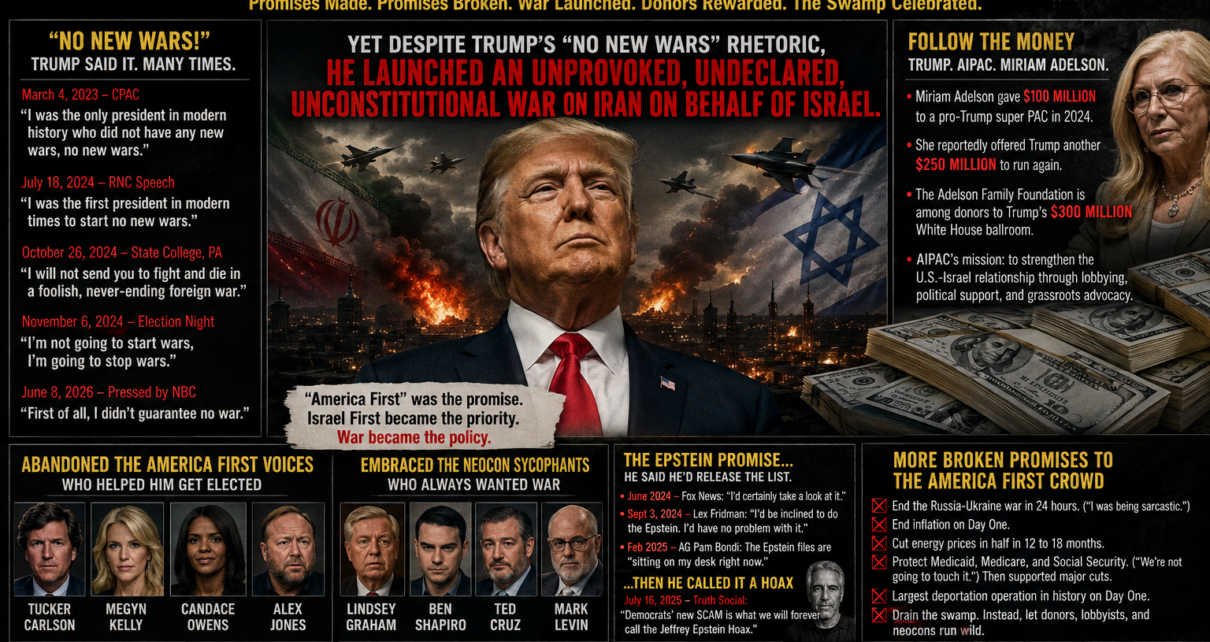
Donald Trump did not stumble into the “no new wars” promise. He made it one of the central moral claims of his political identity. He repeated it like a sacred refrain. He used it to separate himself from the Bush Republicans, the neoconservatives, the professional foreign-policy class, and the very people who had spent two decades confusing American patriotism with Middle Eastern arson.
At CPAC on March 4, 2023, Trump said, “I was the only president in modern history who did not have any new wars, no new wars.” He added, “I finished some old ones.” [1] At the Republican National Convention on July 18, 2024, he boasted, “I was the first president in modern times to start no new wars.” [2] On election night, November 6, 2024, he declared, “I’m not going to start wars, I’m going to stop wars.” [3] At a campaign event in State College, Pennsylvania, on October 26, 2024, he told voters, “I will not send you to fight and die in a foolish, never-ending foreign war.” [4]
These were not stray remarks. They were not obscure footnotes. They were not whispered caveats at a donor dinner. They were the essence of the brand. Trump was not merely promising tax cuts or deregulation or better trade deals. He was promising a break from the central madness of the American empire. He was promising that the sons and daughters of ordinary Americans would no longer be sacrificed for countries they could not find on a map, for causes they did not vote on, and for allies who somehow always required American money, American weapons, American diplomatic cover, and eventually American blood.
And then, despite Trump’s “no new wars” rhetoric, he launched an unprovoked, undeclared, unconstitutional war on Iran on behalf of Israel.
That sentence should sit there for a moment.
Let me say it again for added emphasis. Despite Donald Trump’s persistent and persuasive “no new wars” rhetoric, he instead launched an unprovoked, undeclared, unconstitutional war on Iran on behalf of Israel.
Not a defensive skirmish after Iranian troops landed in Florida. Not a congressional war after weeks of public debate. Not a reluctant response to an attack on the American homeland. A joint U.S.-Israeli military campaign against Iran, begun without a declaration of war, justified with the same familiar fog of nuclear warnings, intelligence claims, executive urgency, and strategic necessity that America First voters were told Trump would reject.
On February 28, 2026, U.S. and Israeli forces launched major strikes on Iran. Britannica describes the opening operation as nearly 900 strikes in 12 hours against Iranian missiles, air defenses, military infrastructure, and leadership. [5] Reuters reported that Trump and Israeli Prime Minister Benjamin Netanyahu authorized major airstrikes targeting Iran’s leaders. [6] Reuters later described the conflict plainly as the “Iran war” and reported that the U.S. Senate advanced a war-powers resolution that would end the war unless Trump obtained congressional authorization. [7] The House followed with its own war-powers measure on June 3, 2026, voting 215 to 208 to curb Trump’s military action in Iran. [8]
So let us dispense with the baby talk. When U.S. and Israeli forces jointly bomb another country, kill its leadership, strike its military infrastructure, and continue operations for months, that is not “restraint.” That is not “peace through strength.” That is not “America First.” That is war.
And when such a war is begun without Congress declaring it, it is undeclared. When it is begun absent a direct Iranian attack on the United States, critics are right to call it unprovoked. When the president bypasses Congress’s Article I war power and uses executive force to begin a major conflict, critics are right to call it unconstitutional. And when the operation is launched jointly with Israel, against Israel’s chief regional enemy, after years of donor pressure and foreign-policy lobbying to harden the U.S. line against Iran, critics are right to say it was done on behalf of Israel.
This was not merely a policy reversal. It was an identity collapse.
Trump had spent years telling voters that he was the antiwar alternative. He mocked the old Republican establishment. He cast himself as the man who would keep America out of World War III. He repeatedly told voters that Biden’s weakness and incompetence had brought the world closer to catastrophe and that he alone could restore peace. In 2024, he ran not just as a Republican, but as the candidate of “peace through strength,” the man who would stop wars, prevent wars, and avoid foolish foreign entanglements.
Then came Iran. Then came the bombs. Then came the usual Washington chorus explaining that this war was different, this emergency was real, this enemy was uniquely dangerous, and this time the experts could be trusted. How fortunate for the American people that every disastrous war in modern history arrives wearing a brand-new suit.
The betrayal became even more insulting when Trump later tried to wriggle out of the plain meaning of his own words. In June 2026, when NBC’s Kristen Welker pressed him on his “no new wars” identity, Trump replied, “First of all, I didn’t guarantee no war.” [9]
There it was: the fine print nobody saw on the rally banner.
Apparently “no new wars” did not mean “no new wars.” Apparently “I’m not going to start wars” did not mean “I’m not going to start wars.” Apparently “I will not send you to fight and die in a foolish, never-ending foreign war” was not a promise, but more of a vibe. A mood. A campaign-season fragrance. Something to be sprayed over the crowd until the polls closed.
This is the sort of linguistic miracle only politics can produce. A man can say “no new wars” for years, run as the peace candidate, attack the foreign-policy establishment, warn against World War III, and then, upon launching a new war, explain that he never technically guaranteed anything. Imagine a groom saying “I do” at the altar, and then, after the honeymoon, informing his wife that he never “guaranteed fidelity.” Technically fascinating. Morally worthless.
The deeper problem is not simply that Trump broke a promise. Politicians do that for sport. The deeper problem is that he broke the one promise that gave “America First” its moral power. There are many kinds of nationalism, some noble, some ugly, some incoherent. But Trump’s best version of America First was simple: the American government should serve the American people before serving foreign governments, global institutions, financial elites, or ideological fantasies. That principle becomes meaningless if the president can drag the country into a Middle Eastern war at the urging of the very factions his movement was created to resist.
And make no mistake: the old factions came roaring back.
The moment Trump moved toward Iran, the neoconservative choir found its hymnbook. Lindsey Graham, Ted Cruz, Ben Shapiro, Mark Levin, and the rest of the Iran-war amen corner suddenly had a president they could praise again. The same crowd that has rarely encountered a Middle Eastern escalation it could not baptize as moral clarity rushed to explain why bombing Iran was not a betrayal of America First but the purest expression of it.
This is always how the trick works. “America First” is redefined until it means “Israel first, but with American financing.” Restraint becomes weakness. Skepticism becomes treason. Congressional authorization becomes a technicality. A foreign war becomes a defensive necessity. And the same voters who were told they were finally overthrowing the neocons are instructed to applaud while the neocons walk back into the building through the front door.
Meanwhile, the America First personalities who objected were treated as embarrassments. Tucker Carlson, Megyn Kelly, Candace Owens, Alex Jones, and others who criticized the Iran war or questioned the Israel-first logic of the operation became targets of Trump’s anger. ABC News reported that Trump blasted several MAGA influencers over the Iran split, attacking figures including Carlson, Kelly, Owens, and Jones. [10] The message was unmistakable: antiwar populism was welcome so long as it helped Trump win. Once it interfered with Trump’s war, it became disloyalty.
The donor context makes the whole spectacle even more nauseating.
Miriam Adelson, one of the most powerful pro-Israel Republican megadonors in America, gave $100 million to Preserve America, a pro-Trump super PAC, during the 2024 race. [11] AP later reported that the Adelson Family Foundation appeared among donors to Trump’s $300 million White House ballroom project. [12] Trump himself joked that Adelson had offered him another $250 million to run for another term. [13] AIPAC, for its part, openly states that its mission is to strengthen the U.S.-Israel relationship through lobbying, political support, and grassroots advocacy. [14]
Now, let us be careful, because lawyers exist and defamation law has not yet been abolished by executive order. The public record does not prove a criminal quid pro quo. It does not prove that any donor bought a war with a check. But it proves the existence of a political ecosystem in which massive pro-Israel donor money, foreign-policy lobbying, Republican hawkishness, and Trump’s personal hunger for praise and loyalty all converged around one result: the United States joined Israel in a war against Iran.
One need not be a conspiracy theorist to notice the pattern. One only needs working eyes.
Trump’s defenders will insist that none of this is corruption. They will say it is merely coincidence that the billionaire donor class, the pro-Israel lobby, the Republican hawks, and the president all ended up in the same place. They will say the war was about American security. They will say Iran had it coming. They will say the Constitution is complicated. They will say Congress is too slow. They will say the commander in chief must act decisively. They will say anything except the obvious: America First became America Last the moment the American people’s interest was subordinated to donor pressure, Israeli strategic goals, and the ego of a president who could not bear to look weak.
This is what made the Iran war so devastating to Trump’s own mythology. He was not Joe Biden. He was not George W. Bush. He was not Hillary Clinton. He was not supposed to be another custodian of the empire. He was the wrecking ball. He was the outsider. He was the man who saw through the lies. He was the man who called Iraq a disaster. He was the man who said the foreign-policy experts were fools. He was the man who told voters he would stop wars, not start them.
Then he started one.
And not just any war. A war with Iran, the white whale of the neoconservative imagination. For decades, the same foreign-policy class that helped sell Iraq has dreamed of confrontation with Iran. Iran has always been the great unfinished project, the final boss in the Middle Eastern interventionist video game. America First voters thought Trump understood that. They thought he knew the trap. They thought he would resist the people who would flatter him into taking the bait.
Instead, he took the bait, mounted it on the wall, and called it leadership.
The Epstein reversal followed the same script: promise transparency, then attack the people who remembered the promise.
For years, the Epstein issue functioned as a symbol of elite impunity. It was not merely about one dead financier. It was about the suspicion that powerful people live by different rules, that intelligence agencies hide the truth, that prosecutors protect the well-connected, that blackmail networks and sexual exploitation are buried when they implicate the wrong names. To the America First base, Epstein was not a sideshow. Epstein was the swamp with a private island.
Trump understood this perfectly when it was useful.
On September 3, 2024, during his interview with Lex Fridman, Trump was asked about releasing Epstein-related documents. He replied, “I’d be inclined to do the Epstein. I’d have no problem with it.” [15] In June 2024, when asked on Fox News about declassifying files related to Jeffrey Epstein, Trump indicated openness, though later reporting noted that Fox edited out a portion where he expressed caution about affecting people’s lives with potentially false material. [16] Still, the political signal to his base was obvious: Trump was the man who would expose what the establishment had hidden.
Then came the administration’s handling of the files. In February 2025, Attorney General Pam Bondi said the Epstein material was “sitting on my desk right now to review” and described it as a directive from Trump. [17] Then, in July 2025, the DOJ and FBI said a review found no Epstein “client list.” [18] Instead of honoring the spirit of transparency his base expected, Trump turned his fire on the people demanding answers.
On July 16, 2025, Trump wrote on Truth Social that Democrats’ “new SCAM is what we will forever call the Jeffrey Epstein Hoax,” adding that his “PAST supporters” had bought into it “hook, line, and sinker.” [19] AP reported that he also blasted “stupid” and “foolish” Republicans for continuing to press the issue. [20]
This was an extraordinary inversion. The people who believed Trump’s transparency rhetoric became the problem. The voters asking for the files became the marks. The base that had been trained for years to distrust the DOJ, the FBI, the media, the courts, and the intelligence agencies was suddenly told to accept the official memo and move along.
So when the issue helped Trump, Epstein was a symbol of elite corruption. When the issue hurt Trump, Epstein became a hoax. How convenient. How very Washington. How perfectly swamp-like.
As it turned out, Representative Thomas Massie became the living rebuke to Trump’s abandoned America First promises because he kept doing the inconvenient thing: he took Trump’s campaign words literally. When Trump promised to back away from endless Ukraine funding, Massie pushed in that direction. When Trump promised “no new wars,” Massie opposed the Iran war and defended Congress’s constitutional war power. When Trump promised transparency on Epstein, Massie pushed for the release of the Epstein files even after Trump clearly wanted the issue buried. That was Massie’s unforgivable sin. He did not oppose Trump because he had become a liberal, a neocon, or a creature of the establishment. He opposed Trump because Trump’s own campaign promises had become evidence against Trump’s governing record. Massie merely held the receipt.
And for that, he was punished. Trump turned on Massie, endorsed Ed Gallrein against him in Kentucky’s 4th District, and celebrated one of the most expensive House primaries in American history as a loyalty test. AP described Massie as one of Trump’s most outspoken Republican critics and reported that Trump-backed Gallrein defeated him in the May 19, 2026 primary. (AP News) Al-Monitor reported that more than $32 million was spent in the race, including about $9 million from pro-Israel groups that helped defeat Massie after his clashes with Trump. (Al-Monitor) Al Jazeera similarly reported that pro-Israel groups and donors spent heavily to defeat Massie, who framed the race as a referendum on U.S. foreign policy. (Al Jazeera) In other words, the one Republican who tried to force Trump to honor the antiwar, anti-swamp, America First promises of his own campaign was ostracized and then politically executed with Trump’s blessing, establishment muscle, and what critics would fairly call Israel-First money.
This is the rhythm of the entire betrayal. Trump promises something bold to the America First crowd. The crowd believes him. The promise becomes inconvenient. Trump reverses himself. Then the original promise is treated as a hallucination invented by unreasonable supporters.
The Ukraine promise followed the same pattern. Trump repeatedly said he could end the Russia-Ukraine war quickly, even suggesting he could do it within 24 hours. AP later reported that once in office, he said he had been “a little bit sarcastic” about the 24-hour claim. [21] Of course. Sarcasm. The universal solvent of broken promises. If the promise is fulfilled, it was genius. If the promise fails, it was sarcasm. If voters believed it, they should have had a more sophisticated appreciation for campaign theater.
Trump also campaigned as the great deporter-in-chief, promising a historic immigration crackdown. On September 13, 2024, he vowed to launch the “largest deportation operation in the history of our country,” starting in Springfield, Ohio, and Aurora, Colorado. Axios reported that Trump made mass deportation a centerpiece of his campaign, and after the election he kept repeating that the effort would begin on “day one.” (Axios) But once back in office, the arithmetic did not match the thunder. Syracuse University’s TRAC found that Obama’s administration logged more than 3.1 million ICE deportations over eight years, peaking at more than 407,000 removals in fiscal year 2012, while Trump’s first administration recorded fewer than 932,000 deportations across four years and peaked at about 269,000 in 2019. (TracReports) Even in Trump’s return to power, ICE reported 442,637 deportations in fiscal year 2025, which was higher than the prior year but still far short of Trump’s stated goal of 1 million deportations per year—and that fiscal year included the final months of Biden’s term. (Axios) In other words, the man who sold his base the biggest deportation machine in American history was still being lapped, numerically, by Barack Obama, the same Democrat many conservatives once mocked as soft on the border.
Then came the walk-back. On June 12, 2025, Trump posted on Truth Social that “our very aggressive policy on immigration is taking very good, long time workers away” from farmers and the hotel and leisure industries, adding that those jobs were “almost impossible to replace.” He then promised, “We must protect our Farmers, but get the CRIMINALS OUT OF THE USA. Changes are coming!” (The Washington Post) Later that day, he told reporters, “Our farmers are being hurt badly by, you know, they have very good workers,” and said the administration would have to use “a lot of common sense.” (New York Post) So the campaign language went from invasion, criminals, mass raids, and the largest deportation operation in history to a softer carve-out for the very illegal immigrant labor force that keeps farms, hotels, restaurants, and resorts running. Apparently the border emergency became more nuanced once the donor class, agribusiness, and hospitality lobby discovered that “mass deportation” also meant losing the cheap labor they quietly depend on.
Again, the immigration promise is where Trump’s rhetoric wildly outran reality. Trump promised the largest deportation operation in American history and said the effort would begin on day one. [27] To be clear, he pursued aggressive immigration policies and over-funded ICE. But the campaign fantasy of instant, total control collided with courts, bureaucracy, manpower, funding, state resistance, business interests, and the practical limits of government. The border rhetoric was absolute. The governing reality was not.
And then there was the oldest promise of all: drain the swamp.
What does “drain the swamp” mean when megadonors fund super PACs, foundations help fund White House ballrooms, lobbyists shape foreign policy, neoconservatives regain influence, and the president’s own movement is told to stop asking questions? What exactly was drained? The skepticism? The antiwar impulse? The hostility to elite impunity? The belief that Washington should serve the American people before foreign allies and donor networks?
Because the swamp itself appears to be doing just fine. It has better lighting now. Possibly a ballroom.
That ballroom may be the most fitting metaphor for the whole transformation. America First began as a revolt against a decadent ruling class that partied while the country rotted. It ends with a president building a grand new room for the powerful while telling his own voters that the war they oppose is necessary and the files they want released are a hoax. The people got slogans. The donors got access. The hawks got Iran. The base got lectures.
Trump’s defenders will say this is too harsh. They will say he is navigating a dangerous world. They will say Iran is evil. They will say Israel is our greatest ally. They will say Epstein conspiracy theories went too far. They will say no president can fulfill every promise. Some of that may be true. But none of it changes the essential fact: Trump’s America First brand was built on restraint, sovereignty, transparency, and contempt for corrupt elites. On the defining tests, he failed.
On war, he promised “no new wars,” then launched one.
On Congress, he promised to restore the republic, then bypassed its war power.
On Israel, he promised America First, then joined an Israeli war against Iran.
On Epstein, he promised openness, then called the matter a hoax.
On dissent, he welcomed anti-establishment voices when they helped him, then attacked them when they opposed his war.
On donors, he claimed independence, then moved through a political world saturated with megadonor money and pro-Israel influence.
On the swamp, he promised drainage and delivered renovation.
The tragedy is that Trump’s critique of the old Republican Party was often correct. The Iraq War was a disaster. The foreign-policy establishment was arrogant and incompetent. The donor class did have too much power. The media did lie. The intelligence agencies did deserve suspicion. The bipartisan consensus did hollow out American sovereignty. Millions of Americans were not crazy to want a president who would break that machine.
But they were naïve to think Trump could not be absorbed by it.
Power did what power does. Money did what money does. Flattery did what flattery does. Foreign allies did what foreign allies do. The hawks waited patiently, praised him extravagantly, whispered about strength and legacy and resolve, and eventually watched him give them what they wanted.
Trump is human. That is not a defense. It is the indictment. He succumbed to the oldest temptations in politics: money, praise, ego, loyalty, fear of weakness, and the thrill of commanding force. Whether one calls it donor capture, political corruption, foreign-policy betrayal, or simply the normal operation of Washington, the outcome is the same. The man who promised to put America First allowed America’s interests to be subordinated to Israel’s war aims, billionaire donor influence, executive vanity, and the same interventionist logic his movement was supposed to bury.
So when exactly did America First become America Last?
Maybe it happened when “no new wars” became “I didn’t guarantee no war.”
Maybe it happened when the antiwar candidate launched an unprovoked, undeclared, unconstitutional war on Iran on behalf of Israel.
Maybe it happened when the president who promised transparency called Epstein a hoax.
Maybe it happened when the neocons came back into the room and the antiwar populists were shown the door.
Or maybe it happened earlier, when millions of voters mistook a slogan for a principle and a performer for a statesman.
Whatever the precise moment, the result is now plain. Trump may be remembered by his admirers as the best U.S. president Israel ever had. But that was not the promise. The promise was America First. The promise was peace. The promise was sovereignty. The promise was that the American people would no longer be lied into wars, priced out of their own country, mocked for demanding transparency, or ruled by donors and foreign-policy fanatics.
Instead, the American people got the old empire in a red hat.
No new wars, indeed!
====
Source key for the bracketed citations
[1] Trump at CPAC, March 4, 2023: “I was the only president in modern history who did not have any new wars, no new wars.”
[2] Trump’s Republican National Convention speech, July 18–19, 2024, where he said he was the first modern president to start no new wars.
[3] Trump’s election-night victory speech, November 6, 2024: “I’m not going to start wars, I’m going to stop wars.”
[4] Trump rally in State College, Pennsylvania, October 26, 2024: “I will not send you to fight and die in a foolish, never-ending foreign war.”
[5] Britannica summary of the opening U.S.-Israeli strikes against Iran on February 28, 2026.
[6] Reuters Breakingviews on Trump and Netanyahu authorizing major airstrikes against Iran’s leaders on February 28, 2026.
[7] Reuters on the Senate advancing a war-powers resolution to end the Iran war unless Trump obtained congressional authorization.
[8] Reuters on the House passing a war-powers measure on June 3, 2026, to curb Trump’s military actions in Iran.
[9] Guardian report on Trump saying he “didn’t guarantee” no war.
[10] ABC News on Trump blasting MAGA influencers over the Iran split.
[11] Reporting on Miriam Adelson’s $100 million support for Preserve America, a pro-Trump super PAC.
[12] AP reporting on donors to Trump’s $300 million ballroom project, including the Adelson Family Foundation.
[13] Reporting on Trump saying Miriam Adelson had offered him another $250 million to run again.
[14] AIPAC’s stated mission of strengthening the U.S.-Israel relationship through lobbying, political support, and grassroots advocacy.
[15] Trump on Lex Fridman, September 3, 2024: “I’d be inclined to do the Epstein. I’d have no problem with it.”
[16] Semafor on Fox News editing a June 2024 Trump interview concerning Epstein-related documents.
[17] Fox News on Pam Bondi saying the Epstein client list was “sitting on my desk right now” for review.
[18] ABC News on the DOJ/FBI memo saying no Epstein “client list” existed.
[19] Trump Truth Social post, July 16, 2025, calling the issue the “Jeffrey Epstein Hoax.”
[20] AP/WTTW coverage of Trump blasting “stupid” and “foolish” Republicans over Epstein-file demands.
[21] AP on Trump saying he had been “a little bit sarcastic” about ending the Russia-Ukraine war within 24 hours.
[22] Trump’s August 9, 2024 inflation promise: “Starting on day one, we will end inflation…”
[23] Trump’s August 14, 2024 energy-price promise to cut energy and electricity prices by half within 12 to 18 months.
[24] Reuters on the House Iran war-powers vote and criticism of the conflict’s economic effects.
[25] Reporting on Trump saying Medicaid would not be touched except for fraud and waste.
[26] ABC News on Republican Medicaid reductions despite Trump’s promises.
[27] AP on Trump’s “day one” immigration promises, including the largest deportation operation in U.S. history.